

Bell XV-3: First practical tilt-rotor aircraft
First flight: 11 August 1955
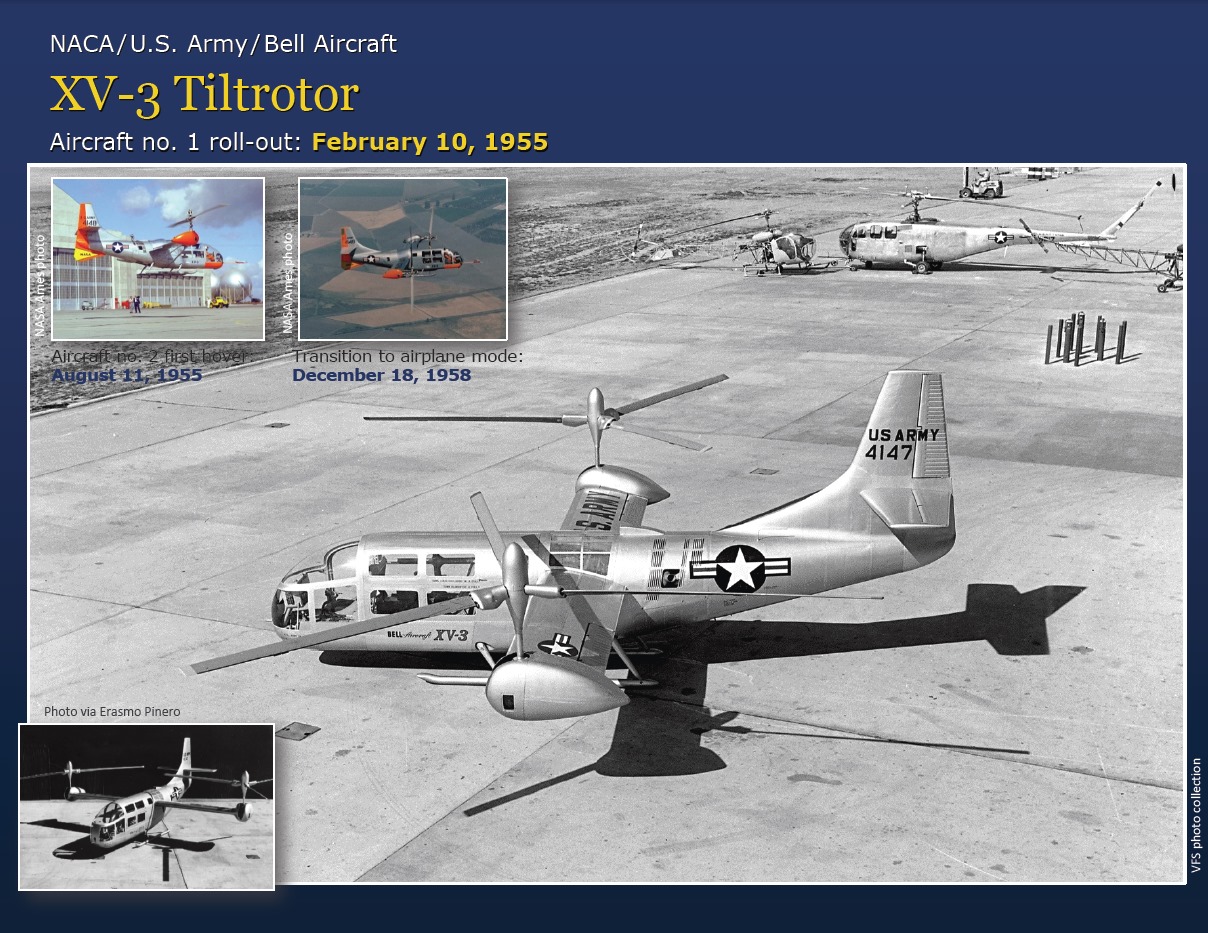
The Bell XV-3 was developed by the Bell Aircraft Corporation in the early 1950s to answer the United States Air Force and the United States Army’s interest in high speed rotorcraft, and to test the so-called “convertiplane” aircraft configuration. The XV-3 was not the first tilt-rotor aircraft to fly or attempt rotor tilts (that honor belongs to the Transcendental Model 1-G, which flew in helicopter mode in 1954), but it was the first practical application of the tilting rotor configuration.
The most salient feature of the XV-3 were its two tilting rotors that allowed the aircraft to go beyond existing helicopter speed restrictions and perform much like conventional propeller driven aircraft of the period. The first of two XV-3s flew for the first time in helicopter mode (rotors configured like a conventional helicopter) on Aug. 11, 1955. Legendary Bell test pilot Floyd Carlson was at the controls.
The XV-3’s Pratt & Whitney 450 hp radial piston engine resided close to the center of the fuselage, and aft of the single seat cockpit and slender cargo compartment (accommodating space for a litter). The engine transmitted its power to the rotors via shafts and bearings. The rotors where initially arranged in a three-blade configuration but were later changed to a two-bladed design to handle rotor-pylon interaction instabilities that surfaced during the early attempts at conversions.
The aircraft converted to an “airplane mode” configuration on Dec 18, 1958 for the first time; and performed more than 100 successful transitions from helicopter to airplane mode and back to helicopter mode between 1958 and 1962. Flight testing of the XV-3 was eventually taken by NASA in 1959, ending the XV-3’s unique and challenging flight test program.
After testing was completed, the survivor of the two Bell Aircraft built prototypes (Bell Serial No. 54-148), was placed in storage at Davis-Monthan AFB in Tucson, Arizona; and eventually found its way to the US Army Aviation Museum in Fort Rucker, Alabama. The survivor aircraft was restored by Bell Helicopter employees between 2005 and 2007, and is currently on display at the National Museum of the US Air Force, in Dayton, Ohio.
The lessons learned on the XV-3 were applied to succeeding tilt-rotor aircraft such as the XV-15, V-22 Osprey, Leonardo AW609 and V-280 Valor. All of these successfully flown tilt-rotors can trace their lineage to the XV-3 and the technology validated by this important experimental test bed.
Text by Erasmo Piñero, Jr.
Go back to the previous photo or view the photo for next month
2020 History Calendar Index