

Vought-Sikorsky VS-300
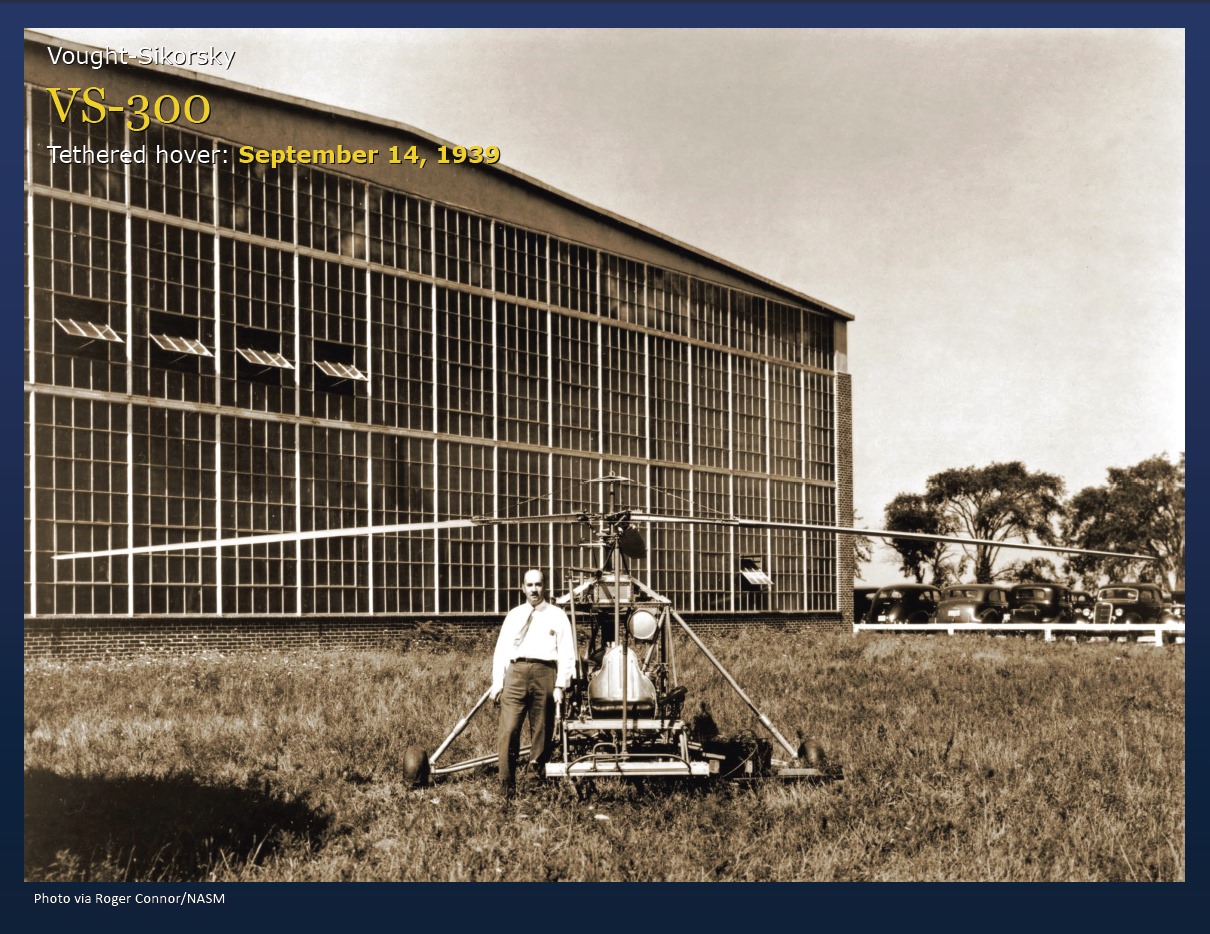
The VS-300 was America’s first practical helicopter and the first in the world to successfully incorporate a single main lifting rotor and single tail rotor for both directional and anti-torque control. But, in 1938, a helicopter was nothing more than an aspiration for Igor Sikorsky. His company was struggling due to a lack of business for their fixed-wing aircraft. In a bold move, Igor requested $30,000 from United Aircraft headquarters to keep his design team together to design a helicopter. The VS-300 was designed in the spring of 1939 and built that summer. The aircraft had a 28-foot diameter main rotor and a single blade tail rotor. It was powered by a 75 hp Lycoming engine. The VS-300 featured full cyclic main rotor control and a single pedal for the tail rotor. Vertical control was provided by a large wheel to the right of the pilot. The first (tethered) flight was piloted by Igor himself on Sept. 14, 1939. It lasted approximately 10 seconds to a height of only a few inches. The helicopter was tethered to a heavy plate by four cables allowing it to move in all directions by dragging the plate. Ground crews were always present to stabilize the aircraft if the pilot lost control. There were no helicopter flight schools, so Igor got on-the-job training. Unfortunately, his helicopter didn’t fly as he expected. The design team was not familiar with the fact that a spinning rotor had gyroscopic properties, called precession, which caused the VS-300 to roll left when the cyclic stick was pushed forward. Sikorsky didn’t know if these control problems were caused by the helicopter design or pilot technique. At one point, Igor jokingly suggested that they should simply turn the seat around. But the team persevered working night and day modifying the configuration to address the myriad issues they experienced with each test flight. The team suffered a major loss of the first model in an accident caused by a wind gust. Undaunted, Igor and his team pressed onward and finally achieved their first untethered flight on May 13, 1940. From there, the VS-300 underwent several major configuration changes to increase its performance and range. In its final variation, the helicopter had a maximum speed was 50 mph with a range of 75 miles. On 6 May 1941, the VS-300 beat the world endurance record held by the German Focke-Wulf Fw 61, by staying aloft for 1 hour 32 minutes and 26.1 seconds. According to the Sikorsky Archives, the VS-300 logged 102 hours, 35 minutes and 51 seconds of flight before being retired to the Henry Ford museum in Dearborn, Michigan.
Text by Robert Beggs
Go back to the calendar cover photo or view the photo for next month
2020 History Calendar Index