

Leonardo AW609: First civil tilt-rotor aircraft
First flight (BA609): 7 March 2003
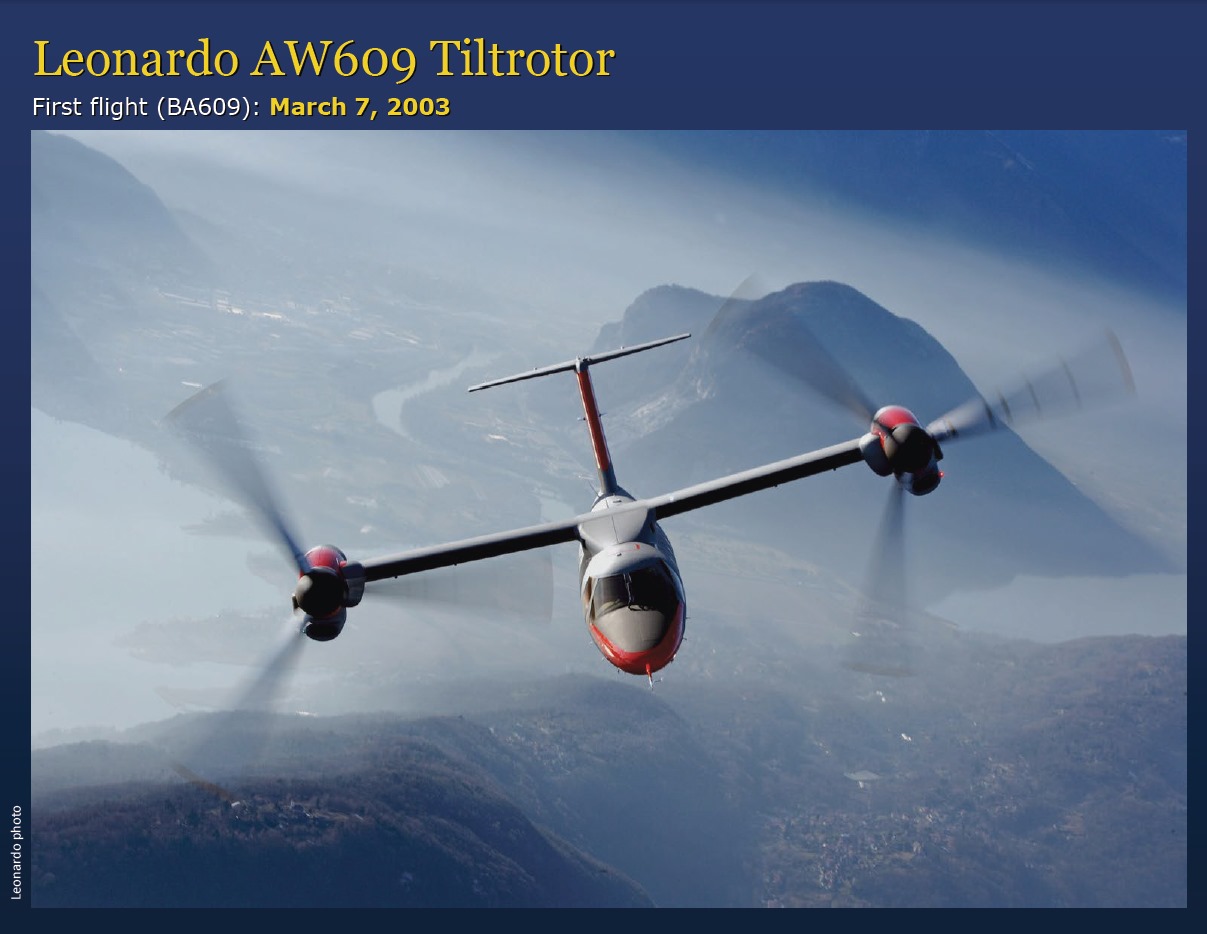
The Leonardo AW609 (previously known as the Bell Boeing BB609, Bell Agusta BA609, and the AgustaWestland AW609) is a twin-engine tilt-rotor VTOL aircraft with a configuration similar to that of the Bell XV-15 and Bell Boeing V-22 Osprey. It is capable of landing vertically like a helicopter while having a range and speed of conventional fixed-wing aircraft such as turboprops. The AW609 was aimed from the outset at the civil aviation market, in particular VIP customers and offshore oil and gas operators.
In 1996, Bell joined forces with Boeing to develop the first tilt-rotor for civil applications but two years into the teaming agreement, Boeing opted out of the project when it sold off its commercial helicopter business. By 1998, the Italian helicopter company Agusta had become a partner in the development of the BA609 with the creation of the Bell Agusta Aerospace Company (BAAC).
Bell’s experience on the XV-15 and V-22 were applied to the BA609; but also taking advantages of new rotorcraft developments in avionics and new construction techniques (The BA609 was about 15% heavier than the Bell XV-15). The AW609 is powered by a pair of Pratt & Whitney Canada PT6C-67A turboshaft engines, each powering a three-bladed articulated rotor (or as it is called on this type of aircraft, a “proprotor”). Ground testing in preparation for first flight began on 2 Dec 2002 and the first flight took place on 7 March 2003 at Bell Helicopter Flight Test Center in Arlington, Texas, at the hands of test pilots Roy Hopkins and Dwayne Williams. Additional restrained and unrestrained ground testing followed, eventually allowing the resumption of flight tests in June 2005.
By October 2008, more than 300 flight hours had been accumulated by the first prototype and a second test vehicle. That same year the AW609 was taken to Europe and flown at the Farnborough Airshow, its first public appearance to a wider audience. By this time, total responsibility for the design and further testing rested on AgustaWestland, which included the rights to market the aircraft, with Bell still playing a supporting role with flight tests and critical aircraft component inspections, manufacture, etc.).
Finally, after a long development program and the tragic loss of the two test pilots and Aircraft 2, the AW609 is near certification by both the Federal Aviation Administration (FAA) and the European Union Aviation Safety Agency (EASA). It is expected that the AW609 will receive full certification and begin deliveries to its launch customer by 2020. As of late 2019, there are three AW609s flying or undergoing flight testing in support of the certification program. Flight testing is taking place in Italy and the US.
Text by Erasmo Piñero, Jr.
Go back to the previous photo or view the photo for next month
2020 History Calendar Index