

US Air Force/Kaman H-43 Huskie - “Pedro”
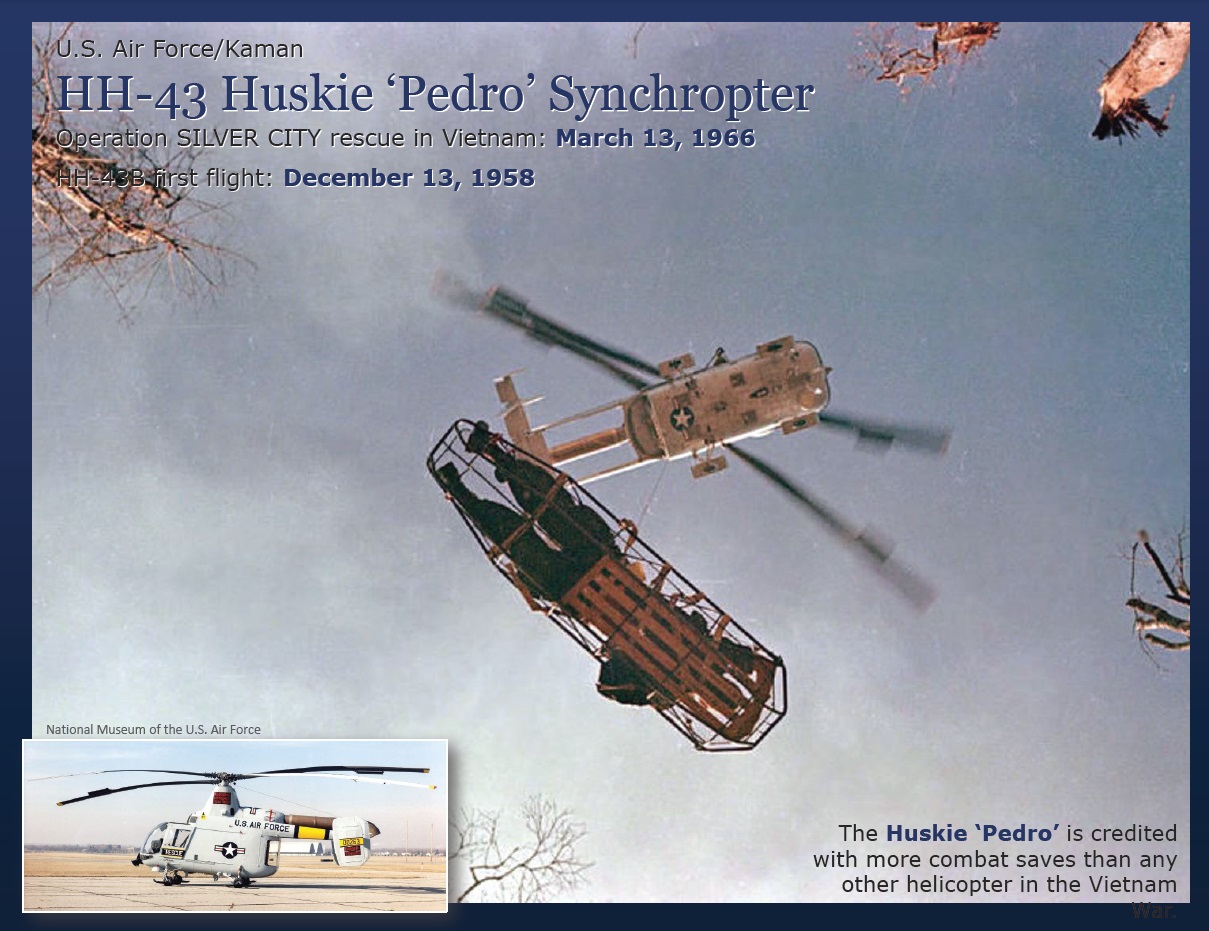
During 1956, Kaman’s Model K-600 scored the highest in an Air Force evaluation of existing helicopter designs suitable for a newly established crash-rescue mission. The Kaman design was based on the HOK-1/HUK-1 “Synchropter” configuration of intermeshing rotors. The design also incorporated an innovative system of servo flaps attached to the trailing edge of each rotor blade. The winning helicopter was designated the H-43 and was first flown on Sept. 19, 1958. An initial Air Force contract for 18 H-34As was awarded and delivery was completed by mid-1959.
In February 1958 the Air Force placed an additional order for 20 H-43Bs. The first H-43B took flight on Nov. 1, 1958 and was powered by the 825 horsepower (614 kW) Lycoming T53-L-1A. Kaman had switched to turbine power, another first among helicopter manufacturers. The original H-43A had been powered by a Pratt & Whitney R-1340-4B Wasp engine which developed 600 horsepower (447 kW). The first production H-43B first flew on March 13, 1959 with delivery beginning in June. Production models were powered by the 860 horsepower (640 kW) T53-L-1B engine which allowed for a maximum sea level speed of 120 mph (190 km/h). The H-43B could accommodate two pilots and six passengers, or a pilot, medical attendant and four litters.
A total of 202 H-43Bs were produced. Because of the need to cope with hot climate conditions in Southeast Asia during the Vietnam War, an improved version designated the HH-43F was introduced. The HH-43F utilized the 1,150 horsepower (856 kW) T53-L-11A, allowing for 11 passengers, plus the crew. A total of 42 HH-43Fs were built with production ending in 1968. An additional 33 H-43Bs were eventually converted to HH-43F Models.
The H-43’s safety record was the best ever established by a military aircraft. Its accident rate was far below all US Air Force helicopter and fixed-wing rates. It was in service for nearly five years before it suffered its first fatal accident. The H-43B also distinguished itself in the record-setting arena, breaking eight world records. A number of altitude (32,840 ft/10,009 m) and rate-of-climb records were set in 1961.
It was during the Vietnam War that the H-43 proved its worth being used for both close-in fire fighting and crash rescue operations. When equipped with a fire-suppression kit, known as the “FSK,” it was capable of responding to aircraft accidents. The FSK was a 950-lb (432 kg) suspended unit that held 78 gallons (295 L) of water and a separate container with five gallons (19 L) of concentrated foam. When the water and concentrated foam was combined, the FSK could generate 690 gallons (2,612 L) of aerated foam. The unique rotor system created an extremely powerful downwash that could suppress the flames to an extent and also assist in spreading the foam over the fire. The rotors would also be used to push fire away from personnel allowing firefighters to move in and extract the crew of the wrecked aircraft.
Despite its limited range, Huskies penetrated deep into Laos and North Vietnam to rescue downed pilots. These rescues often brought Huskie crews within 40 miles (64 km) of Hanoi, by carrying additional 55-gallon (208 L) fuel drums lashed in the cabin. The first rescue occurred on May 17, 1965 in North Vietnam. By the end of 1966, a total of 19 HH-43Bs and 10 HH-43Fs were in South Vietnam and Thailand. That year also saw a name change to “Pedro,” a radio call-sign originally used at Laredo Air Force Base, Texas. That same year, a camouflage paint scheme was introduced. Of a total of 2,039 combat saves accomplished during the peak period of 1966 through 1970, by four rescue aircraft types, the HH-43 accounted for 888. By war’s end, the Pedro was credited with 1,100 saves.
Detachment 5 of the 40th Aerospace Rescue and Recovery Squadron of the Udorn Royal Thai Air Force Base became the last acting HH-43F Huskie operational unit within the US Air Force on Sept. 30, 1975. Most of the retired H-43 helicopters were placed in storage at the Davis Monthan Air Force Base “Boneyard” in Arizona, with some being acquired by military and civilian museums. Most of the helicopters placed in storage were purchased by Allied Aircraft Sales in Tucson, Arizona, which scrapped the majority of them. Those aircraft that did survive have found their way into the hands of operators using them for logging, firefighting and agricultural spraying.
Characteristics (HH-43F):
- Crew: Four: two pilots, two rescue crew
- Length: 25 ft (7.6 m) • Main rotor diameter: 2 × 47 ft (14.3 m)
- Height: 17 ft 2 in (5.18 m) • Gross weight: 9,150 lb (4,150 kg)
- Powerplant: 1 × Lycoming T53-L-11A turboshaft, 1150 hp (856 kW)
- Maximum speed: 120 mph (190 km/h)
- Cruise speed: 105 mph (169 km/h)
- Range: 500 miles (805 km @ 350 gallons/1,325 L)
- Service ceiling: 23,000 ft (7,010 m)
Reference:
- Mutza, Wayne. KAMAN H-43: An Illustrated History, Schiffer Military/Aviation History, 1998
Text by Paul Fardink, Lt Col, US Army (Retired)
Go back to the photo for last month or view the photo for 'The Year at a Glance'
2020 History Calendar Index