

Volocopter eVTOLs
Volocopter GmbH was founded in 2011 in Karlsruhe, Germany, by Alexander Zosel and Stephen Wolf with the intent of making an electric vertical takeoff and landing (eVTOL) multicopter aircraft for fast and efficient urban travel. Known as “e-volo GmbH” until being renamed in July 2017, the company is now based in Bruchsal, Germany.
According to the Guinness Book of World Records, the first manned flight of an electric multicopter was the Volocopter VC1 prototype. The VC1 multicopter was flown by co-founder, primary designer, inventor and builder, Thomas Senkel on Oct. 21, 2011.
The Volocopter VC1 was succeeded by the Volocopter VC2, which was an unmanned demonstrator that featured 18 propellers instead of 16. Its body consisted of a tetrahedron/octahedron aluminum truss frame with a central seat for test payloads. e-volo made some radio controlled test flights with the VC2, but no manned flights.
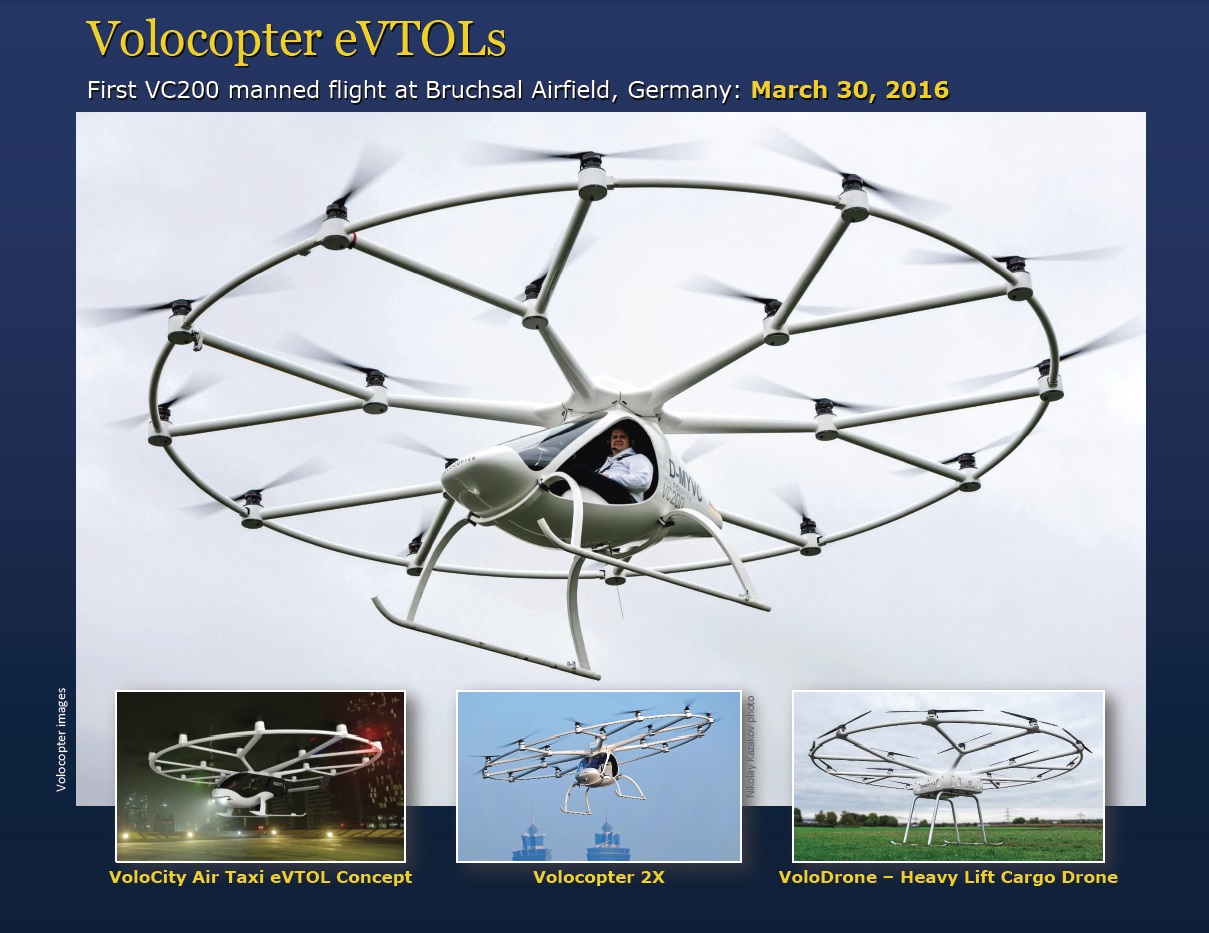
The Volocopter VC200, with 18 electric propellers, made its first unmanned flight in November 2013. Its first manned flight was March 30, 2016 [shown in the main photo], by co-founder Alex Zosel. Volocopter claimed this as the world’s first two-seat electric VTOL aircraft. The aircraft is designed for up to 100 km/h (54 kt) and demonstrated a speed of 69 km/h (37 kt) in July 2016.
The Volocopter 2X is a refined next generation version of the VC200, with a limited number of more refined “pre-production prototypes” built for testing. The most notable difference is that the electric motor housings do not extend below the support ring. Volocopter has never released much information on the 2X series, but it is believed that around three examples were built. On Sept. 14–15, 2019, more than 12,000 spectators saw the flights of the Volocopter 2X unmanned air taxi at the Mercedes- Benz Museum in Stuttgart, Germany. [Note: the bottom middle image in the calendar is labeled incorrectly. This is also the VC200.]
The VoloCity, announced in Aug. 2019, has 18 small fixed-pitched propellers and 18 electric motors on top the beam structure. The 4th generation VoloCity aircraft [bottom left photo] has been redesigned with notable changes, such as making a more modern and streamlined airframe with wrap around windows, newly designed and lowered landing skids making entry and exit from the aircraft easier, the beams which hold the propellers are more aerodynamic, housings within the beam structure have been added to protect the electric motors, a rear stabilizer has been added for increased lift and to provide more stability during forward flight, and the company has increased the redundancy in critical systems. The eVTOL aircraft can fly at speeds 100 km/h (62 mph) with a range of 35 km (~22 miles). The batteries can be changed-out in about 5 minutes.
In November 2019, Volocopter unveiled a prototype for a heavy-lift utility drone for agriculture, developed in collaboration with John Deere. A demonstrator model of this VoloDrone [bottom right photo] was displayed with a John Deere crop protection sprayer, which had made tethered flights as of that time.
Volocopter stated in November 2019 that the VC1, VC2, VC200 and 2X prototypes have collectively made over 1,000 test flights, including in Dubai and Singapore.
Text by Mike Hirschberg
Go back to the photo for last month or return to the calendar cover photo
2020 History Calendar Index