

Lockheed CL-475 Experimental Rigid Rotor Helicopter
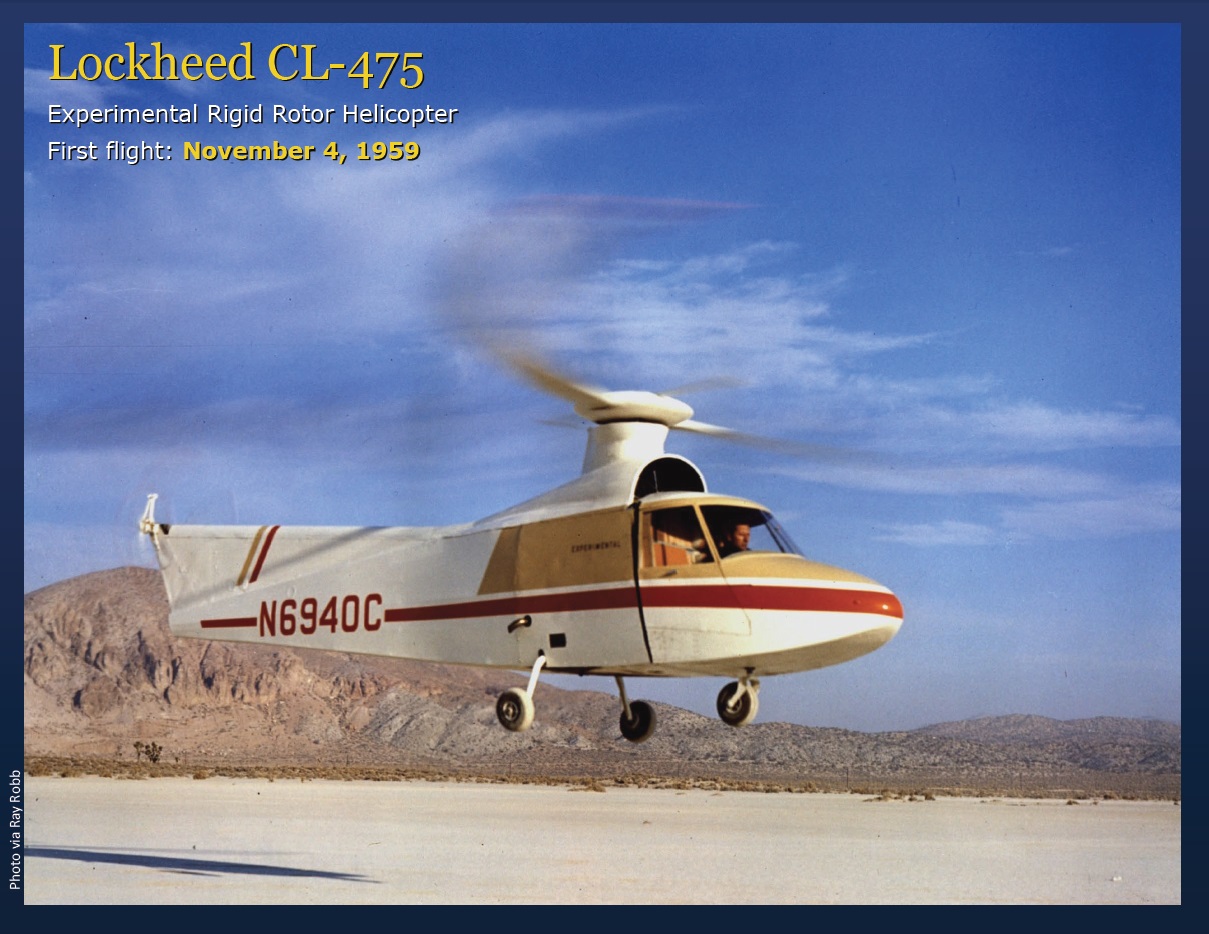
In the mid-1950s, Irv Culver developed a rotor concept that would eliminate the hinges found on the articulated rotors that were typical of that time. A gyroscopic control system was also implemented to stabilize the rotor concept. The goal of the new rotor concept was to create a system with better reliability, performance and handling qualities at a lower cost. The rotor concept was initially tested on a radio-controlled model. The inherent stability and control of the helicopter model was good enough to work with the crude radio-control equipment that existed in the 1950s. Irv Culver had a great problem-solving reputation at Lockheed and the model performed well enough to convince Lockheed to allow Culver to develop a manned prototype in 1959. That prototype was designated as the CL-475 by Lockheed. The CL-475 was a single engine, single rotor helicopter with a metal tube structure covered with fabric. It was powered by a Lycoming VO-360-A1A piston engine that developed 140 horsepower.
The CL-475 was flown for the first time in November 1959, at Rosamond dry lake. A two bladed rotor was tested in the beginning, but was found to have unacceptable vibration levels. CL-475 research continued with three and four bladed rotors. A three bladed rotor with a ring gyroscope installed in the control circuit of the rotor hub was found to perform the best and was easier to fly than contemporary helicopters.
Lockheed’s first exploration into helicopter design produced advanced rotor technology that was years ahead of its time. Developments that were pioneered on the CL-475 were taken forward and applied to the XH-51 and AH-56 Cheyenne helicopter programs.
While Lockheed rotor technology led the world in bearingless rotor systems, financial problems at the corporation in the 1970s blocked any further helicopter development.
Text by Todd Hodges
Go back to the photo for last month or view the photo for next month
2020 History Calendar Index