

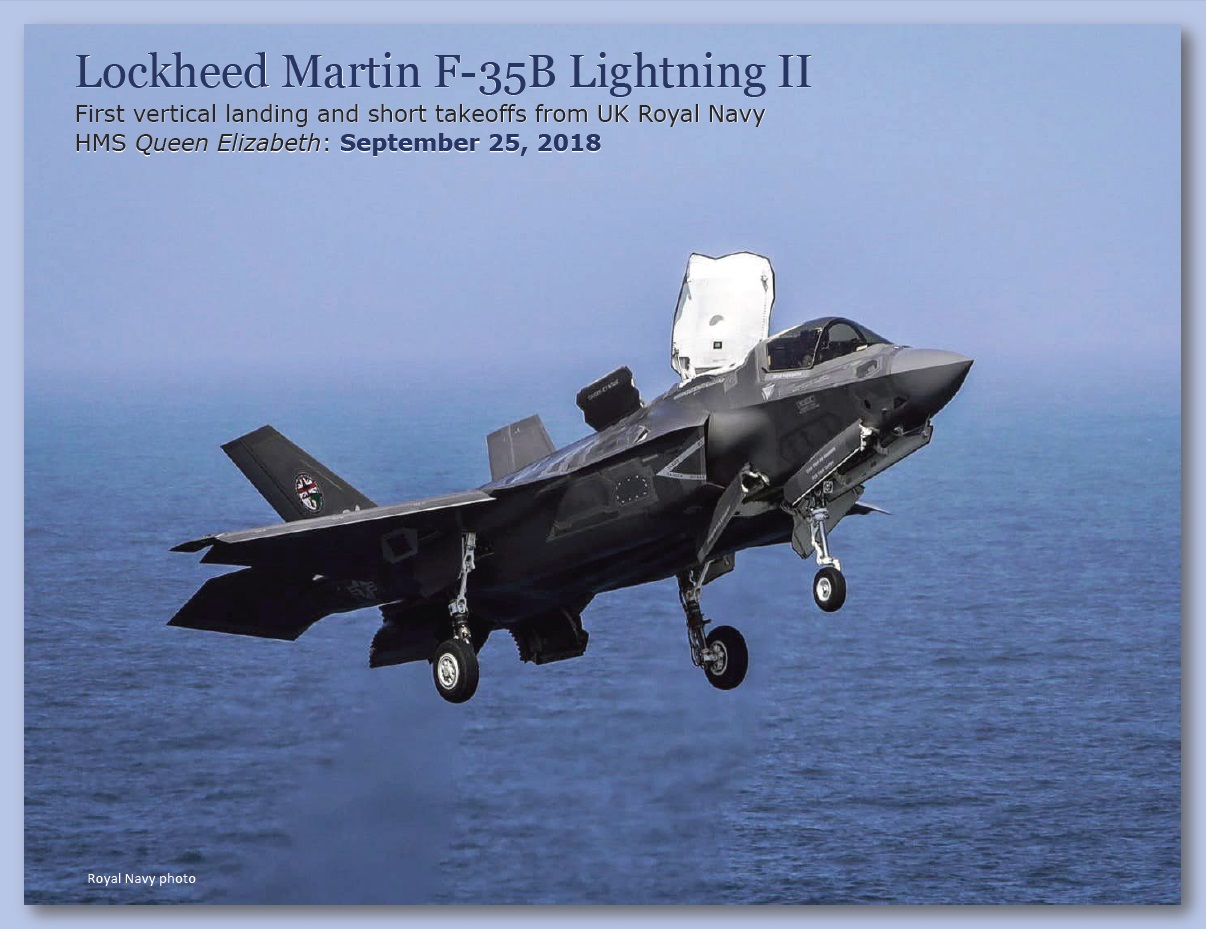
 Lockheed Martin F-35B
The Lockheed Martin F-35B Lightning II is the STOVL (Short Take Off Vertical Landing) product of the Joint Strike Fighter (JSF) program. The US Department of Defense initiated the JSF program in the late 1990s to develop a 5th generation, multi-role, supersonic fighter to replace a variety of aircraft operated by the US Air Force, US Navy and US Marine Corps. The F-35B replaced the Marines’ AV-8B Harrier. Of all the JSF requirements, STOVL capability with minimal impact on payload and range was the most demanding. It was successfully accomplished by the addition of a swiveling nozzle on its single engine that redirected its thrust vertically when required and a large shaft-driven, contra-rotating lift fan in the forward fuselage for the remainder of the vertical thrust — more than 20,000 lb — needed. The challenge was designing a lightweight clutch and 90-degree gearbox that could transmit 29,000 horsepower from the engine to drive the lift fan. The X-35B proof-of-concept demonstrator successfully demonstrated its feasibility and benefit, including a flight on July 20, 2001, combining a short takeoff, supersonic dash at 25,000 ft, and vertical landing, the so-called Hat Trick. The F-35B flew for the first time on June 11, 2008. In July 2015, the USMC’s F-35B was the first of the three F-35 variants to begin service; it was first employed in combat in September 2018 in Afghanistan. The United Kingdom was the next to begin operations with the F-35B; Italy, Japan and Singapore are also procuring it.
Prepared by Tommy H. Thomason.
Royal Navy photo
Go back to the photo for last month or view the photo for next month
2022 History Calendar Index