

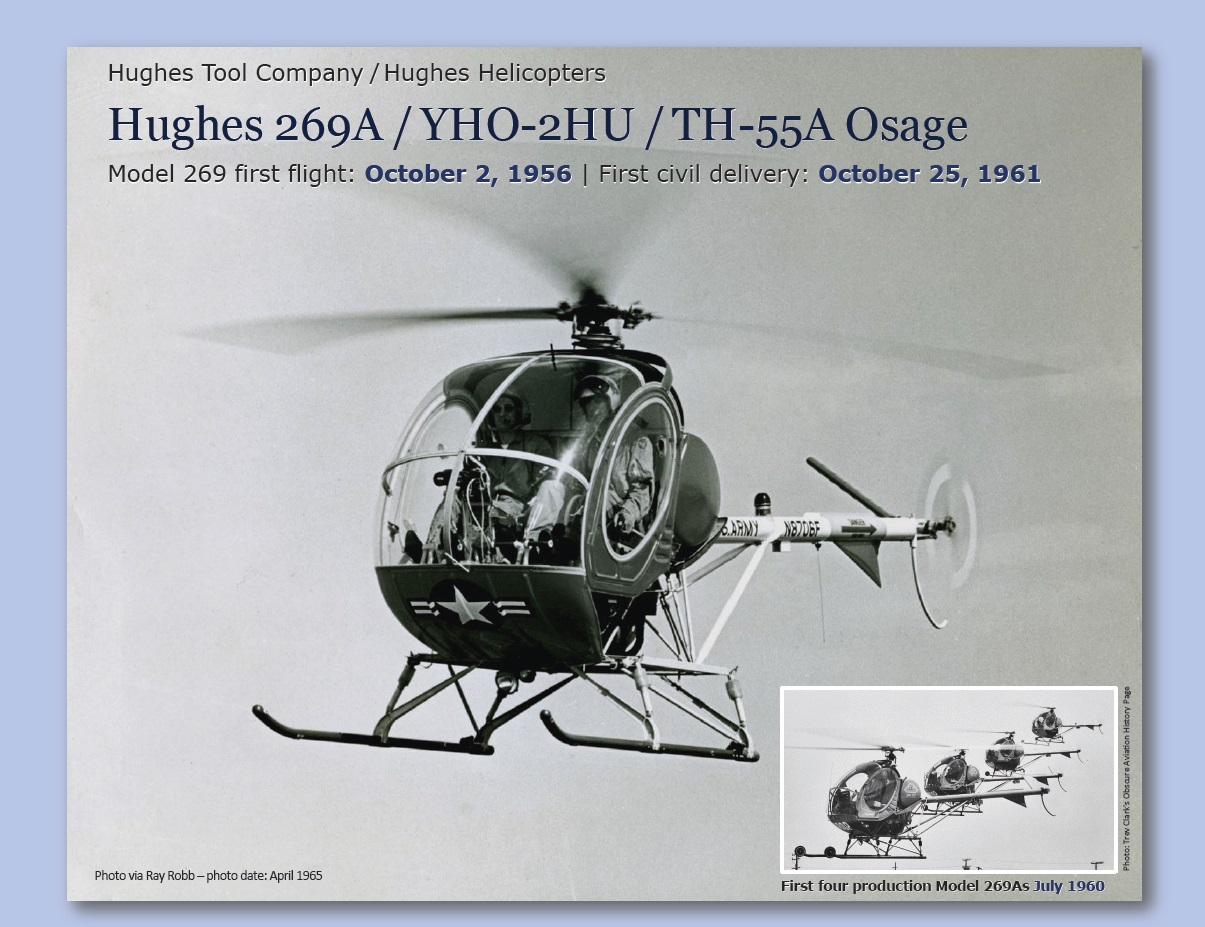
 Hughes Model 269A: ARMY TH-55A Osage
The Hughes Model 269A is a piston-powered light training helicopter produced for the US Army and designated as the TH-55A Osage. It was also produced as the Model 269 family of light utility helicopters. A three-seat version of the slightly larger Model 269B was marketed as the Hughes 300. Subsequently produced and sold a various points by McDonnell Douglas, Schweizer and Sikorsky, it is today known as the Schweizer RSG 300-series.
The Hughes Model 269 first flew on Oct. 2, 1956. Two prototype helicopters were built with a truss tailboom and powered by a 180 hp Lycoming O-360-A engine. It wasn't until 1960 that the decision was made to develop the helicopter for production. The 269A replaced the truss tailboom with a simple aluminum tube. Customers had the option for dual controls, and a 19 gal (72 liter) auxiliary fuel tank. The maximum weight was 1,550 lb (703 kg).
The Hughes 269 was designed with a fully articulated, three-bladed main rotor system designed by Drago Jovanovich, and a two-bladed tail rotor. It also has shock absorber-damped, skid-type landing gear. The flight controls are directly linked to the swashplate of the helicopter, meaning that there are no hydraulic systems in the 269. There are generally two sets of controls, although this was optional on the civil 269A
The first delivery to a civilian customer signaled the start of a program that eventually produced about 2,900 variants of the Model 269. By the middle of 1963, the production line in Building 15 at the Hughes Helicopters plant in Culver City, California, was producing 20 helicopters a month. With this model, Hughes successfully captured a large portion of the civilian helicopter market with an aircraft that would prove itself popular in agriculture, police work and other duties.
The US Army chose the 269A as its new primary training helicopter and designated it as the TH-55. After an initial order for twenty helicopters, the number delivered to the Army climbed to 792 with final delivery in March 1969.
Prepared by Paul Fardink.
Photos via Ray Robb (1965) and Trev Clark's Obscure Aviation History Page
Go back to the photo for last month or view the photo for next month
2022 History Calendar Index