

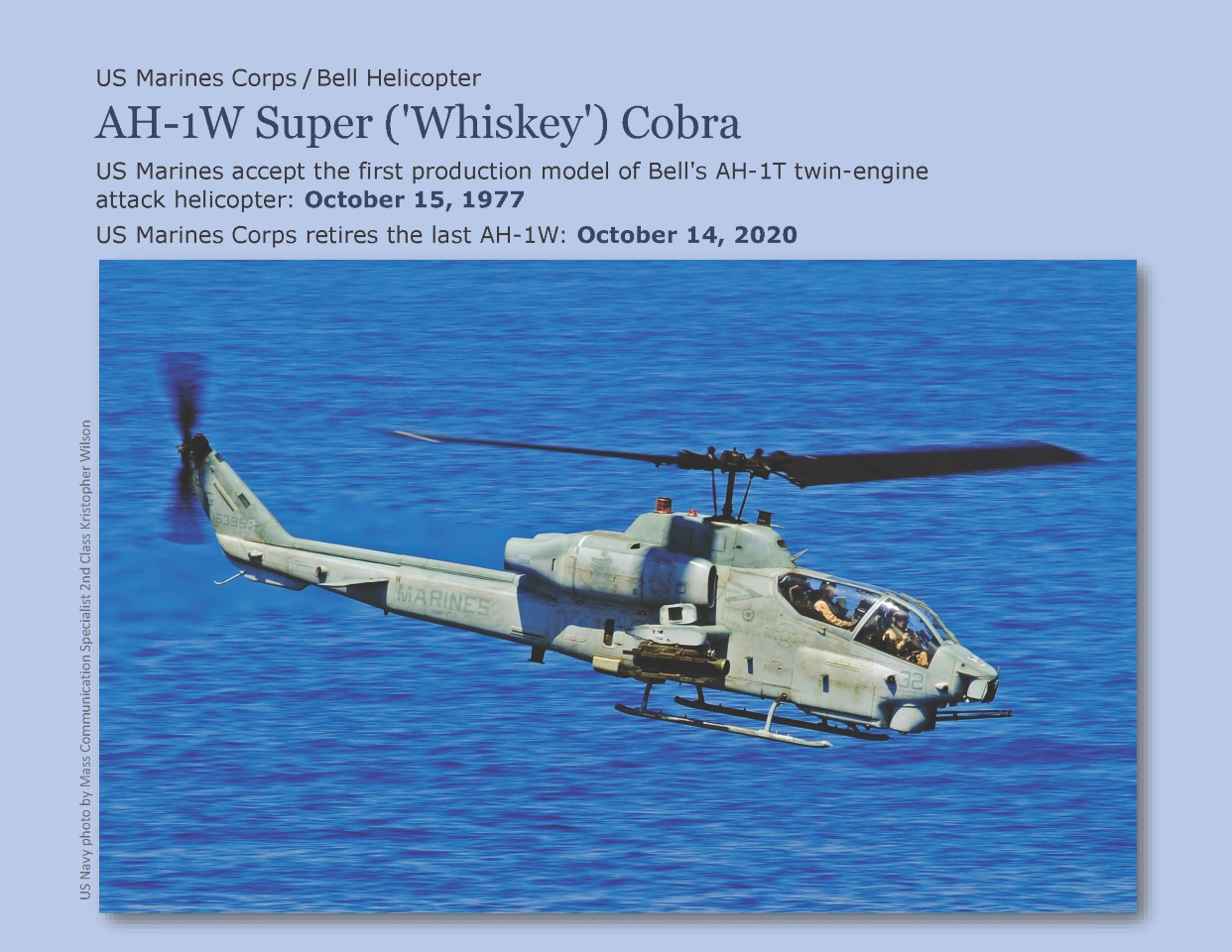
 Bell AH-1W Super Cobra
The AH-1W “Wiskey” Super Cobra is a twin-engine attack helicopter manufactured by Bell Helicopter. It is a derivative design, based on the US Army’s single-engine AH-1 Cobra. Beginning in 1971, the US Marine Corps began the purchase of twin-engine Cobras, starting with the AH-1J Sea Cobra. This was followed by the AH-1T Improved Sea Cobra in 1976, and then the AH-1W Super Cobra in 1986. The AH-1W Super Cobra served as the backbone of the Marine Corps attack helicopter fleet for 34 years. From 1986-1999, the Marines received 179 Super Cobras, which flew a total 933,614 hours. It was retired from service in 2020 and was replaced by the next generation AH-1Z “Zulu” Viper.
The AH-1W has a fuselage length of 45.7 ft (13.9 m) with stub wings spanning 10.9 ft (3.3 m). Its two-bladed rotor system is 48 ft (14.6 m) in diameter which gives the helicopter a disc area of 1,809 ft² (168.1 m²). It has an empty weight of 10,200 lb (4,630 kg) and a maximum takeoff weight of 14,750 lb (6,690 kg). It’s powered by two General Electric T700-GE-401 turboshaft engines, each having a 1,690-shp (1,300-kW) rating giving the helicopter an advertised rate of climb of 1,620 ft/min (8.2 m/s) and a service ceiling of 12,200 ft (3,720 m) with a combat radius of 317 nm (365 miles or 587 km).
The crew of two (pilot and co-pilot/gunner) sit in a tandem configuration with a variety of armament at their disposal, which in turn can be tailored to specific combat missions: 20 mm M1973 3-barrel Gatling Gun; 2.75 in (70 mm) Hydra 70 or APKWS II rockets; 5 in (127 mm) Zuni rockets; TOW Missiles; AGM-114 Hellfire missiles; and/or AIM-9 Sidewinder anti-aircraft missiles.
Description: Paul Fardink
Photo credit: US Navy/Mass Communication Specialist 2nd Class Kristopher Wilson
Go back to the photo for last month or view the photo for next month
2021 History Calendar Index