

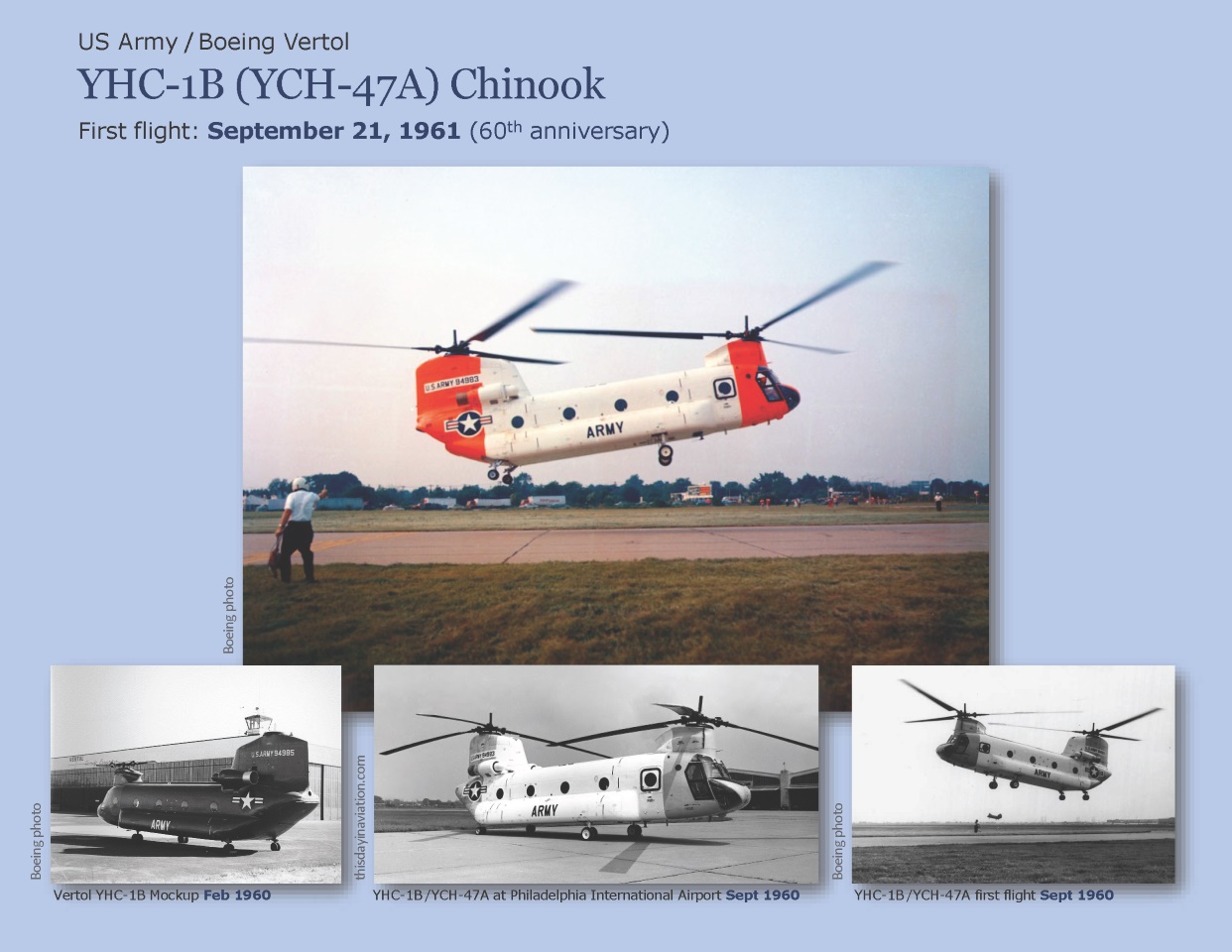
 YHC-1B (YCH-47A) Chinook
With the US Army’s mid-1950s Air Mobility Studies showing a requirement to replace its fleet of piston-powered helicopters, Vertol Aircraft Corporation began extensive market research and interviews with US military customers to get a better understanding of their requirements. In addition to the general goal of having an airborne equivalent of a 2½-ton truck, the Army had a need to transport the MGM-31 “Pershing” missile in the intra-theater mobility role.
In July 1957, Vertol gave a briefing to Maj. Gen. Hamilton Howze, then Chief of Army Aviation, on the company’s plan to build and fly a new turbine-powered, tandem-rotor transport, the Vertol 107 demonstrator. The aircraft used the rotor and some drivesystem components from the US Army/Vertol H-21 Shawnee, while replacing the single Wright R-1820 piston engine with two T53 turboshaft engines to be loaned from the Army.
The Army was interested and on June 26, 1958, Vertol received a contract to build ten improved 107s, with the Army designation YHC-1A. These aircraft were to be re-engined with the more powerful GE YT58, along with other improvements. This order was eventually cut to three YHC-1As (which later became the basis for the US Marine Corps H-46 Sea Knight) with the remaining funding redirected to develop Vertol’s larger 107-1, or Vertol Model 114, which was more suitable and able to meet the Army’s requirements.
On June 25, 1958, the Army (through the US Air Force Air Materiel Command) issued the General Management Proposal for the US Army Medium Transport Helicopter. Five companies responded: Bell, Kaman, McDonnell, Sikorsky and Vertol. By September 1958, the Joint Army/Air Force Source Selection Board had reviewed the proposals and decided that Vertol’s approach was the most promising. On March 4, 1959, the Board formally recommended that the Army choose Vertol. That June, the Air Force awarded a $19M contract for engineering, tooling, five airframes, a mock-up, and initial testing for the Vertol 114, or YHC-1B.
On April 28, 1961, the YHC-1B prototype was rolled out. Work progressed on the first five aircraft, and the second YHC-1B built was used to complete a 15-minute first flight on Sept. 21, 1961.
In July 1962, the DoD redesignated all US military aircraft and the YHC-1B became the YCH-47A and the HC-1B redesignated the CH-47A Chinook.
On August 16, 1962, the Army Aviation Board took delivery of its first CH-47A at Fort Rucker, Alabama and in October 1963, the Chinook was formally designated the Army’s standard medium transport helicopter.
Description: Ken Bartie
Photo credits: Boeing, thisdayinaviation.com
Reference:
- Boeing Helicopters CH-47 Chinook, David Anderton and Jay Miller, Aerofax Minigraph 27, 1989.
Go back to the photo for last month or view the photo for next month
2021 History Calendar Index