

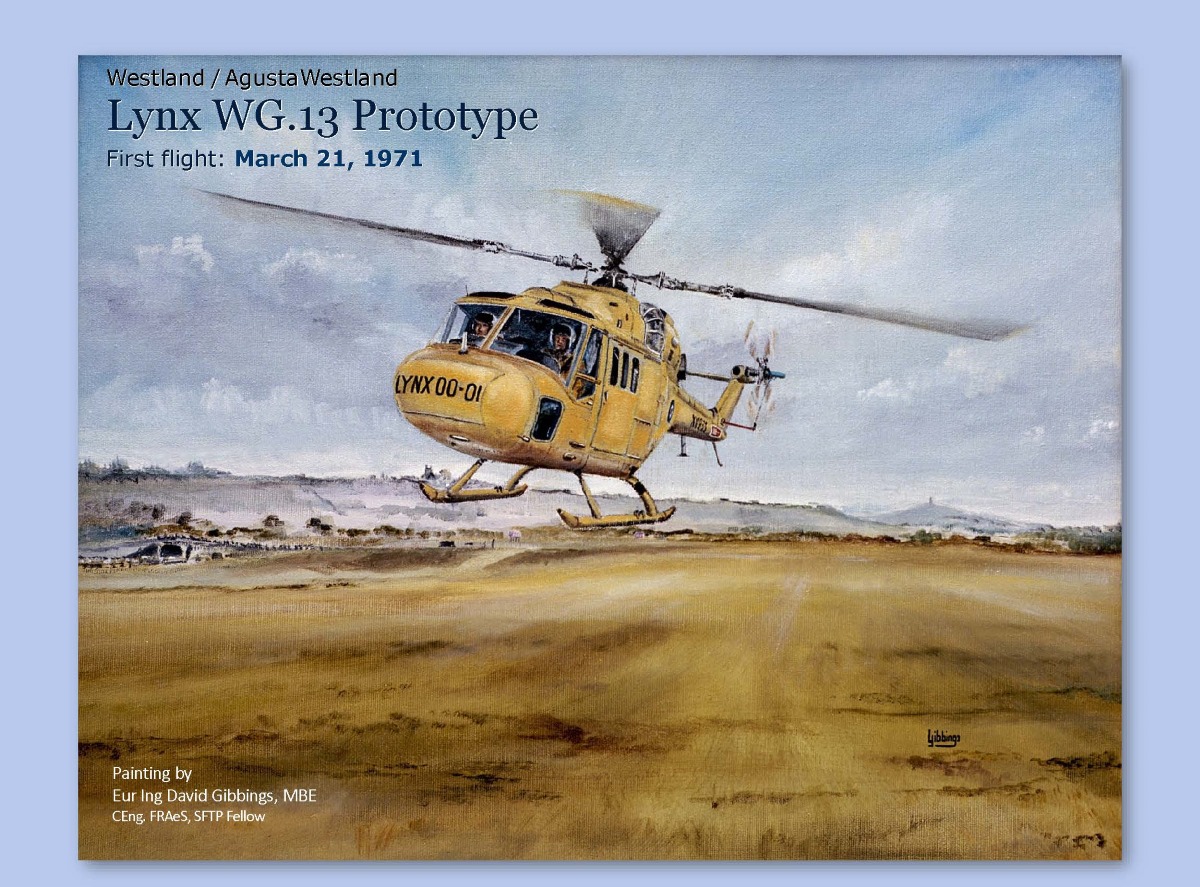
 March 2023: Westland Lynx WG.13 Prototype
First flight: March 21, 1971
The origins of the Lynx can be found in studies sponsored by Raoul Hafner for a modern tactical transport helicopter completed after his appointment as Technical Director (Research) for the newly merged helicopter activities of Bristol, Fairey, SARO and Westland. A baseline was established as project WG.3 with twin Pratt & Whitney Canada PT6 engines initially alongside the main transmission, but later this was changed to a pair of Bristol Siddeley Gnomes re-positioned above the cockpit.
In this form, the design had grown well beyond the original intent and was re-established as a small troop carrier, identified as project WG.13. At the same time, consideration was given to both a small ships helicopter derivative and an armed attack tandem cockpit variant. The desire for a high degree of commonality across all of these variants drove another engine configuration change where the twin engines, once more of PT6 levels of power, were placed aft of the rotor. Schemes to integrate the aft drive PT6 with this new configuration were discarded in favor of a front drive engine (though this would later be re-visited) and the Bristol Siddeley BS.360 Gem was selected. In this form WG.13 would be included in the Anglo-French helicopter program with detailed design for tactical transport, naval and armed escort variants, the latter to meet a French Army requirement. Responsibility for detailed design was transferred from Yeovil to the Westland facility at Hayes, formally Fairey Aviation, under Tadeusz (Ted) Ciastula as Chief Engineer. By 1969, the design had been frozen and build begun, but at the end of that year the requirement for an armed escort variant was withdrawn as a cost-saving measure and this aircraft would be built only as a mock-up.
Ground running of an “iron-bird” began in August 1970 alongside a wide range of structural and system functional test rigs. A pair of Scout helicopters would receive a scaled version of the semi-rigid rotor head, which gave the test pilots a chance to experience its impact on handling characteristics as well as gather useful in-flight dynamic and loads data. The first aircraft to come to flight was XW835, which took place on March 21, 1971, followed by four more prototypes each assigned to specific development tasks.
David Gibbings was the flight test engineer dedicated to the early Lynx flight test program, as well as the artist responsible for the March 2022 calendar feature depicting XW835 flying low, to the east of Glastonbury Tor. This area was later used in 1972 for the first successful speed record campaign using the first pre-production Lynx and then again in 1986 for the capture of the absolute helicopter world speed record by G-LYNX, flown by Trevor Egginton. The yellow Lynx prototype had its planned flight testing cut short by an in-air engine fire followed by an otherwise uneventful landing away from the Westland airfield. It was rebuilt as the PT6 demonstrator aircraft flown in support of the nascent civil Lynx Type 606 program for which the established PT6 engine was favored. The puzzle of having to integrate a rear-drive engine with an installation designed for the front-drive BS.360 was solved by installing the PT6 backwards! Engine and exhaust ducts were a work of engineering art.
The Westland/AgustaWestland/Leonardo Lynx would go on to serve in the UK Royal Navy, British Army, German Navy and French Navy. More than 450 examples were built. It was succeeded by Leonardo AW159 Wildcat (which had been called the “Future Lynx” and “Lynx Wildcat” during development).
Painting by Eur Ing David Gibbings, MBE, CEng, FRAeS, SFTP Fellow
Description: Jeremy Graham
Go back to the previous photo or view the photo for next month
2023 History Calendar Index