

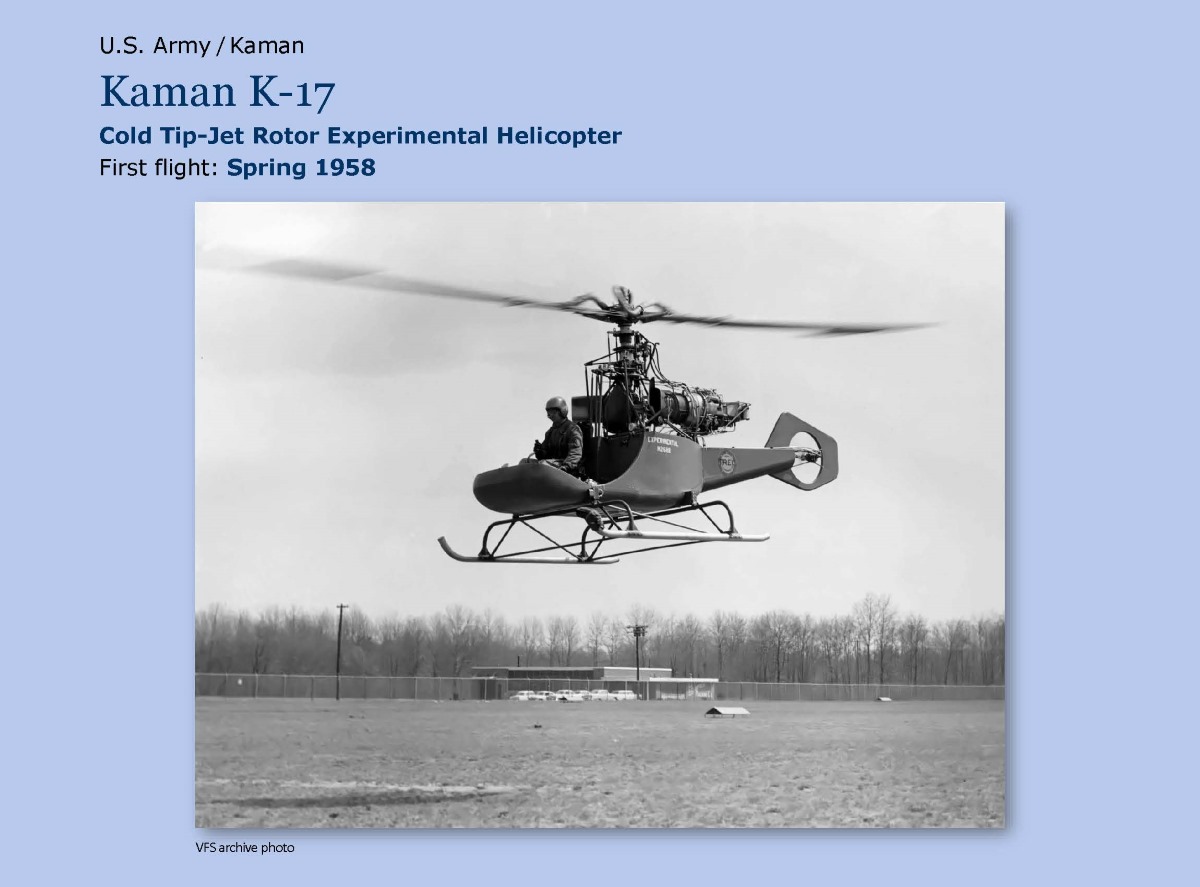
 April 2023: U.S. Army/Kaman K-17
Cold Tip-Jet Rotor Experimental Helicopter
First flight: Spring 1958
The K-17 was a one-off, two-seat, experimental evaluation by Kaman of a tip-jet helicopter. It had an empty weight of about 950 lb (431 kg) and a maximum takeoff weight of 2,000 lb (907 kg). The “cold” high-pressure air ducted out to the tips of its single, two-bladed, teetering, 37-ft (11.28-m) rotor was provided by a compressor powered by a 400-hp (300-kW) Blackburn-built Turbomeca Turmo 600 turbine engine. Rotor control was provided by the simple and proven Kaman servo-flap system. The tail rotor control power required was minimal because rotor torque was almost zero. It was provided by a simple fixed-pitch propeller turned by a variable-speed hydraulic motor that was reversible in rotation to provide pilot-commanded thrust to the left or right for directional control. It was US civil registered as N2688 although some funding of the program was provided by the US Army as one of several tip-driven rotor projects that were of interest to it at the time.
First flight occurred in April 1958. Kaman designed and promoted it to be a low-cost, minimal-maintenance helicopter for civil operators; it lacked a transmission, clutch, tail rotor drive system, and complex rotor hub/controls, and was structurally simple. It was, in essence, a less expensive follow-on to Kaman’s very first helicopter, the easy-to-fly K-125 synchropter that Charley Kaman envisioned would be utilized as, for example, a crop-duster. However, after an initial evaluation, Kaman terminated the project in part to focus on the new US Navy HU2K program.
Description: Tommy Thomason
Go back to the previous photo or view the photo for next month
2023 History Calendar Index