

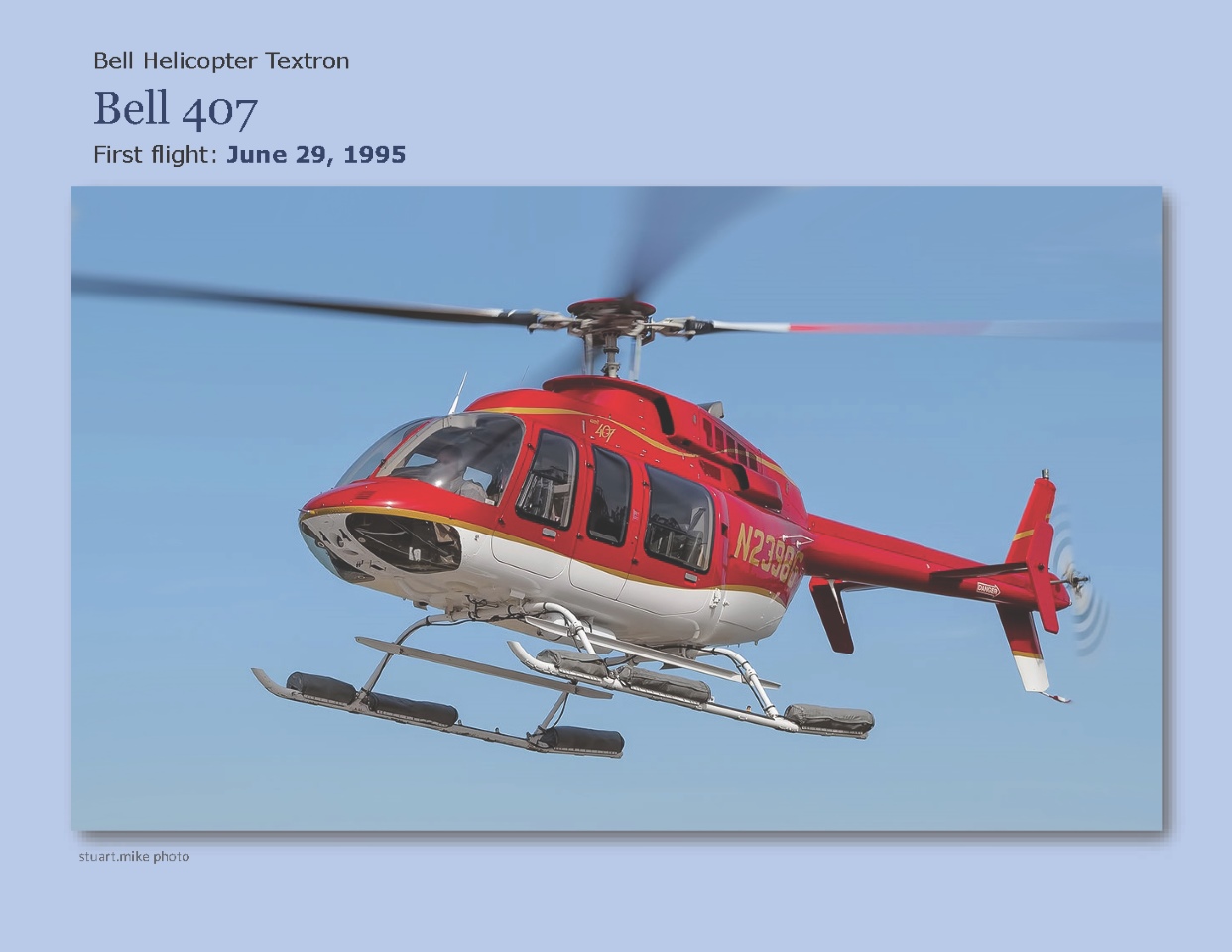
 Bell 407
In 1993, Bell began the development of a new light helicopter as a replacement for its Model 206 series. The program resulted in the Bell Model 407, a derivative design of the 206L-4 LongRanger. The 407 uses the four-bladed, soft-in-plane rotor system with composite hub and blades developed for the US Army’s OH-58D Kiowa Warrior to replace the two-bladed, semi-rigid teetering rotor of the 206L-4.
The first 407 prototype was flown on June 29, 1995 at Bell's Mirabel, Quebec, Canada, plant. After a short development program, the first production 407 flew on Nov. 10, 1995. The 407 was certificated by Transport Canada on Feb. 9, 1996 and the US Federal Aviation Administration (FAA) on Feb. 23, 1996. Full production began in 1996 with production of 140 helicopters in 1997. Over 1,400 407s were delivered by the end of 2017. The ARH-70 Arapaho (Armed Reconnaissance Helicopter) developed for the US Army was based on the 407, but was canceled on Oct. 16, 2008 due to requirements creep, though the Iraqi Air Force operates more than two dozen armed IA-407 aircraft.
The 407 has a length of 41.7 ft (12.7 m) and a height of 11.7 ft (3.6 m). The main rotor is 35 ft (10.7 m) in diameter. The typical internal seating capacity is for five passengers in the main cabin with one or two pilots in the cockpit area giving the helicopter an internal payload of 2,347 lb (1,065 kg) or a maximum external hook capacity of 2,646 lb (1,200 kg). Maximum takeoff weight is 6,000 lb (2,722 kg).
The Bell 407 is powered by an Rolls-Royce Allison 250-C47B turboshaft engine rated at 813 shp (606 kW), giving the helicopter a maximum speed of 140 kt (160 mph, 260 km/h), a cruise speed of 133 kt (153 mph, 246 km/h) with a range of 324 nm (373 mi, 600 km) and a service ceiling of 18,690 ft (5,700 m).
Description: Paul Fardink
Photo credit: stuart.mike
Go back to the photo for last month or view the photo for next month
2021 History Calendar Index