

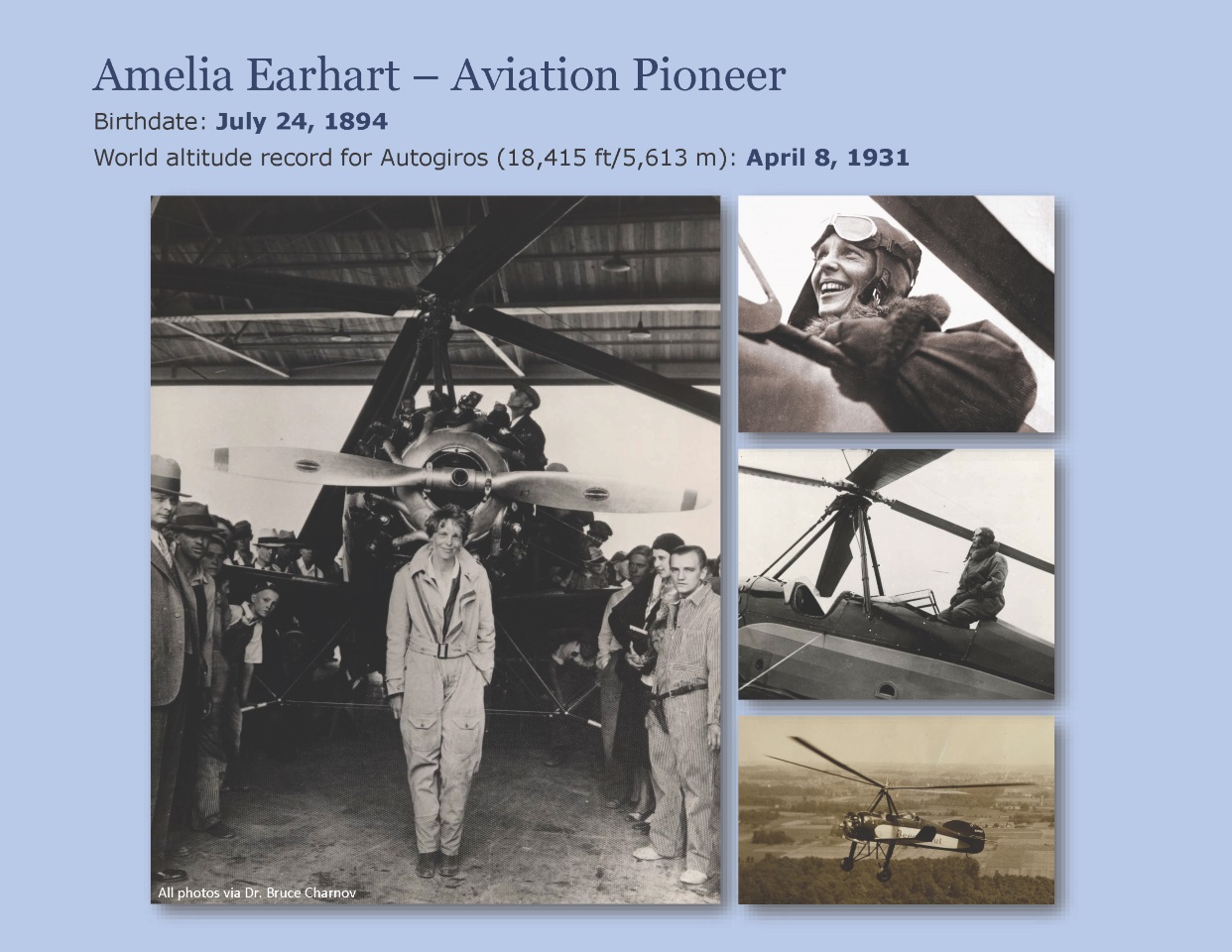
 Amelia Earhart – Aviation Pioneer
Amelia Mary Earhart was born July 24, 1897 in Atchison, Kansas. She was the first female aviator to fly solo across the Atlantic Ocean. She set many other records, wrote best-selling books about her flying experiences, and was instrumental in the formation of The Ninety-Nines, an organization for female pilots. Earhart was the first woman to fly an autogyro and the first woman to cross the United States in an autogyro, both in 1931.
April of that year was a very good month for the newly-formed Autogiro Company of America — its PCA-2 became the first autogyro to receive a US Department of Commerce approved Type Certificate (No. 410) on April 2. Earhart set the first autogyro altitude record of 18,415 ft (5,613 m) on April 8 at Willow Grove, Pennsylvania, flying a borrowed from Beech-Nut Chewing Gum. And, most importantly, on April 22, Harold F. Pitcairn and his associates were presented with the 1930 Robert J. Collier Trophy by President Herbert Hoover on the back lawn of the White House.
First flown in March of 1930, the PCA-2 it was powered by a 225-hp Wright R-760-E Whirlwind J-6-7 engine and featured a 45-ft (13.7-m) 4-blade English-made rotor and a 30-ft (9.1-m) fixed wing. This was the first Autogiro to mechanically spin-up the rotors with a drive-shaft connected to the motor.
PCA-2 production was announced on October 1930 with a more powerful 300-hp (225-kW) Wright-975-E Whirlwind J-6-9 engine. The rotors, now made in America, featured chrome molybdenum steel spars with wooden ribs and plywood and fabric covering. The 3,000 lb (1,360 kg) production PCA-2 achieved a maximum speed of 118 mph (190 km/h), a cruising speed of 98 mph (158 km/h) and a rate-of-climb of 800 ft/min (4 m/s). It was a three-seater with the passengers in the front side-by-side cockpit) and the pilot in the rear.
Earhart would fly the Beech-Nut Autogiro for the next few years in promotional tours, but the PCA-2 was economically unsuccessful, primarily due to its limited lifting capacity and, in the midst of the Great Depression, its $15,000 cost (equivalent to more than $256,800 in 2020).
During an attempt at becoming the first woman to circumnavigate the globe, Earhart and navigator Fred Noonan disappeared over the central Pacific Ocean near Howland Island on July 2, 1937.
Photos and Description: Bruce H. Charnov Ph.D. J.D. Esq. FRAeS
Go back to the photo for last month or view the photo for next month
2021 History Calendar Index