

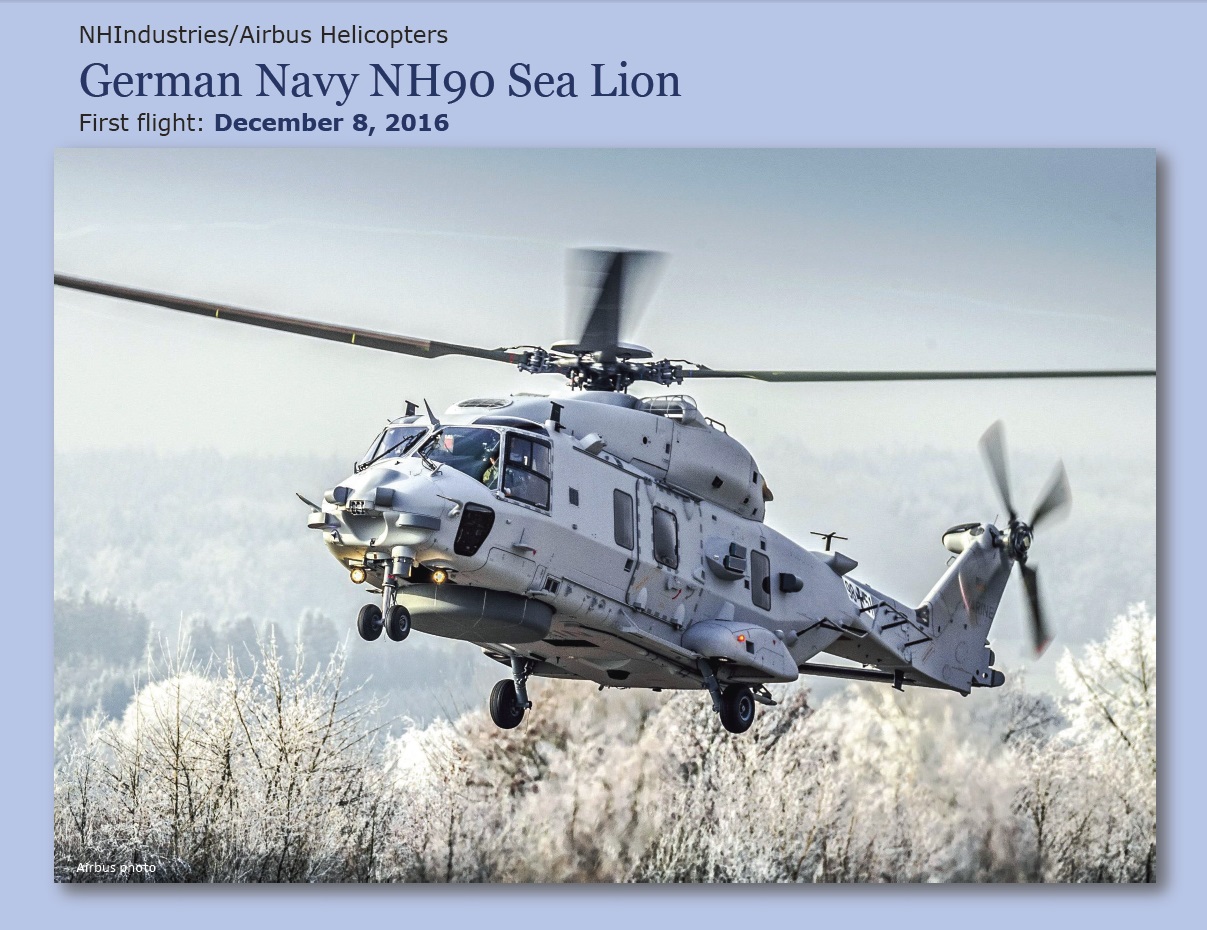
 German Navy NH90 Sea Lion
The NATO Helicopter 90 (NH90) has its roots in 1985 from the need of France, Germany, Italy and the Netherlands — as well as, initially, the United Kingdom — to develop a NATO multi-role medium-sized 11-ton helicopter for the 1990s. Beginning in 1993, it was developed by NHIndustries, a cooperation of Airbus Helicopters, Leonardo and Fokker Aerostructures; the first flight took place in 1995. Two main variants were developed: the Tactical Transport Helicopter (TTH) and the NATO Frigate Helicopter (NFH), both of which were customized to operator requirements. The fuselage is mainly composed of carbon fiber, reducing weight and radar detectability. Although many technical, funding and political problems delayed the NH90, orders eventually totaled to 529 helicopters, with the German Army receiving the first NH90 in 2006.
The NH90 is the first helicopter with a redundant full fly-by-wire flight control system with a 4-axis autopilot, integrated mission and navigation systems, and a digital cockpit with multi-functional displays. It is capable of all-weather, day and night, ship-borne operations at high sea states, and operations up to an altitude of 19,685 ft (6 km) in temperatures ranging from -40 to 122°F (-40 to 50°C). Two Turboshaft engines of 1800 kW allow a maximum speed of 174 kt (324 km/h). Equipment includes electronic warfare protection systems, exhaust gas cooling, flares and more.
Thirty-one NFH known as the Sea Tiger were ordered in 2020 to replace the old fleet of Sea Lynx helicopters. Another variant of the NFH is the German Naval Transport Helicopter (NTH) Sea Lion, which was ordered in 2013 mainly for search and rescue, special unit and transport operations; 18 were ordered to replace the aging Sea King fleet. Special equipment of the Sea Lion includes a 360° radar, optical and electronic sensors, and automatically deployed floats to ensure a safe water emergency landing. In addition to a crew of up to four, the helicopter has a carrying capacity of 14 fully equipped troops or nine stretchers. Cargo loads of up to 4.2 tons can also be carried inside or as a slung load.
Prepared by Berend van der Wall.
Airbus Helicopters photo
References:
Go back to the photo for last month or view the January 2023 page (tribute).
2022 History Calendar Index