

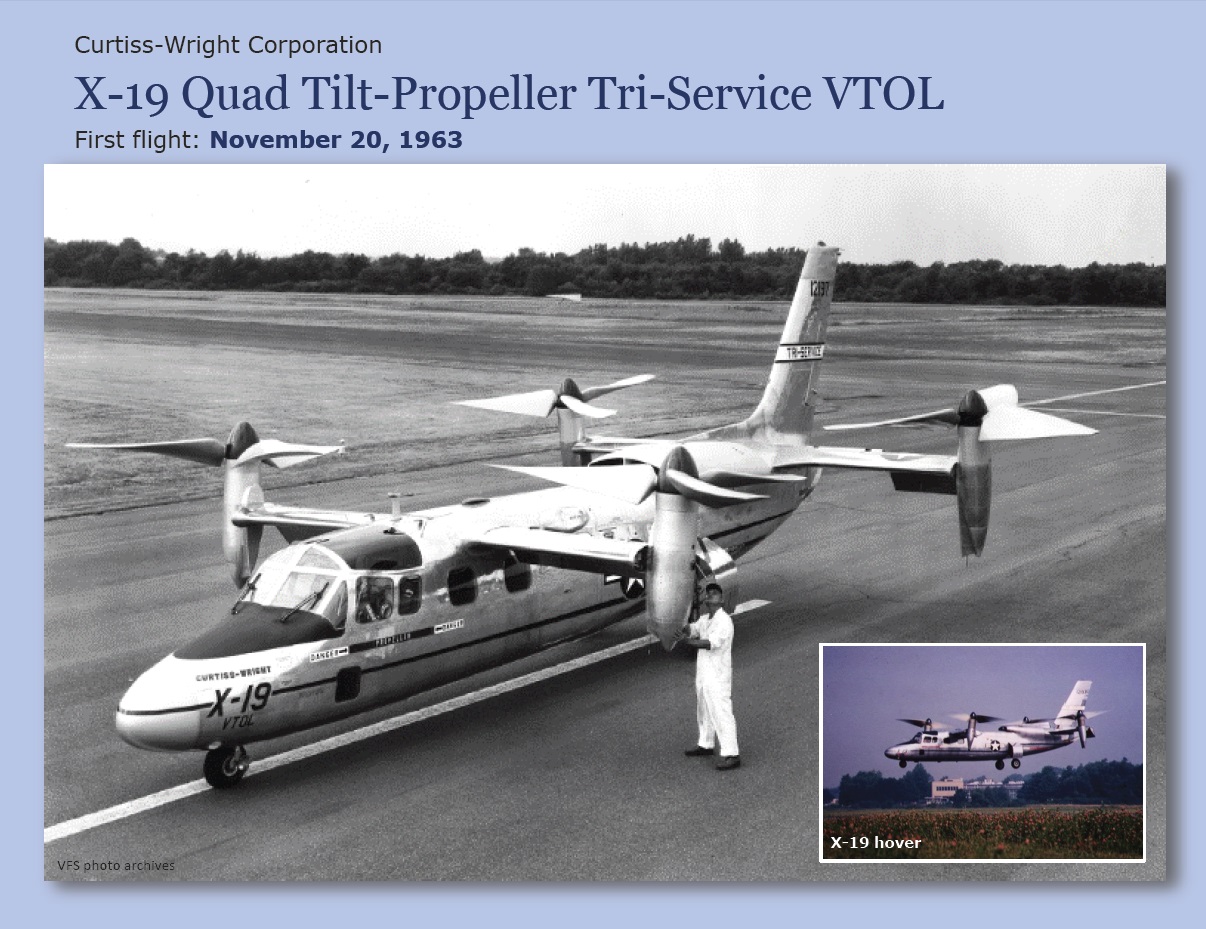
 Curtiss-Wright X-19 Quad Tilt-Propeller Tri-Service VTOL
The Curtiss-Wright X-19 was an experimental V/STOL transport featuring tandem wings with a quad tilt-propeller lift system. Using the propeller radial lift force concept proven by the X-100 demonstrator, Curtiss-Wright designed a six-passenger civil executive transport, originally designated the X-200. As part of the joint US Army, Navy and Air Force Tri-Service Assault Transport Program, the Air Force funded the conversion of two partially built prototypes to meet Tri-Service requirements.
The 44-ft (13.4-m) long fuselage carried a crew of two; it was powered by two Lycoming T55-L-7 turboshafts of 2,650 shp (1,976 kW) each and had four, 13-ft (4-m) diameter tiltable propellers constructed of fiberglass.
The aircraft was rolled out on July 23, 1963, and made its first hovering flight on Nov. 20, 1963, although a hard landing resulted in a collapsed landing gear. During the aircraft’s 50th test flight on Aug. 25, 1965, at an altitude of approximately 1,000 ft and an airspeed of 90 kts, a propeller separated from its nacelle and caused an asymmetric lift condition, which led to one of the first ejections from a VTOL aircraft. Both pilots survived the low altitude ejection with minor injuries.
The second X-19 prototype was never completed and is currently stored at the National Museum of the United States Air Force in Dayton, Ohio. The X-19 was the last aircraft ever built by Curtiss-Wright Corporation.
Prepared by Ken Bartie
Photo credits: VFS Photo Archives
References:
- https://vertipedia.vtol.org/aircraft/getAircraft/aircraftID/811
- https://www.aviastar.org/helicopters_eng/curtiss_x-19.php
- The X-19 V/STOL Technology-A Critical Review, Curtiss-Wright Corp., Technical Report AFFDL-TR-66-195-Volume II, Harold Fluk, et al, May 1967.
- The Curtiss-Wright X-19 Experimental Aircraft – Lessons Learned, H. Borst, AIAA 90-3206.
Go back to the photo for last month or view the photo for next month
2022 History Calendar Index