

Gazelle Experimental High Speed Helicopters
The Sud Aviation/Aérospatiale (now part of Airbus Helicopters) flew for the first time on April 7, 1967. Intended to replace the Alouette III, the Gazelle is noteworthy for several reasons:
- First helicopter to be equipped with a 13-blade “Fenestron”
- First helicopter to be certified for single-pilot instrument flight rules (IFR).
- Use of a semi-rigid rotor designed in cooperation with Messerschmitt-Bolkow- Blohm (MBB)
- Reduced maintenance costs
- Cooperation between three manufacturers (Aérospatiale, MBB and Westland) in three different countries (France, Germany and UK)
It was produced in several models and versions:
- SA 340: prototype
- SA 341: Gross weight was 3,970 lb (1.8 tonnes) and max cruise speed was 142 kt (264 km/h) with a 590-shp engine. Versions B to E for UK military, version F for French military. Version G civil version certified by French CAA in 1971 and then by FAA. Version H: military export.
- SA 342: Gross weight was 4,190 lb (1.9 tonnes) and max cruise speed was 142 kt (264 km/h) with a 870 shp engine. Version J civil version certified in 1976 by French CAA and then by FAA. Versions K and L: military. Version M: French army anti-tank version.
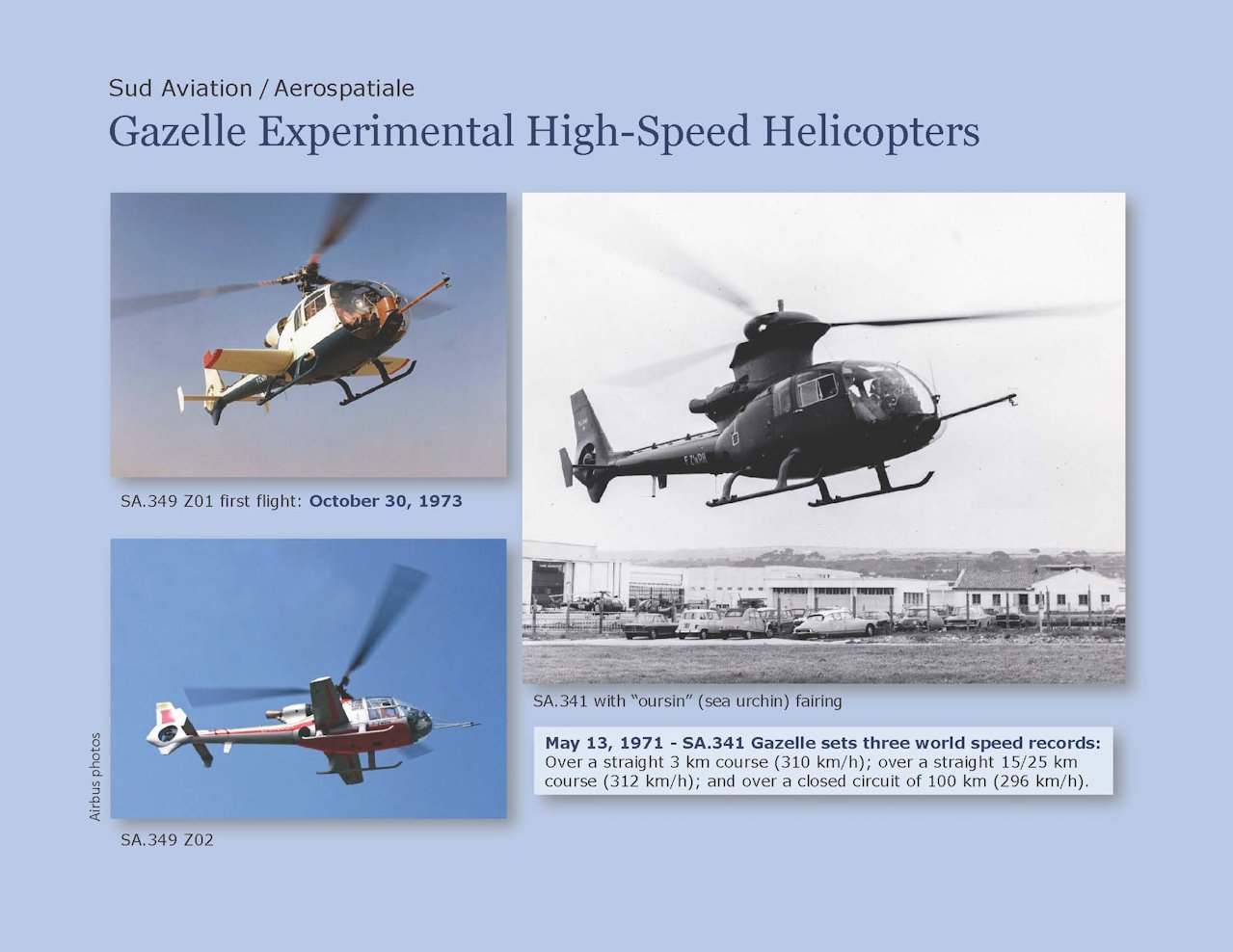
The SA 341-01 F-ZWRH piloted by Denis Prost together with Jean-Marie Besse set three FAI Class E.1.c records on May 13 and 14, 1971:
- 310 km/h (167.4 kt) in straight line over a 3-km (1.6 nm) course
- 312 km/h (168.5 kt) in a straight line over a 15/25-km (8.0/13.5-kt) course
- 296 km/h (159.8 kt) over a 100-km (54.0 nm) closed circuit
The aircraft had received the following modifications: streamlined mast called “Soc” (ploughshare), streamlined rotor head called “Oursin” (sea urchin), improved streamlining of the skids, fiberglass blades, rotor hydraulic dampers replaced by viscous elastic adapters, and a semi-rigid rotor.
The SA 349 Z01 flew in 1973 with wings. Its purpose was to study high-speed flights for future anti-tank helicopters. The first test campaign led to a new version (Z02) in 1976 that reached 300 km/h. Its design mass was 4,400 lb (2 tonnes). Its wings were equipped with spoilers and ailerons. It was not pursued because of unsatisfactory autorotation characteristics.
During the 1980s, Z02, without wings, continued to test various rotors concepts, for example, the Biflex and Triflex rotor heads. The Biflex rotor head, flexible in flap and drag, was made of a composite glass/resin material. It was fitted with a feathering hinge at the end of each arm and drag deflections were damped by small hydraulic dampers. The Triflex rotor head had arms made of fiberglass embedded in an elastomer and was flexible in the flap, drag and feathering planes. Z02 is now in the French Army helicopter museum.
Interestingly, following an agreement between the French Ministry of Armed Forces and NASA, the data of those rotor tests were passed to NASA, which produced three reports in the late 1980s and early 1990s on hubs and blade loads based on these results. One of these reports refers to an advanced geometry rotor designed by Aerospatiale.
— Text by Yves Morier
Go back to the photo for last month or view the photo for next month
2025 History Calendar Index