

US Army/de Lackner YHO-2/HZ-1 Aerocycle One-Man Flying Platform
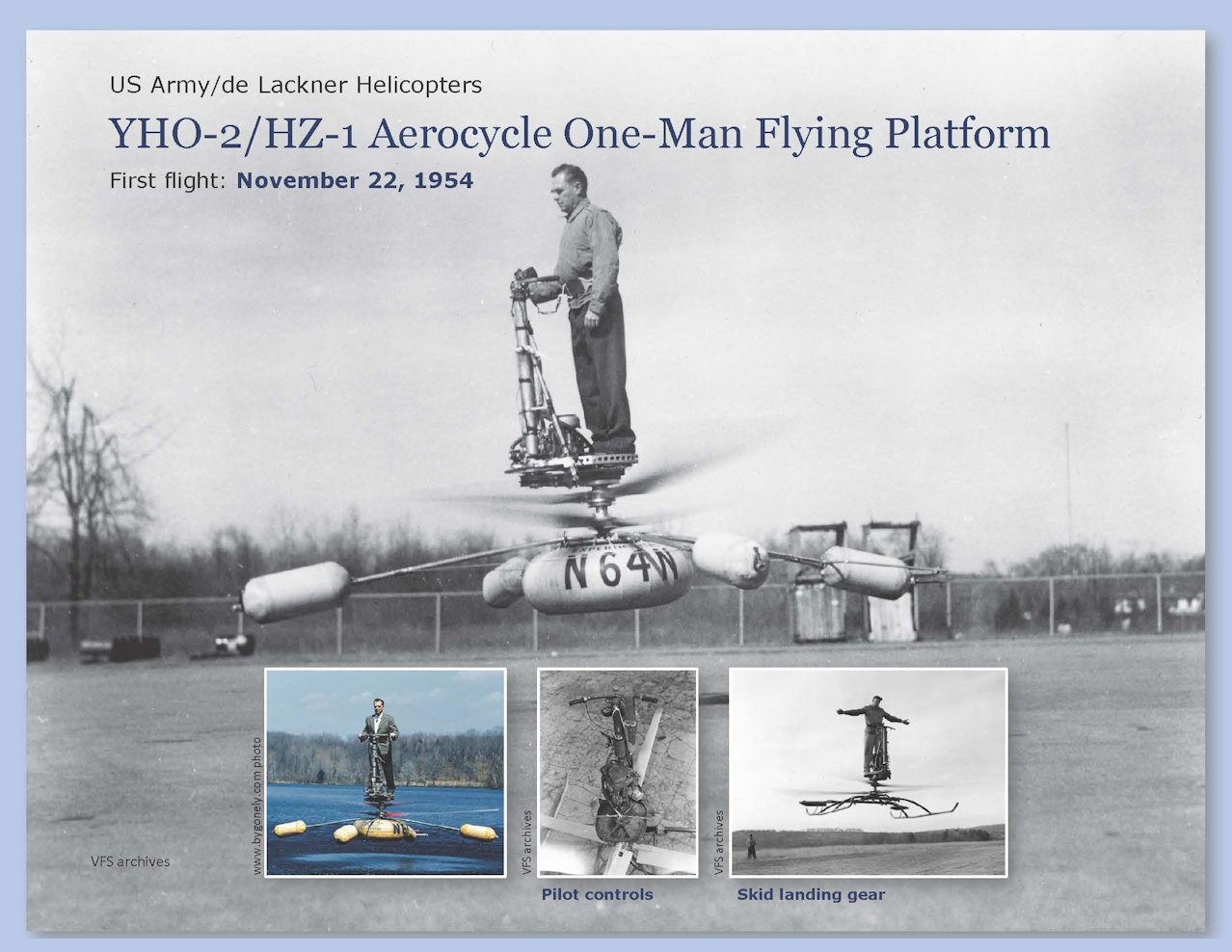
The Aerocycle was the brainchild of Helmut de Lackner, a visionary engineer determined to push the limits of aviation technology. Founded in the early 1950s in Mt. Vernon, New York, de Lackner Helicopters emerged during a period of rapid growth and innovation in the aviation industry. At the height of the Cold War, the US Army was actively exploring new methods for reconnaissance, mobility and rapid response. In response, de Lackner Helicopters created its DH-4 single-person vertical takeoff and landing (VTOL) aircraft that required little to no pilot training. Originally designated YHO-2 by the Army, the aircraft was later re-designated HZ-1 and named the "Aerocycle."
The Aerocycle carried a single pilot on a circular platform positioned just above two belt-driven, contra-rotating 15-ft (4.6-m) propellers. The throttle and basic instruments were attached to bicycle-type handlebars, fixed to a 3-ft (0.9-m) high pedestal atop the main platform. The pilot stood behind the pedestal and was secured to it with safety belts. An additional tether was installed to automatically cut the engine if the rider fell off. The craft was controlled through “kinesthetic control,” meaning the pilot leaned in the direction of travel.
Powered by a four-cylinder, water-cooled 43-hp (32-kW) Mercury outboard motor with a 5-gallon (18.9-l) fuel tank, the Aerocycle had a range of up to 50 miles (80.5 km). It was designed to fly at altitudes of up to 15 ft (4.6-m) and reach speeds of around 75 mph (120 mph), though it could theoretically ascend to 5,000 ft (1,525 m) and achieve speeds of over 85 mph (137 km/h) under optimal conditions.
Captain Selmer Sundby, an experienced Army pilot with more than 1,500 hours in fixed- and rotary-wing aircraft, served as the test pilot for the Aerocycle at Fort Eustis, Virginia, in 1956. Sundby volunteered for numerous test flights, ranging from mere seconds to one lasting almost 43 minutes. However, two crashes during the flight test program led to the project's cancellation in the same year.
Of the dozen Aerocycles ordered by the US Army, only one HZ-1 remains. This surviving example is currently displayed at the US Army Transportation Museum at Fort Eustis.
References:
- One-Man Amphibious 'Copter, Paramount News, circa 1955
- de Lackner HZ-1 Aerocycle, Wikipedia
— Text by Bob Beggs
Go back to the photo for last month or view the photo for next month
2025 History Calendar Index