

Unither Bioelectronics Electric Helicopter Research
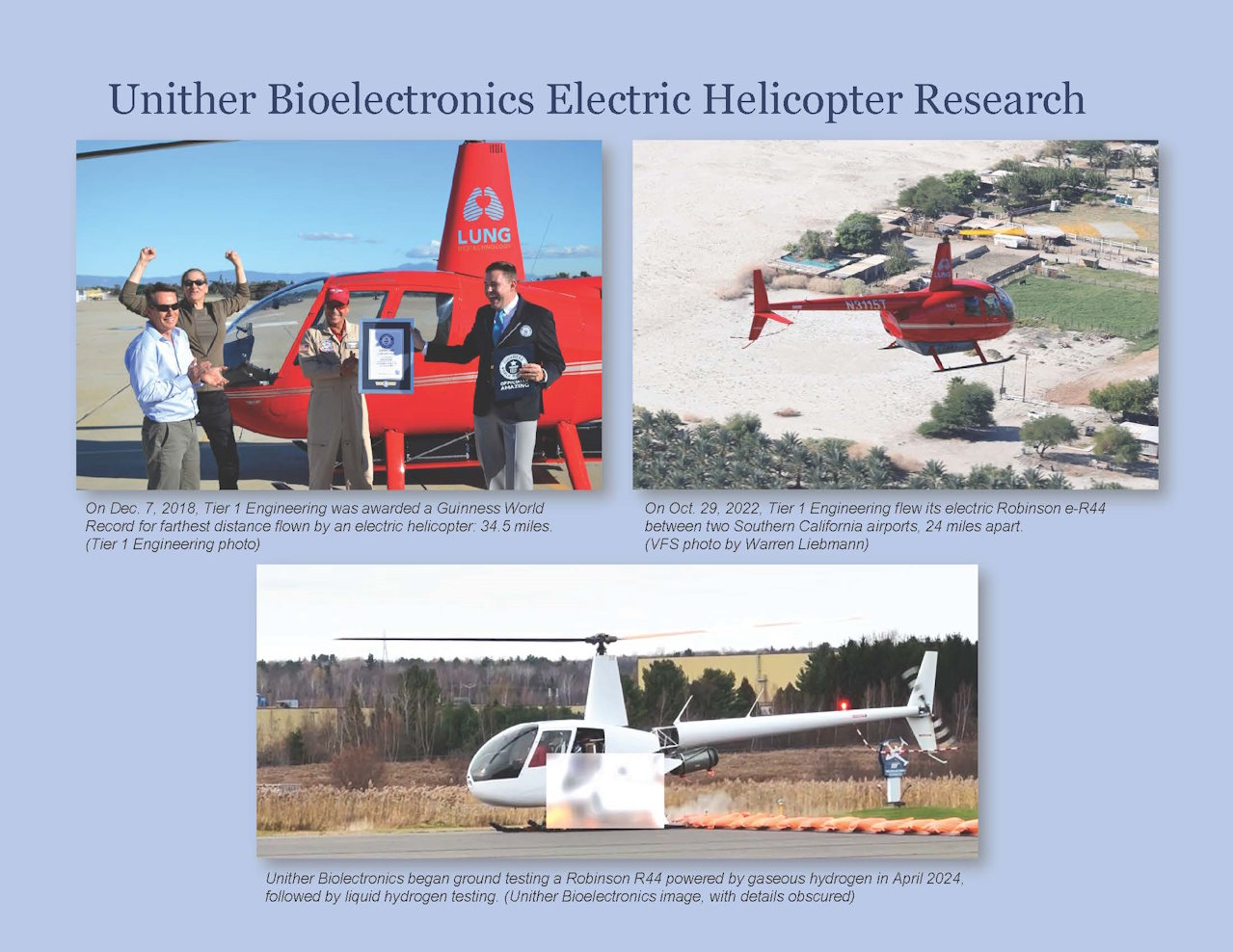
When Dr. Martine Rothblatt, founder and CEO of United Therapeutics (UT), first conceived of the idea of an electric rotorcraft that could deliver transplant organs to hospitals in 2015, her outreach to large aerospace companies was greeted with skepticism.
That led Rothblatt to partner with Glen Dromgoole, President of Tier 1 Engineering of Santa Ana, California, who produced a feasibility study for an electric rotorcraft configured to transport human organs, which became known as the Electrically Powered Semi-Autonomous Rotorcraft for Organ Delivery (EPSAROD). The study led Rothblatt to be an investor in several eVTOL aircraft developers (see the cover description) with the hope that at least 1 would be commercially viable.
To validate the performance of an electric rotorcraft in practice, UT subsidiary Lung Biotechnology PBC contracted Tier 1 Engineering to retrofit the popular Robinson R44 Raven II helicopter with a battery-electric propulsion system built using commercial off-the-shelf components in 2016.
The helicopter’s 260-hp (190-kW) Lycoming IO-540-AE1A5, accessories and complete fuel system were removed and replaced with two early YASA Motors (now Evolito) P400HC axial-flux electric motors packaged together with a common driveshaft, 11 battery modules totaling 1,100 lb (500 kg) from electric motorcycle maker Brammo of Oregon, Washington, inverter/motor controllers provided by Formula 1 hybrid-electric supplier Rinehart Motion Systems of Oregon, and the 2:1 reduction gearbox from Autoflight New Zealand.
The first ground run of the e-R44 (N3115T) took place at John Wayne Airport in Orange County, California, in July 2016. Then, the e-R44 was trailered to Los Alamitos Army Airfield (KSLI). That’s where test pilot Ric Webb made the first hover on Sept. 13, 2016, its first hover-taxi the following day, and a record five-minute cruise flight on Sept. 21, using 20% of the battery energy.
A licensed airplane and helicopter pilot, Rothblatt actively participated in the test flight activity, including the world’s first two-pilot electric helicopter flight in February 2018, were the battery weight was reduced by 18% to allow Rothblatt to fly with Webb.
Dec. 7, 2018, the Tier 1 Engineering team achieved a Guinness World Record for the farthest distance traveled by an electric helicopter. The flight covered 30.7 nm (56.87 km) at an average speed of 80 kt (148 km/h) over a circular course entirely within the confines of the Los Alamitos military base, and which was witnessed by an official adjudicator.
Webb flew the second-generation e-R44 (N484AK) for the first time at Los Alamitos on July 26, 2021, with the new, 800-lb (360-kg) battery pack providing the same power and endurance as the 1,100-lb (500-kg) battery pack on the original e-R44.
This aircraft was also part of first eVTOL aircraft display, held after the 9th Annual VFS Electric VTOL Symposium at the Hiller Aviation Museum at San Carlos Airport, California, on Jan. 28, 2022. The e-R44 featuring tie downs for an organ handling system in place of the rear seats.
Development of a third-generation e-R44 was launched during COVID-19 as a commercial product targeted for a supplemental type certification (STC), eliminating the lead pollution of aviation gasoline (avgas) engines. The magniX magni350 electric motor was selected to power the e-R44 design. On Oct. 27, 2021, the US Federal Aviation Administration (FAA) special conditions for the Part 33 certification of the magniX magni350 and magni650 models went into effect.
The initial ground runs of the third-generation e-R44 began behind the Tier 1 Engineering offices in Santa Ana on March 31, 2022, with the Tier 1 Engineering team performing system checks to validate the cooling system and engine controls of the engine. The first flight at Los Alamitos on June 4 lasted three minutes, with Webb and Rothblatt once again at the controls.
The prototype magni250 and production magni350 are about twice the diameter of the original YASA motor but produce more torque and better match the output rpm of the R44’s original Lycoming engine. This allowed Tier 1 Engineering to simplify the rotor drive system on the third-generation e-R44 by replacing the engine reduction gearbox (required for the 5,600 rpm YASA motor), as well as the R44’s original vee-belt drive and automatic tensi1r with a synchronous belt drive.
A major highlight of the program occurred in the scenic Coachella Valley of California on Oct. 29, 2022, when Webb and Rothblatt made the world’s first all-electric cross-country helicopter flight.
The helicopter took off from Jacqueline Cochran Airport (KTRM) and landed at Palm Springs International Airport (KPSP), covering the FAA-approved 24-mile (39-km) route in a flight time of 20 minutes, with the battery cells at a 50% state of charge (SOC) on landing for meet the FAA-mandated reserves.
“This was the first-ever electric-helicopter flight between two cities and between two airports,” said Rothblatt, adding that it demonstrated that “it is practical to deliver transplantable organs by electric helicopters from hospital to hospital.”
The flight also marked the culmination of battery-electric e-R44 development in California. The next chapter in the aircraft’s development would be led by Unither Bioelectronics, another UT subsidiary, based in Bromont, Quebec, with the goal of ground-testing and eventually flying a Robinson e-R44 converted to run on liquid hydrogen fuel cells.
Unither Bioelectronics acquired its own R44 Raven II, registration C-FXUB, in May 2022. By May 2024, the proof-of-concept H2eR44 — with two low-temperature proton exchange membrane (PEM) fuel cell stacks, a booster battery pack and a vacuum-insulated liquid hydrogen composite tank mounted under the tailboom — on the ramp outside the Unither hangar at Bromont Airport, about an hour east of Montreal.
Using off-the-shelf comp1nts, this aircraft is intended to inform Unither decisions regarding the technology required for a certifiable aircraft.
Rothblatt said that Unither’s pivot to hydrogen fuel-cell development was mapped out on the day the e-R44 made its cross-country flight to Palm Springs, adding that “when you’re doing technology development, it’s very wise to have multiple shots on goal, because it’s very hard to predict the exact course of any given technology’s development, because it depends on so many other streams of technology pouring in, not to mention regulatory factors as well.”
One of the mission requirements for an aircraft employed by the United Therapeutics Organ Delivery System is enough range to fly between organ manufacturing facilities and transplant hospitals, and Unither didn’t see battery chemistry evolving fast enough for an electric helicopter. However, “we realized that… all of the work that we’ve been doing on motor development… can be pushed to much greater ranges… if we shifted from batteries to hydrogen fuel cells.”
The groundbreaking work developing an electric R44 has been closely followed by Robinson Helicopter Corp. since 2015.
However, the relationship entered a new phase in August 2024 when new Robinson President and CEO David Smith announced his company had signed a collaborative agreement with Unither Bioelectronics to help accelerate the development and certification of hydrogen-powered versions of the popular R44 and R66 helicopter models.
Smith, who joined Robinson in 2023 as vice president of operations, was named president and CEO in February 2024.
“We believe the time is now right for RHC to offer our resources and experience to drive the certification and production of the first generation of zero emission certified rotorcraft,” said Smith. “This is also a fantastic project with an incredibly inspiring mission. We are proud to team with UT on this lifesaving and historic effort.”
“This collaboration combines Robinson’s expertise in helicopter design to certify aircraft with Unither’s hydrogen-electric vertical lift technology,” the company posted on social media. “Together, we’re working to make rapid, zero-emission organ transport a reality, advancing the role of vertical lift technology in medicine and ultimately saving more lives.”
Rothblatt sees the larger R66 Turbine — with a maximum takeoff weight of 2,700 lb (1.2 tonnes) — as an ideal candidate for hydrogen-electric power, but most of the company’s research work in electric propulsion has, to date, utilized the 2,500-lb (1,135-kg) R44 Raven II.
Rothblatt recalled that in early meetings with Mikaël Cardinal, the Vice President of Program Management and Organ Delivery Systems and Head of United Therapeutics Organ Delivery Systems (UTODS), more than eight years ago, they recognized that “Canada, and especially Québec, is a perfect nursery… for an electric aviation program because it has an overlap of the two key ecosystems that you need for electric aviation.”
UT speaks of two ecosystems in Quebec. One is aerospace and the other is hydroelectric power. Québec is a world center of excellence and home for major aircraft original equipment manufacturers (OEMs), such as Bell and Bombardier Aerospace, which were supported by “great regulatory expertise.” Meanwhile, Hydro-Québec is the third largest hydropower producer in the world, “which has been a green electric-power producer from the very beginning.” Rothblatt believes that Hydro-Québec’s exclusive reliance on hydroelectric power generation also positions the utility to be “the greatest source of green hydrogen… in the Americas.”
On the biomedical front, UT is on the cusp of delivering to a hospital its 500th donated lungs refurbished through ex vivo lung perfusion (EVLP) — an innovative therapy applied to donor lungs outside of the body — for transplant, said Rothblatt in an August 2024 interview with VFS, adding that over the past few years there have been multiple xeno-kidney and xeno-heart transplants.
The US Food and Drug Administration (FDA) recently approved a clinical trial of a Unither bioengineered-organ for the first time, notably an investigational-stage external liver assist product (ELAP) that is designed to provide liver support in critical care settings.
References:
- Tier 1 Engineering Reveals its Second Battery-Electric Robinson R44 Helicopter, Vertiflite, Sept/Oct 2021.
- Tier 1 Engineering Pioneers Electric e-R44, Vertiflite, July/Aug 2022
- Hydrogen Begins to Take Off, Vertiflite, July/Aug 2024
- Unither Bioelectronics and Robinson Helicopter Partner on Hydrogen, Vertiflite, Sept/Oct 2024
— Text by Ken Swartz
Go back to the photo for last month or go to the bonus photo.
2025 History Calendar Index