

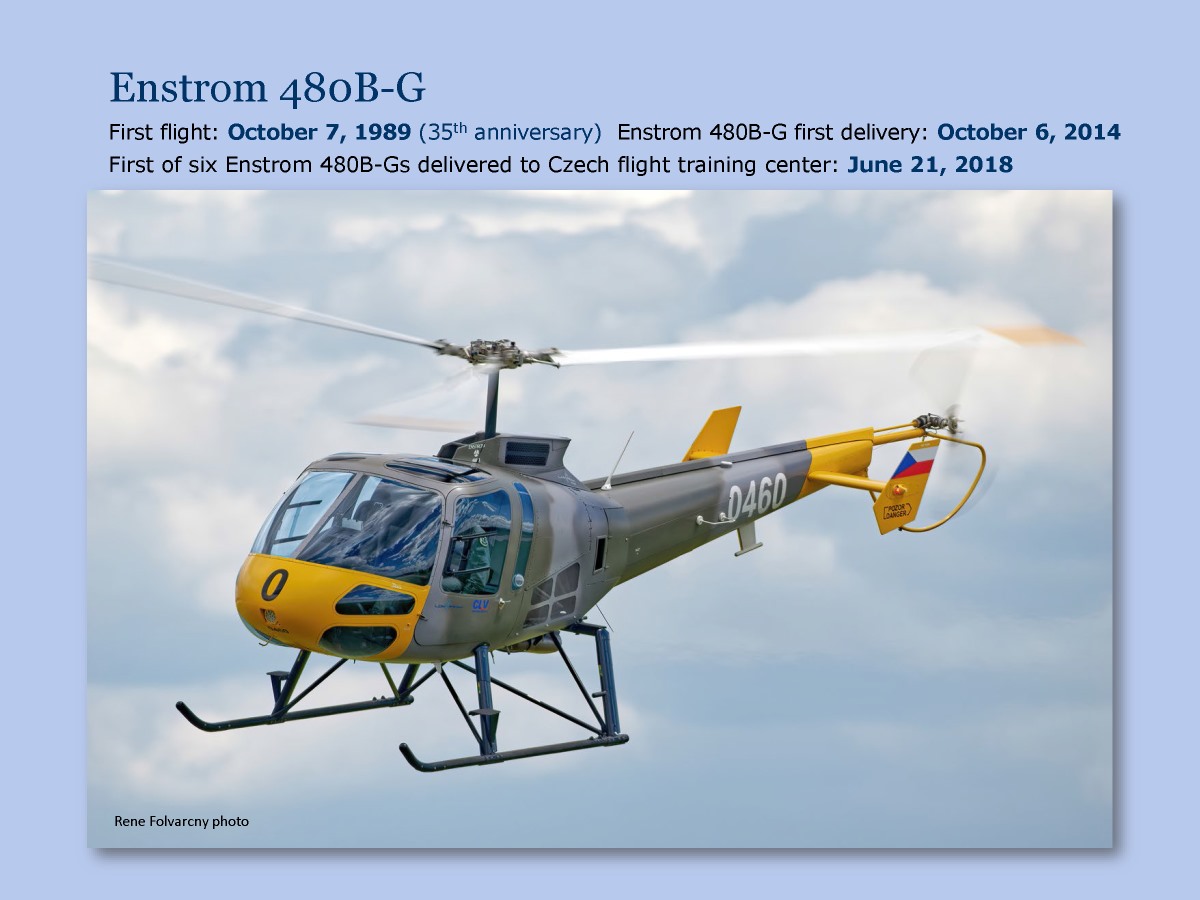
 Enstrom Model 480B Helicopter
Based on the success of the Enstrom Model TH-28 Helicopter, Enstrom Helicopter Corporation developed a derivative of the 280FX powered with an Allison 250-C20W turbine engine and equipped with a larger cabin with a five-person capacity. The Model 480 Helicopter was FAA-certified on Aug. 12, 1996. The Model 480B Helicopter is a derivative of the 480, developed for US Army New Training Helicopter (NTH) requirements with increased gross weight from 2,850 lb (1,293 kg) to 3,000 lb (1,360 kg) and a power limit of 285 hp (212 kW) to 305 hp (227 kW) at takeoff with a Rolls-Royce 250-C20W engine, certified FAA Part 27 on Feb. 8, 2001. The Model 480B Helicopter has a minimum of one crew and can carry up to four passengers. Like the Enstrom F-28 and 280 helicopters, the 480B has a fully articulated main rotor assembly with a larger diameter of 32.2 ft (9.8 m) from 32 ft (9.7 m) and three metallic blades. Its two-bladed tail rotor has a 5-ft (1.5-m) diameter. A tail guard is equipped to protect the rotor. To ensure a high speed of 144 mph Vne (231 km/h), it has a fixed stabilizer, a trailing edge tilted downward relative to the aircraft's water line and two vertical fins. An energy-absorbing landing gear is installed for emergency landing. Unlike conventional helicopters, the Enstrom helicopter models, such as 480B’s main rotor push-pull rods, are housed inside the main rotor shaft, which reduces the helicopter rotor flat plate drag and foreign object damage.
Resources:
- Enstrom 480, Vertipedia, Vertical Flight Society
- Enstrom 480B, Vertipedia, Vertical Flight Society
Photo by Rene Folvarcny
Description by Jacques Virasak
Go back to the photo for last month or go to the next month.
2024 History Calendar Index