

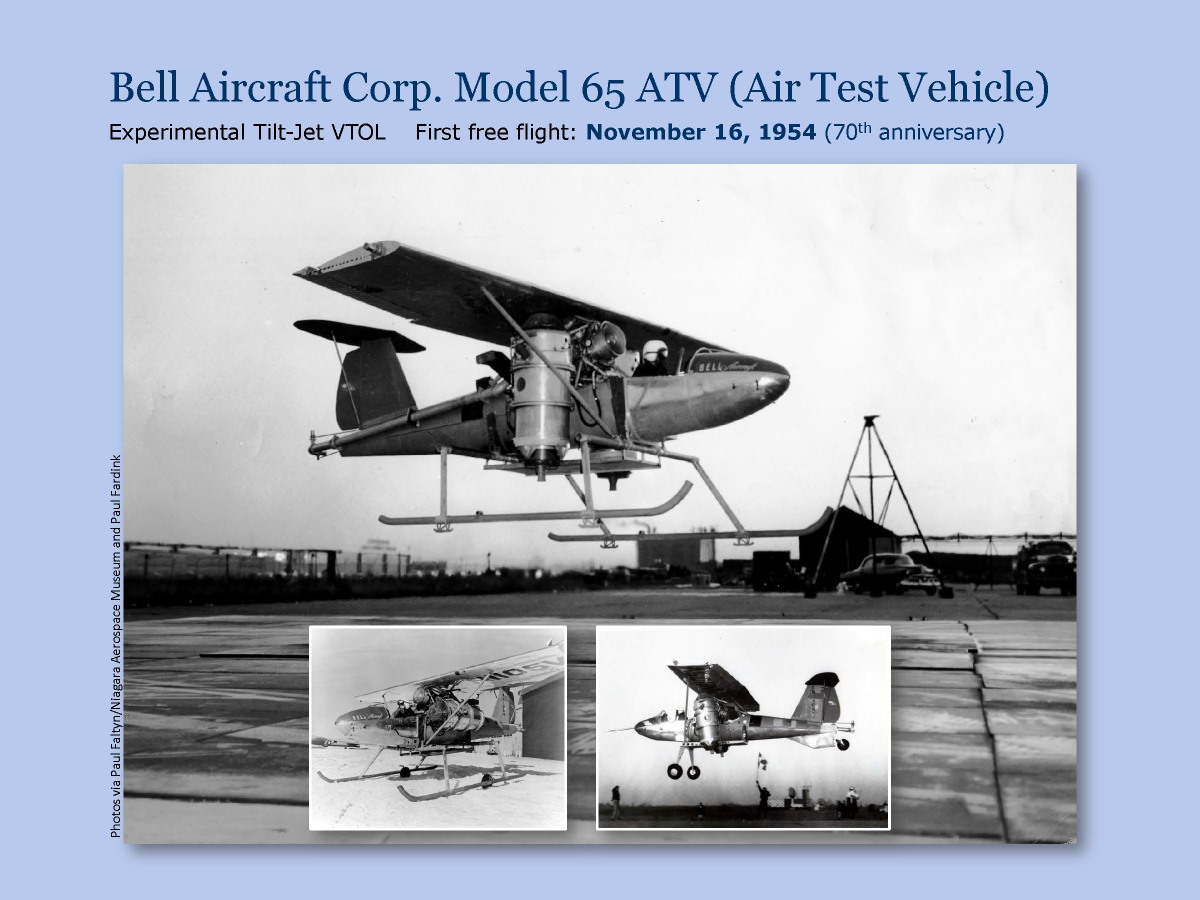
 Bell Model 65 Air Test Vehicle (ATV)
The Bell Model 65 ATV (or Air Test Vehicle) was a true vertical flight pioneer in every sense of the word. Unsurprisingly, Bell engineers designed and later manufactured this unique aircraft at Bell’s Niagara Falls, NY, facilities; thereby living up to their reputation of building “ahead of their time” aircraft such as the XP-59, X-1, X-2, XV-3, X-22A, etc. The Bell ATV was the first crewed conventional V/STOL aircraft that was not a powered rig that conducted a jet powered hover (powered lift) in the world, flying on Nov 16, 1954. It was ahead of many other V/STOL pioneers such as the vectored thrust aircraft that soon followed.
The quest for vertical flight was always a challenge for post-World War II aircraft manufacturers on both sides of the Atlantic; and dealing with meager funds and inter-service requirements rivalries in the post-war era was the norm. Because of the desire to minimize costs — and in keeping with Bell tradition — simplicity was the hallmark of the ATV. Bell used an open cockpit fuselage from a Schweizer T-tailed glider, a Cessna 170 wing, two borrowed tilting turbojets from the US Air Force and a Bell 47 landing gear skid assembly. The twin engines were manufactured by Fairchild (J44s) and capable of 1,100 lb (499 kg) of thrust each. Engines were tilted to the vertical position about the center of gravity of the aircraft and on either side of the fuselage. The engines tilted in unison.
Obviously, for hover flight, the ATV had a maximum gross weight of 2,046 lb (908 kg). The 36-ft (11-m) wings of the Cessna 170 wings were clipped 5 ft (1.5 m) on either side giving the ATV a wingspan of 26 ft (7.9 m). The overall length was 21 ft (6.4 m).
A Continental-Turboméca Palouste turbocompressor (based on the Turboméca Palouste 4A) was installed on the upper fuselage behind the single seat cockpit area and provided compressed (bleed) air (2.4 lb/s or 1.09 kg/s) to the reaction controls on both the wing tips (for lateral control) and the tail cone. The tail cone “puffer” could pitch the aircraft up or down and provided yaw control. These “puffer” jets allowed control of the aircraft on all axes during hover.
As noted above, the first free (untethered) hover took place on Nov. 16, 1954, in the hands of Bell experimental test pilot David Wayne Howe (1919-1995). Conventional flights were performed by the ATV towards the tail end of its test program (again, using a Cessna wheeled landing gear) to avoid the limitations of transitional flight as the engine thrust at altitude was not sufficient to allow full transitions from powered-lift to wing-borne flight. Eventually, only 4.5 hours of testing were completed in about 28-to-30 flights before the company-funded project ended in 1955. The lessons Bell learned with the ATV were intended to be applied on a future tilt-jet fighter project (Project D-188A) that never advanced beyond the mockup stage; but the control system found application on Bell’s next V/STOL project, the Bell X-14.
Today, this pioneering aircraft is in storage at the Smithsonian National Air and Space Museum Paul E. Garber facility in Maryland, awaiting restoration and display.
Resources:
- Bell Model 65 ATV, Vertipedia, Vertical Flight Society
- Bell Model 65 ATV (Air Test Vehicle), National Air and Space Museum website
- VTOL Military Research Aircraft, by Mike Rogers
- Straight Up: A History of Vertical Flight, by Steve Markman and Bill Holder
- Aircraft Engines of the World 1961/1962, by Paul H. Wilkinson
- Bell Aircraft since 1935, by A.J. Pelletier
Photos via Paul Faltyn/Niagara Aerospace Museum and Paul Fardink
Description by Erasmo Piñero
Go back to the photo for last month or view the photo for next month
2024 History Calendar Index