

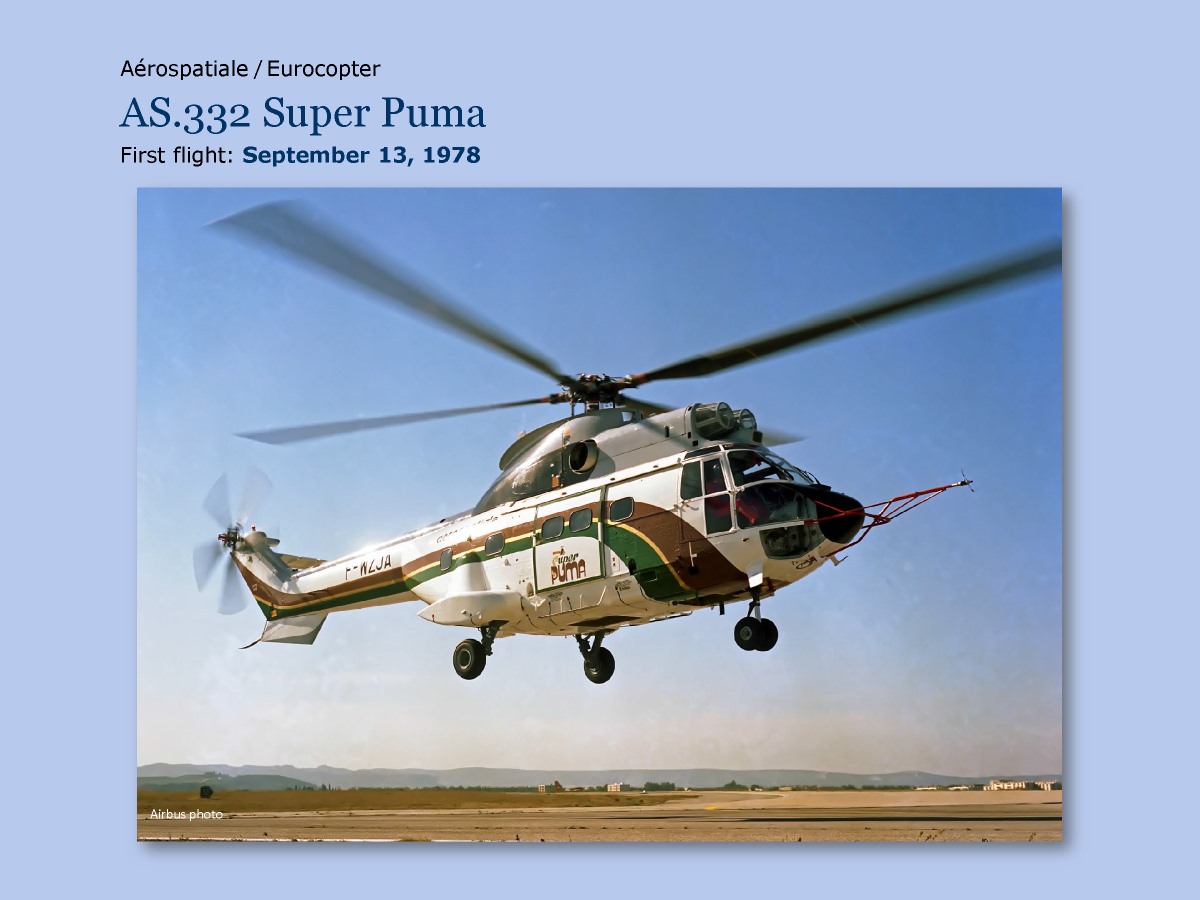
 AS 332 Super Puma
The AS 332 Super Puma is chronologically the second member of a family of very successful medium-lift multi-purpose twin-engine helicopters, with the two other members being the SA 330 Puma and the EC 225. The three models are on the same EASA type certificate (No. EASA.R.002). The models’ designators reflect an history of mergers and of European cooperation: SA stands for Sud Aviation, which produced the Puma in cooperation with Westland; AS stands for Aerospatiale, which resulted from the merger of Nord and Sud Aviation (1970); and EC stands for Eurocopter, which resulted of the merger of Aerospatiale Helicopters and Messerschmitt-Bölkow-Blohm (MBB) in 1992. EC 225 became H225 in 2016 after Eurocopter became Airbus Helicopters (2014).
The AS 332 is derived from the SA 330 Puma that first flew in 1965 and was produced in eight versions. The latest — SA 330J — was certificated using FAR 29 by the French Authorities in 1976. Powered by two Turbomeca Turmo IV C of 1,100 kW (1,495 shp), it had a maximum take-off mass of 7,400 kg (16,314 lb) and could carry 19 passengers. Of the SA 330, there were 697 aircraft produced.
The AS 332 first flew in 1978. It has two versions: the Super Puma Mark I and the Super Puma Mark II. Both versions included, the total production amounts to 1,000 aircraft.
- The Super-Puma Mark I includes two sub-versions: short fuselage (AS 332 C and C1) and long fuselage (AS 332 L and L1) models. The C and L models were certificated using FAR 29 as a basis by the French Authorities in 1981 and the model C1 and L1 in 1985. The models C and L are powered by the 1,130-kW (1,536-shp) Turbomeca Makila 1A and the models C1 and L1 by the 1,185-kW (1,611-shp) Makila 1A1. It incorporates a Starflex rotor mast. Its maximum take-off mass is 8,300/8,600 kg (18,300 lb/18,960 lb), maximum speed is 268 km/h (167 mph) and range 840 km (521 mi). Passenger capacity is unchanged at 19 for the model C and C1 but increased to 24 for the models L and L1. The versions equipped with Advanced Helicopter Cockpit Avionics System (AHCAS) are designated AS 332 C1e and L1e and became H215 in 2016.
- The Super Puma Mark II flew in 1987. It was certificated by the French Authorities in 1991 still using FAR 29 as a basis. It is powered by Safran Makila 1A2 engines of 1,236 kW (1,680 shp). It is equipped with Spheriflex rotor mast and longer blades with an improved tip design. It has a maximum take-off mass of 9,300 kg (20,500 lb) and can carry 25 passengers. It has a maximum speed of 275 km/h (171 mph) and a range of 840 km (521 mi).
Finally, the EC 225 first flew in 2000 and was certificated by the European Union Aviation Safety Agency (EASA) in 2004 using as a basis the Joint Aviation Requirement 29 (JAR 29), today Certification Specification CS-29. It is powered by Makila 2A or 2A1 engines of 1303 kW (1,771 shp). It has a five-bladed main rotor instead of the four-bladed main rotors of the SA 330 and AS 332. It has a maximum take-off mass of 11,000/11,160 kg (24,250 lb/24,603 lb) and can carry 25 passengers. It has a maximum speed of 305 km/h (189 mph) and a range of 870 km (540 mi). Total production amounts to 170 aircraft.
Note: All engine regimes are maximum continuous power with all engines operating. Turbomeca became Safran Helicopter Engines in 2016 after having joined the Safran group in 2005.
Airbus photo
Description by Yves Morier
Resources:
- Eurocopter AS332 Super Puma, Wikipedia
- Airbus Helicopters AS332 C Super Puma Mk I, Vertipedia, Vertical Flight Society
- Airbus Helicopters AS332 C1 Super Puma Mk I, Vertipedia, Vertical Flight Society
- Airbus Helicopters AS332 L Super Puma Mk I, Vertipedia, Vertical Flight Society
- Airbus Helicopters AS332 L1 Super Puma Mk I, Vertipedia, Vertical Flight Society
- Airbus Helicopters AS332 L2 Super Puma Mk II, Vertipedia, Vertical Flight Society
Go back to the photo for last month or view the photo for next month
2024 History Calendar Index