

US Navy/Boeing Vertol
C/UH-46D
Sea Knight
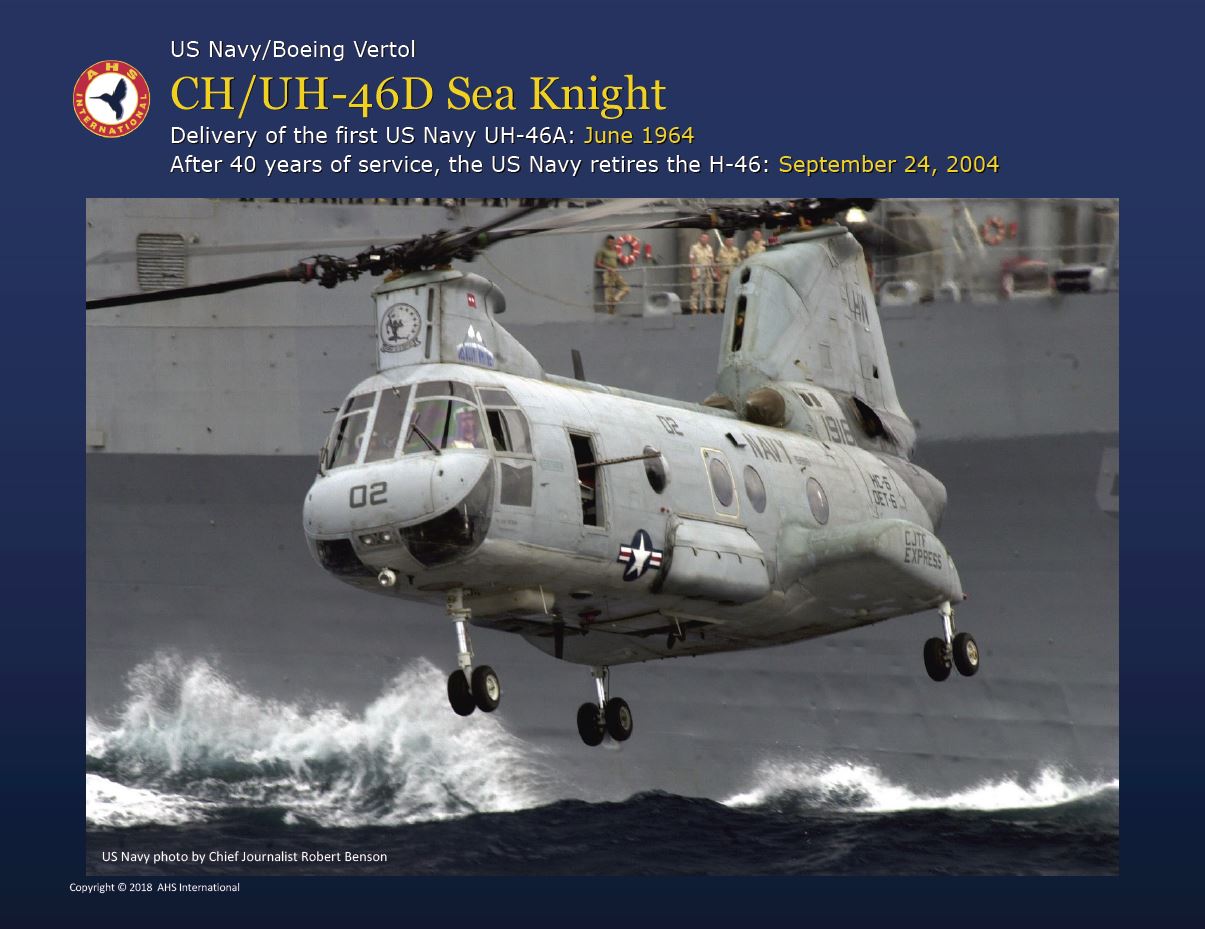
Delivery of the first US Navy UH-46A: June 1964
After 40 years of service, the US Navy retires the H-46: September
24, 2004
On Sept. 24, 2004, the US Navy held retirement ceremonies in Norfolk, Virginia and San Diego, California for the Boeing H-46D Sea Knight. The aircraft, first delivered to the Navy in June 1964 as the UH-46A, had served for over 40 years in a utility and cargo delivery role with one of the key missions performed being a ship-to-ship cargo transfer known as Vertical Replenishment, or VertRep, that became known as “the 46 dance.” The aircraft would carry external pallets of “beans and bullets” (mail, food, water, spare parts, or ammunition) slung on the aircraft cargo hook to delivery areas on the ships at sea.
The tandem-rotor configuration enabled the Sea Knight to perform this at-sea aerial ballet without regard to wind direction or weather conditions while the ships remained underway. Prior to helicopters completing this cargo resupply mission, the vessels had slowed their speed and joined alongside and moved cargo or personnel via wire cables stretched and attached between them.
In addition to the VertRep cargo mission, the H-46 served in a fleet logistics support role, special warfare missions, conducted medical evacuations and search and rescue missions.
Based on the Vertol Aircraft Corp. company-funded, twin turbine-powered Model 107 prototype which flew in April 1958, the Marines received the majority of the H-46 Sea Knights produced in the US with the first US Marine Corps 107M/HRB-1 (later CH-46A) flight taking place in August 1962. They were utilized in the troop lift and amphibious assault/support role until their retirement from the Marine Corps in August 2015.
The Navy-administered procurement and competition for the new Marine Corps assault helicopter was won by the Vertol Division of Boeing in February 1961 and as part of the contract awarded in September 1961, the Navy ordered ten UH-46As for the utility role, then converted fifty USMC CH-46As for the search and rescue (SAR) role as HH-46As. Later, these A’s were upgraded to HH-46Ds for the combat supply and rescue missions. Some CH-46Fs also served in the Navy utility role.
All subsequent H-46s were upgraded at Marine Corps depots through several Navy/Marine Corps/Boeing modification and upgrade programs starting in the mid-1970s and continuing into the mid-1990s. A fiberglass rotor blade replacement program also took place with USMC CH-46E Sea Knights getting the first composite blades in the late 1970s. Many of the H-46 airframes reached over 10,000 flight hours.
CH-46s were powered by two GE T58 turboshaft engines with the engines buried on each side of the rear rotor pylon with a driveshaft to the forward rotor. The engines were coupled so either could power both rotors in an emergency. The 51-foot diameter, three-bladed rotors included powered blade folding. With the blades folded over the fuselage, the compact size made it ideal for shipboard use and stowage; on-deck or in the hangar deck.
With a crew of three, the CH-46A could carry 17-20 troops or passengers; or 15 litters with two attendants; or 4,000 lb (1,815 kg) of cargo. It had a 24-ft long x 6-ft high x 6-ft wide (7.3 m x 1.8 m x 1.8 m) cargo bay with a rear loading ramp that could be left open in flight for extended cargo or for parachute drops. An internal winch system and rollers in the floor enabled easier cargo loading. The Navy U/CH-46 also featured an external rescue hoist as well as the USMC HH-46D/Es SAR helicopters. A belly-mounted sling cargo hook could be used for carrying externally slung loads. A pintle-mounted 0.50-in. (12.7 mm) machine gun was mounted on each side of the helicopter for self-defense.
The CH-46 had fixed tricycle landing gear with the configuration causing a nose-up stance to facilitate cargo loading/unloading from the ramp. The main gear was fitted in rear sponsons that also contained fuel tanks with a total capacity of 350 US gallons (1325 liters).
After the Sea Knight’s retirement, the US Navy’s Military Sealift Command hired commercial airlift firms to provide logistics and vertical replenishment services along with US Navy/Sikorsky S/MH-60 helicopters.
Main
photo: US Navy photo by Chief Journalist Robert Benson
Text:
Ken Bartie
Go back to the photo for last month or view the photo for next month
2018 History Calendar Index