

Indian Air Force/Hindustan Aeronautics Limited (HAL)
Light Combat Helicopter (LCH)
LCH Technology Demonstrators (TD)
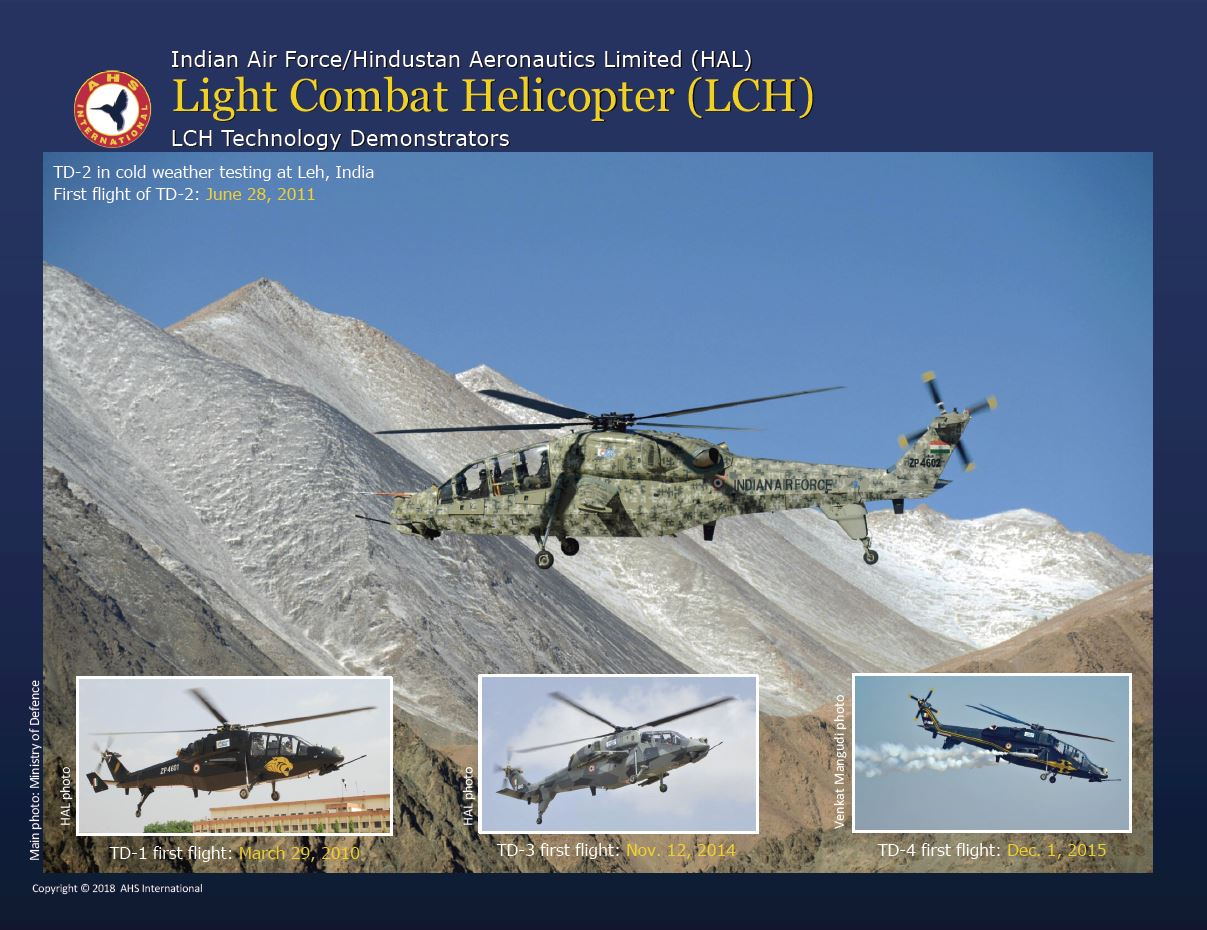
The indigenous Light Combat Helicopter (LCH), a derivative of the HAL Dhruv, is designed to meet the operational requirements of the Indian Air Force (IAF) and Army in both offensive and air defense roles, including close air support, anti-infantry and anti-armor. Four prototype aircraft have been built:
- TD-1: ZP4601 — black with lion. First flight: March 29, 2010
- TD-2: ZP4602 — digital camo. First flight: June 28, 2011
- TD-3: ZP4603 — grey camo. First flight: Nov. 12, 2014
- TD-4: ZP4604 — black with trident. First flight: Dec. 1, 2015
The 5.5-ton class LCH has a sleek and narrow fuselage, tri-cycle crashworthy landing gear, crashworthy and self-sealing fuel tanks, armor protection, and low visibility features — all of which make the LCH lethal, agile and survivable.
The aircraft was originally conceived as the Light Attack Helicopter (LAH) in 1989, based on initial IAF requirements. In August 2003, however, the IAF issued a new Air Staff Requirement, this time designated the Light Combat Helicopter program. This requirement was approved by the Defence Acquisition Council in January 2006 and given a go-ahead by the Ministry of Defence that October. A new full-scale mock-up was displayed at Aero India 2007, although there were some significant differences from the final design, which was frozen in March 2008.
Using the same rotor system and engines as the Dhruv, the LCH is similarly designed for operations at India’s extreme altitudes. The two HAL/Turbomeca Shakti engines produce 1032 kW (1385 shp) each. The 5,800 kg (12,790 lb) gross weight LCH is designed for take-offs in the Himalayas at up to 3 km (10,000 ft) and for a service ceiling of 6.5 km (21,300 ft).
The first LCH prototype, TD-1, began its first ground runs on February 4, 2010 and completed ground check-out testing over the next six weeks. HAL’s chief rotary wing test pilot — Wing Commander (ret.) Unni Pillai — and Group Captain (ret.) Hari Nair made the first flight at the HAL facility in Bangalore, India on March 29, 2010.
The second development aircraft, TD-2, was designed for weapons and missions systems testing. The third prototype, TD-3, was built to production standards and used for operational testing.
HAL expects orders to deliver 65 LCHs to the IAF and 114 to the Army, and believes that the LCH could have success in the export market as well. HAL received a Request for Proposal (RFP) for 15 Limited Series LCH from the IAF and the Indian Army on Dec. 22, 2017.
LCH has the distinction of being the first attack helicopter to land in forward bases at Siachen, 17,700 ft (5,400 m) above sea level. The Siachen is the largest glacier in the Eastern Karakorum Ranges, sometimes called “The Third Pole” as it is the largest glacier region outside the arctic and Antarctica. TD-2 conducted cold soak operations, starting at an altitude of 13,500 ft (4,100 m) after overnight temperatures fell to 0°F (-18°). TD-3 conducted high altitude/hot temperature trials in Summer 2015 at Leh, in the Siachen, at temperatures of 53–90° F (12–27° C) with “reasonable” weapons and fuel loads.
The LCH was designed for high-altitude operations since the Indian military did not have such an attack helicopter during the 1999 Kargil War with Pakistan. The Kashmir region, on the Siachen glacier, is a disputed area of contention between the two countries.
Photos: India Ministry of Defence, HAL, and Venkat Mangudi
Text: Mike Hirschberg
Go back to the photo for last month or view the photo for next month
2018 History Calendar Index