

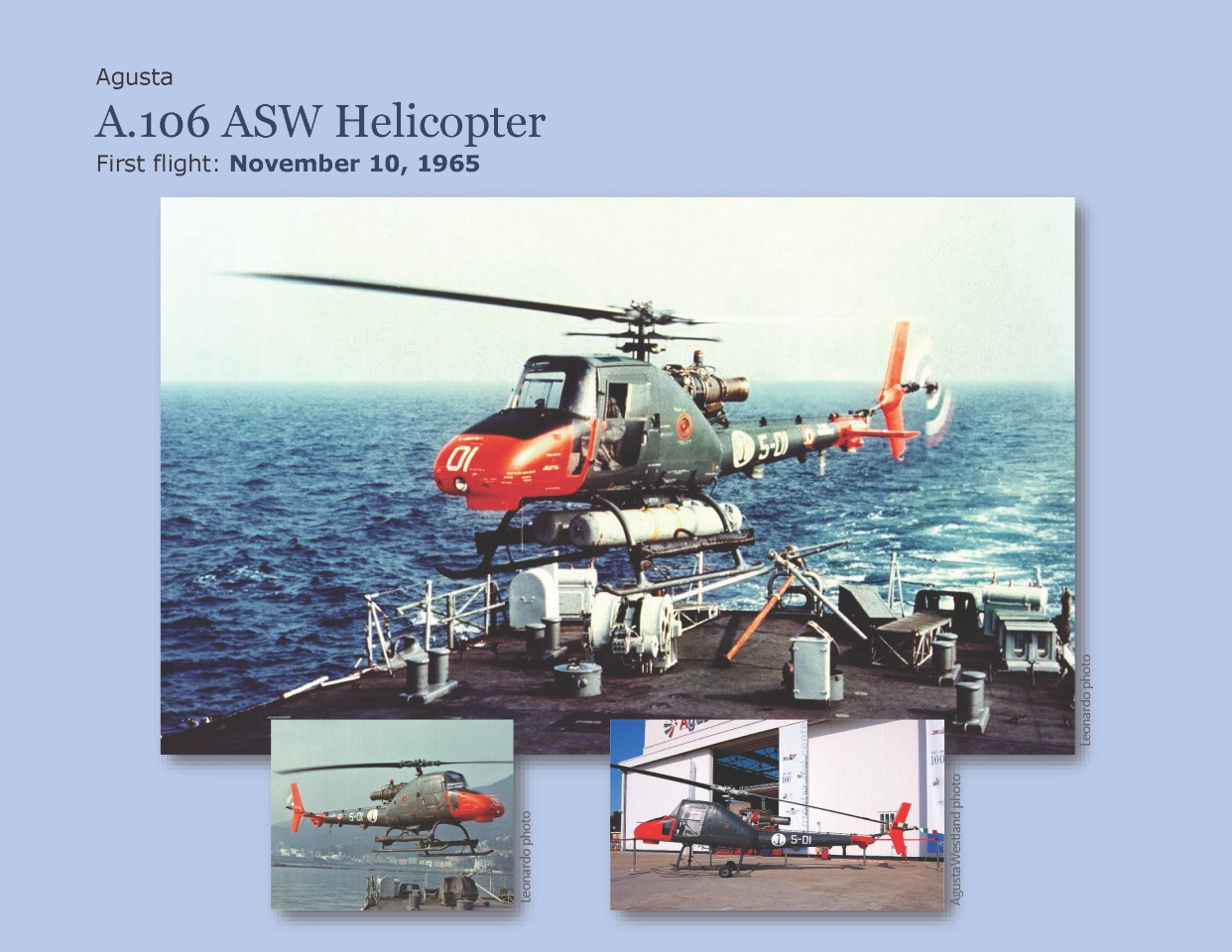
 Agusta A.106 ASW Helicopter
The first contacts with the Italian Navy on this program date back to 1961. The Navy wished to have a drone embarked on relatively small ships for “contact discrimination” and “weapon carrier missions” in the context of antisubmarine warfare (ASW). The helicopter was to act as a signal relay in order to determine if the contact was real or false; if real, the drone had to be able drop self-hunting Mk.46 anti-submarine torpedoes. For these requirements, Agusta proposed a turbine-powered drone named the A.108BT.
In those days technology for this type of operations and aircraft was not available. It had to be invented, so to develop the concept of operations and the platform, a small single-pilot helicopter was considered. Thus was born the idea of the A.106. The helicopter was to be foldable, and Turbomeca provided Agusta with a purposed-built simplified single-shaft turbine engine derived from the Astazou: the Turbomeca Agusta Astazou TAA 230 with 350 shp (260 kW). Agusta designed and built the gearbox with a special hydraulic clutch, accessory control and advanced mechanical features. This was the first Agusta’s very high-speed gearbox, and was the progenitor of the company’s later ones, like for the A.129 Mangusta. The study of the reducer began in Autumn 1962 and the first 50 hours of engine operation were successfully completed in January 1964.
The helicopter made its first flight on Nov. 9, 1965. After the necessary development and systems integration phase, two helicopters were built and delivered to the Navy, for operational test. This was conducted in July 1971 on the Intrepido frigate, both docked at the quay and in the open sea. The chief designer, Bruno Lovera, was on board and followed all the trials: it was a great opportunity to learn what was good or wrong. The helicopter interfaced well with the ship, and there were no particular problems. The Navy continued their tests but they concluded that the pilot's workload in particular sea conditions and at night was excessive and that the single pilot formula was unsustainable. On the other hand, for reasons of space on board, a two-seater formula was not feasible and therefore the program was definitively stopped.
A106 Main data:
- Crew: one
- Rotors: two-bladed main; two-bladed tail
- Main rotor diameter: 31.1 ft (9.50 m)
- Max takeoff weight: 3,000 lb (1,360 kg)
- Empty weight: 1,300 lb (590 kg)
- Payload: 1,480 lb (670 kg)
- Max power: 350 shp (260 kW)
- Vmax: 108 kt (200 km/h) at ISA sea level
- Vcruise: 100 kt (185 km/h) at ISA sea level
- Range: 150 nm (280 km) at ISA sea level
Description: Bruno Lovera
Photo credits: Leonardo, AgustaWestland
Go back to the photo for last month or view the photo for next month
2021 History Calendar Index