

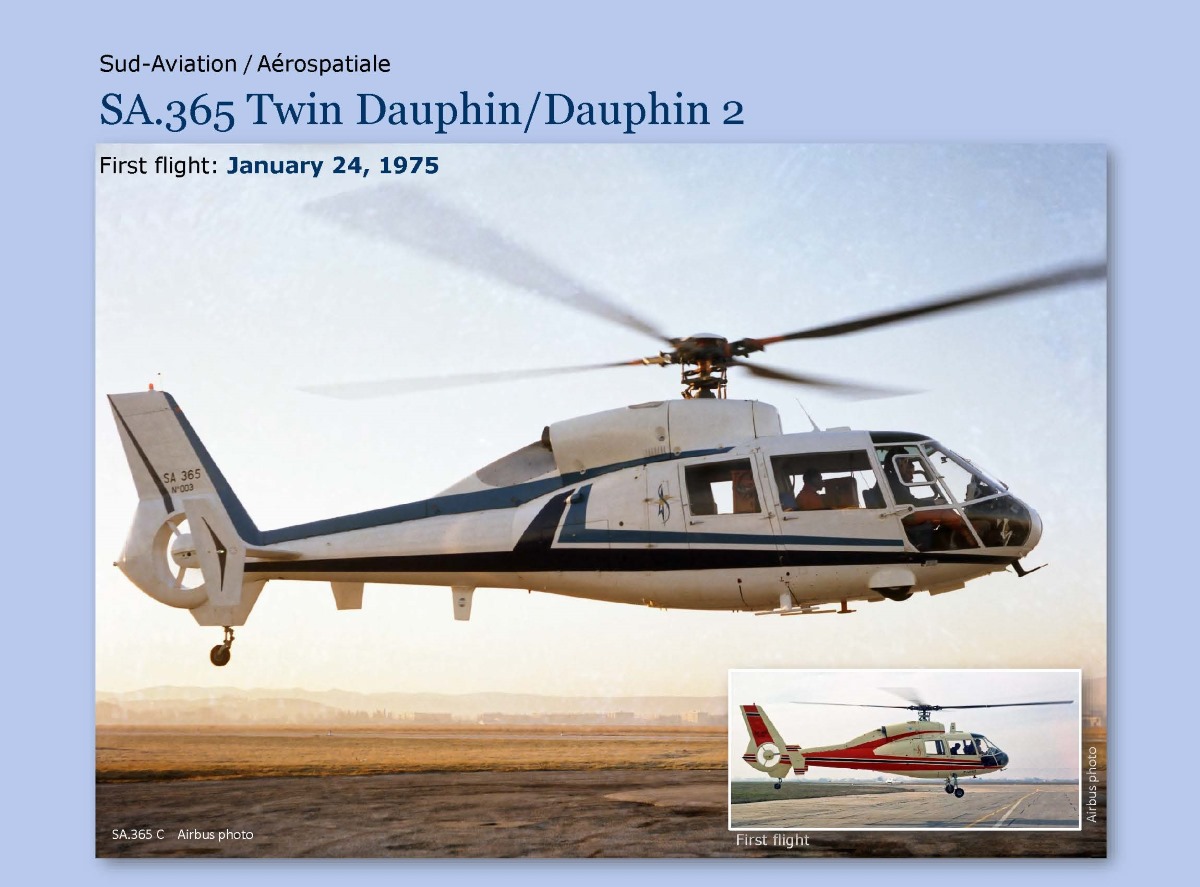
 January 2024: Sud-Aviation/Aérospatiale SA.365 Twin Dauphin/Dauphin 2
First flight: January 24, 1975
The French SA 365 Dauphin 2 is a medium-weight, long-range, hot-and-high-capable, multipurpose twin-engine helicopter that took off the ground first on Jan. 24, 1975, obtained certification in 1978 and was manufactured for more than 40 years. It was initially developed and produced by Aérospatiale (after merger with the German MBB to become Eurocopter in 1992, this is today’s Airbus Helicopters) as successor of the former model, the SA 360 Dauphin (first flight June 2, 1972). The Dauphin 2 prototype demonstrated an airspeed of 170 knots in level flight and set multiple speed records, among them the Paris-London trip at an average of 322 km/h.
The former SA 360 had a single engine and did not meet customers’ expectations, but the twin-engine Dauphin 2 became an extremely successful model and a cash-cow for its manufacturer. It has been operated by a wide variety of civil and military operators and has been widely used as a corporate transport, airborne law enforcement platform, emergency medical services (EMS) helicopter, electronic news gathering platform, and search and rescue helicopter. Many major variations and specialized versions of the Dauphin 2 have been developed and entered production, including the military-oriented Eurocopter Panther, the air-sea rescue HH/MH-65 Dolphin, the Chinese-manufactured Harbin Z-9 and the modernized Eurocopter EC155.
In 1982, the Dauphin 2 was succeeded by the more capable SA 365 N with more powerful engines, greater use of composite materials, a better cabin arrangement, and retractable landing gear. Further improvements were made with the introduction of the SA 365 N1, which had a substantially redesigned Fenestron anti-torque device, and with the SA 365 N2, which was equipped with more powerful Turbomeca Arriel 1C2 turboshaft engines; on later variants, these were equipped with FADEC units.
A special feature is the foldable Starflex main rotor. Main and tail rotors are driven via two separate transmissions and gearboxes with separate hydraulic systems as well as a stand-by hydraulic system for emergency use. The cabin area is reconfigurable with up to 12 passengers and two pilots. Various portions of the rotorcraft are made from composite materials, e.g. the rotor blades are made of carbon fiber. An optional hoist or cargo sling can be installed, various types of radar can be installed in the aircraft’s nose.
The combination of the rotorcraft’s Starflex main rotor and Fenestron tail provides low-noise and low-vibration characteristics; Airbus Helicopters has claimed it the quietest helicopter in its class. It can take off under a full load from sea level under Category A conditions. It can be flown by a single pilot under IFR conditions; this was achieved in part by avionics such as the four-axis Dual Digital Automatic Flight Control System to reduce crew workload. Other major avionics include large multi-mission touch screen displays, weather radar, global positioning system (GPS) receiver, traffic alert and collision avoidance system (TCAS), automatic voice alarm device (AVAD), health and usage monitoring system (HUMS), quick access records for helicopter flight data management, and digital audio communication system (DACS).
In 1985, a new AS365F model became the first rotorcraft in the world to fly with flight instruments being displayed in electronic displays instead of the traditional instrumentation. By 2011, more than 1,000 AS365/366/565 versions had been produced that were in service with over 300 operators worldwide; and as of 2014, the AS365 N variant of the Dauphin holds the world speed record for a 3-km (1.9-mile) course, set at 372 km/h (231 mph) in 1991.
Its successor is the Airbus Helicopters H160 with first flight on June 13, 2015, that entered operational service in 2021.
Description: Berend G. van der Wall.
Go back to the photo for last month or return to the calendar cover photo
2023 History Calendar Index