

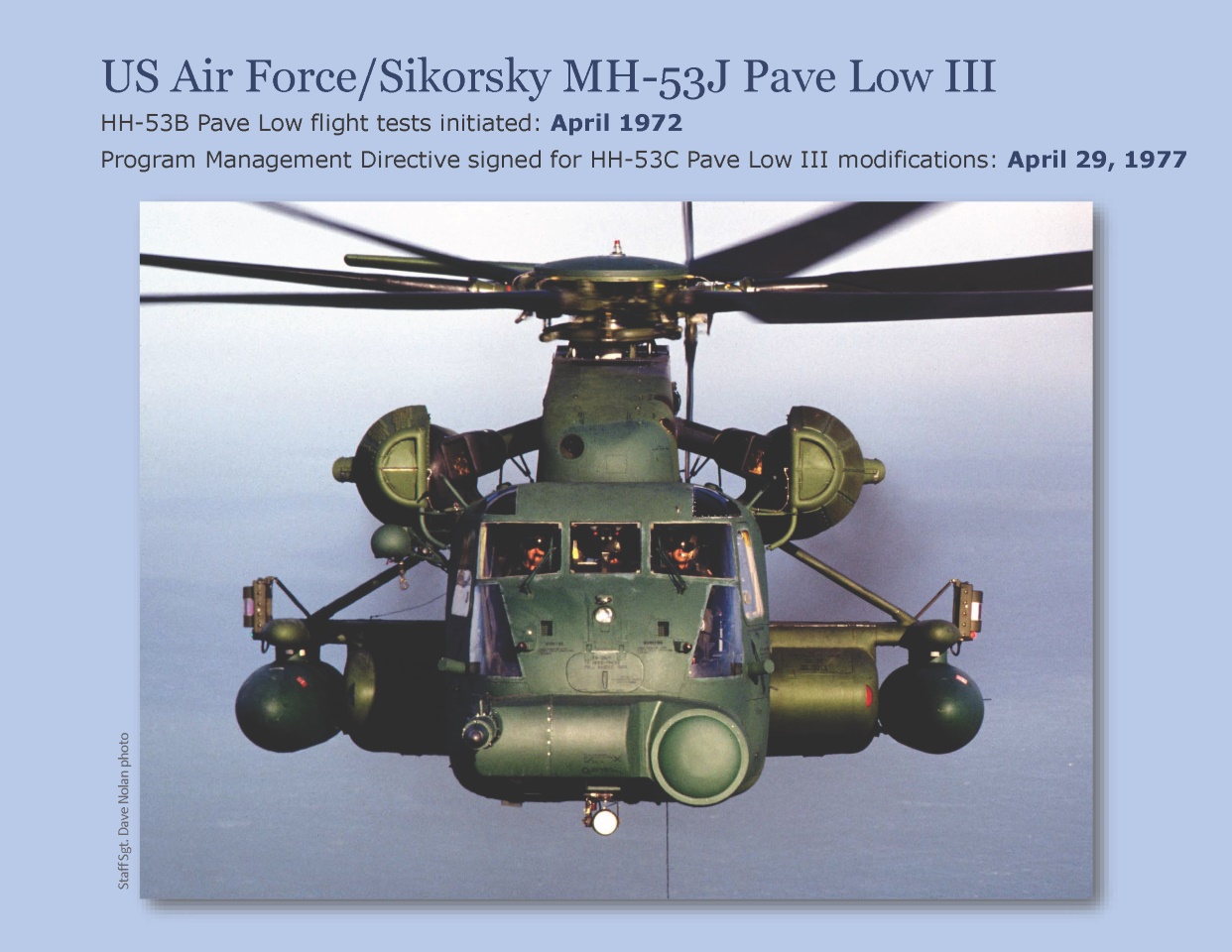
 Sikorsky MH-53J Pave Low III
The MH-53J Pave Low III, first deployed in 1981, is a derivative design of the original Sikorsky CH-53A (S-65) helicopter. The Pave Low was designed for special operations missions typified by low-level, long-range, undetected penetration into denied areas, day or night and in adverse weather. A special mission equipment package consisted of an APQ-158 terrain-following and terrain-avoidance radar, an AN/AAQ-18 forward-looking infrared sensor, an enhanced inertial navigation system with a global positioning system (GPS), along with a projected cockpit map display and integrated avionics that enabled precise navigation to and from target areas.
The MH-53J is 88 ft (28 m) in length and 25 ft (7.6 m) high. Its 6-bladed rotor system is 72 ft (21.9 m) in diameter. It has an empty weight of 32,000 lb (14,515 kg) and a maximum takeoff weight of 46,000 lb (20,865 kg). It is powered by two General Electric T64-GE-100 engines with 4,330 shp (3,230 kW) per engine. It has an maximum service ceiling of 16,000 ft (4,876 m) and range of 600 nm (1,100 km); the range is unlimited with its aerial refueling capability. It is capable of a top speed of 144 kt (266 km/h).
In its operational configuration, the MH-53J has a crew of six: two pilots, two flight engineers and two aerial gunners. It was equipped with armor plating. Armament consists of any combination of three 7.62 mm M134 mini-guns and/or .50 BMG (12.7 mm) M2 Browning machine guns mounted on the left and right sides of the helicopter. It could transport 38 troops at a time and sling up to 20,000 lb (9,000 kg) of cargo with its external hook. The Pave Low helicopter was retired by the Air Force in 2008.
Description: Paul Fardink
Photo credit: Staff Sgt. Dave Nolan
Go back to the previous photo or view the photo for next month
2021 History Calendar Index