

US Army/Doak Aircraft Company Doak Model 16/VZ-4 Tilt-Duct VTOL
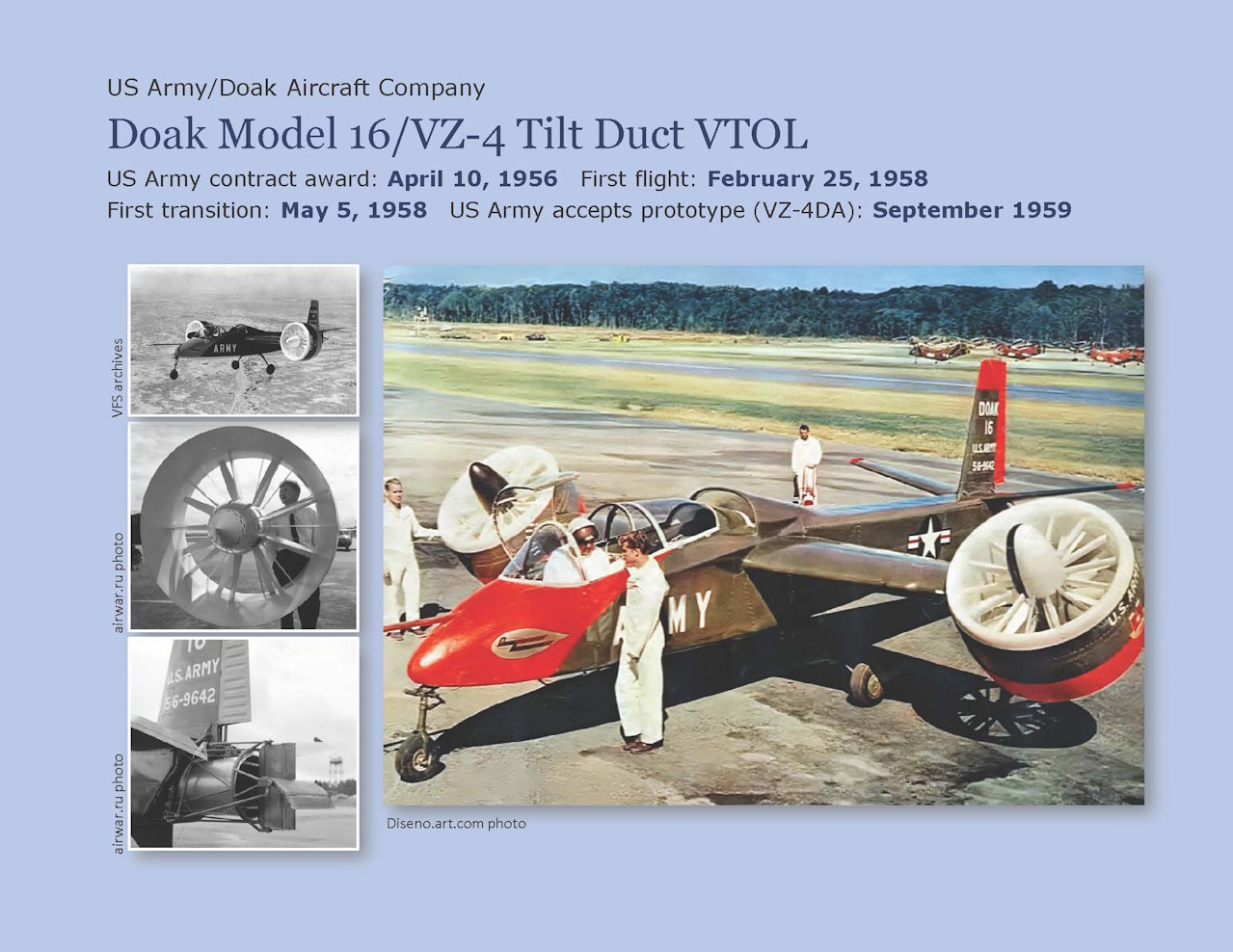
The Doak Aircraft Company Model 16 (US Army designations VZ-4 and later VZ-4DA) was an American prototype vertical takeoff and landing (VTOL) tilt-duct aircraft built in the 1950s as a demonstrator for possible service in the US Army. This significant experimental vehicle was the first successful tilt-duct aircraft to fly. Its designer, Edmund R. Doak, Jr., formerly with the Douglas Aircraft Company, founded the Doak Aircraft Company in 1940, in the town of Torrance, California. In 1950, Doak proposed a VTOL aircraft to the US Army as a contract bid under the US Army Transportation Research and Engineering Command at Fort Eustis, in Newport News, Virginia. In April 1956, Doak won the contract to build a single prototype for use as a research aircraft.
The 32-ft (9.75-m) long aircraft, designated the Doak Model 16 (serial number 56-9642), was powered by a 825-shp (607-kW) Lycoming T53-L-1 mounted in the fuselage, aft of the crew compartment. The engine drove two wingtip-mounted ducted fans on relatively short span wings. Each tilting fan had an inner diameter of 48 inches (1.22 m) and the duct outer diameter was 60 inches (1.52 m). The fans were positioned vertically for takeoff and landing, and rotated to a horizontal orientation for horizontal flight. Parts from other aircraft were used to construct the VZ-4; for example, duct actuators came from a Lockheed T-33.
During the life of the aircraft, its gross weight grew from 2,600 to 3,200 lb (1.8 to 1.45 tonnes). The cockpit could accommodate two crew members in a tandem arrangement, but the aircraft typically flew with only a test pilot in the front seat. Standard stick and rudder controls were part of the design, but ducted engine exhaust was used for pitch and yaw control during hover and transitions to conventional flight (via vanes located at the base of the rudder). Hover roll control was generated by variable incidence vanes in the ducts but during conventional flight, the VZ-4 used orthodox fixed-wing aircraft controls. Flight testing began at Torrance Municipal Airport with the aircraft performing its first free flight hover on Feb. 25, 1958. The first transition from vertical to horizontal flight (and back again) took place on May 5, 1958.
After Doak completed a series of tethered and hover tests, the aircraft was transferred to Edwards Air Force Base, California. There, it underwent another 50 hours of testing, in which speeds of 230 mph (370 km/h) were attained. The US Army and NASA eventually took ownership of the aircraft and continued research work on ducted fan technology. Many valuable lessons on tilt-duct aircraft performance, handling qualities, and control, were learned on this aircraft; and data from that research helped the design of other tilt-duct aircraft. Doak teamed with Douglas for its unsuccessful four tilt-duct competitor in the competition that resulted in the Bell Aerosystems X-22A.
Work continued in the VZ-4 until 1963, when the US Army decided to stop funding on the project due to changing requirements for US Army transportation needs. In 1973, it was transferred to Fort Eustis and displayed at the US Army Transportation Museum on the base.
References:
• VTOL Military Research Aircraft, by Mike Rogers
• Straight Up: A History of Vertical Flight, by Steve Markman and Bill Holder
• Aerodynamic Characteristics of a 4-Foot-Diameter Ducted Fan Mounted on the Tip of a Semi-Span Wing, NASA TN D-1301, K.W. Mort and P.F. Yaggy, April 1962.
• Doak VZ-4, Wikipedia
— Text by Erasmo Piñero, Jr.
Go back to the photo for last month or view the photo for next month
2025 History Calendar Index