

Tissandier Brothers Electric Airship
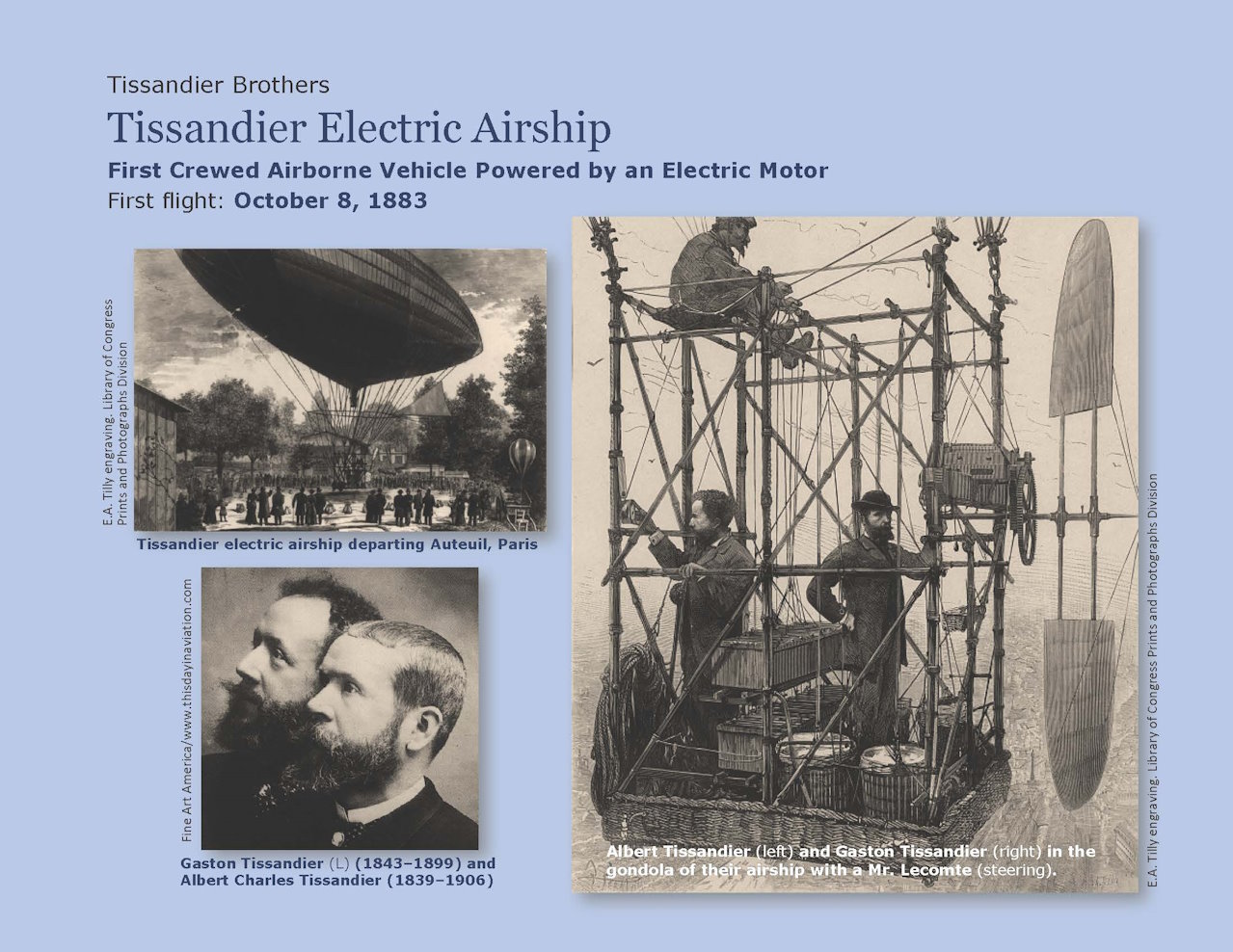
The brothers Albert-Charles Tissandier (1839–1906), an architect by trade, and Gaston Tissandier (1843–1899), a chemist by trade, were experienced French aeronauts and had constructed previous balloons. Gaston contributed to the setup of mail delivery by balloon during the siege of Paris in 1870–1871 and almost lost his life during the ascension to 29,000 ft (8,600m) in the balloon “Le Zenith.” His two companions, Théodore Sivel and Joseph Crocé-Spinelli, lost their lives, and this accident created a lot of emotions in France.
The Tissandier Brothers’ Electric Airship was the first to be powered by electricity and made its first flight at Auteuil, a suburb of Paris, France, where Gaston had his workshop and where he produced his own hydrogen.
The gondola was constructed of bamboo strengthened by cords and gutta-percha-covered copper wires. The stern-mounted rudder was made of unvarnished silk held in place by a bamboo rod. The gondola car housed the 1.5-hp (1.1-kW) Siemens electric motor that drove a two-bladed propeller through a reduction gear, producing 26 lb of thrust (116 N). The propeller had a diameter of 9.3 ft (2.80 m) and rotated at 180 rpm. 24 cells of bichromate of potash (potassium bichromate) provided electricity for the motor, which propelled the airship at up to 3 mph (4.8 km/h). The mass of the electric power-plant was 617 lb (280 kg).
On Oct. 8, 1883, the Tissandier Brothers were able to obtain an altitude of 1,640 ft (500 m) and reach a velocity of around 6.7 mph (3 m/s) during a flight of 1 hour 15 minutes. They did a second experiment on Nov. 26, 1883, with an improved propeller and rudder that lasted two hours and covered a distance of around 15.5 miles (25 km) between Auteuil and Marolles en Brie. The purpose of both flights was to show that an airship could travel against the wind, in contrast to a balloon.
Their airship was 91 ft (28 m) long with a maximum diameter of 30.1 ft (9.2 m). Its gas capacity was 37,434 cubic ft (1,060 cubic m). The total weight of the airship, with crew, instruments and ballast, was 2,734 lb (1.24 tonnes).
References:
- Tissandier Electric Airship, This Day in Aviation, Oct. 8, 2024
- Tissandier's Electric Balloon, translation of La Nature article published in Scientific American Supplement, Vol. XVI., No. 416, 22 December 1883
- La Navigation Aérienne (“Air Navigation”), by J. Lecornu, published by Vuibert et Nony Éditeurs à Paris, 1910
— Text by Ken Bartie and Yves Morier
Go back to the photo for last month or return to the calendar cover photo
2025 History Calendar Index