

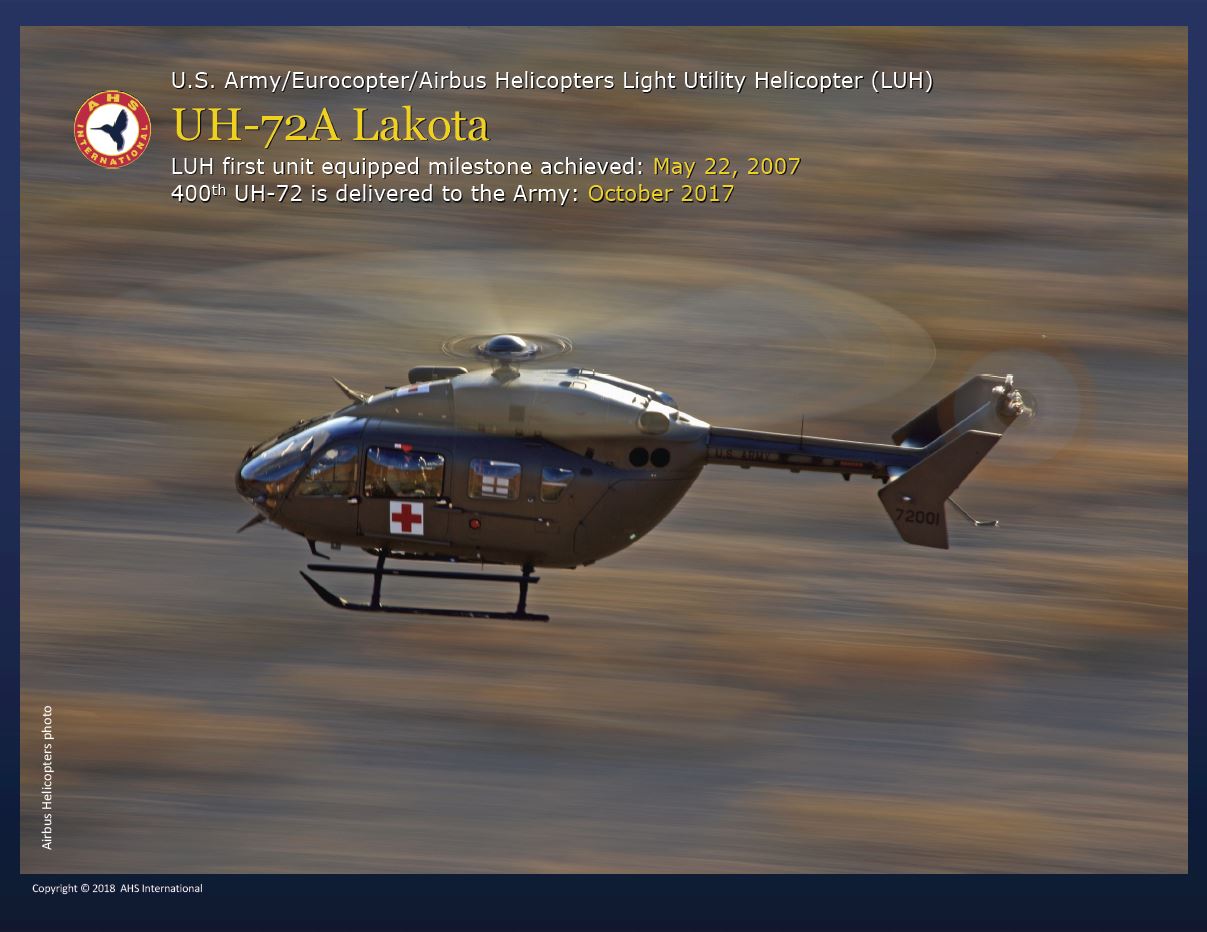
US Army/Eurocopter/Airbus Helicopters Light Utility
Helicopter (LUH)
UH-72A Lakota
LUH first unit equipped milestone achieved: May 22, 2007
400th UH-72 is delivered to the Army: October 2017
On June 30, 2006, the EC-145 Eurocopter (now Airbus Helicopters) helicopter was selected as the winner of the United States Army’s Light Utility Helicopter (LUH) program meeting the requirements for a pre-existing, off the shelf FAA certified helicopter to fulfill the role of light duty utility helicopter. In following the service's tradition of giving Native American names to its helicopters, the Army designated its militarized version as the UH-72A Lakota.
In October 2006, American Eurocopter was awarded a production contract for 345 aircraft. The first UH-72A was delivered to the US Army on December 11, 2006. On August 23, 2007, the UH-72A received full-rate production (FRP) approval at the Eurocopter facility in Columbus, Mississippi and as of December 2017 over 400 helicopters have been delivered. (Eurocopter was renamed Airbus Helicopters on Jan. 2, 2014.)
The UH-72A serves the Army’s logistics and support missions within the United States. The UH-72A is an unarmed helicopter optimized for routine air operations, to include civil support, air transport, medical evacuation, and search and rescue, in a permissive, non-hostile environment. It is also used by the Army National Guard for homeland security and disaster-response missions and medical evacuations.
It is a twin-engine light duty helicopter. It is equipped with a single 4-bladed 36.1 ft (11 m) diameter main rotor and a single 2-bladed 6.4 ft (1.95 m) tail rotor mounted on the left-hand side of the tail assembly. The main and tail rotors are high set to allow fast and safe access to the cargo area for the loading of bulk cargo or litters. Loading can be expedited while the rotors are turning through the main access doors (mounted on each side of the aircraft) and large clamshell doors on the rear of the airframe.
The helicopter is powered by two Turbomeca Arriel 1E2 tuboshaft engines, each providing 738 shp (551kW) of take-off power and 692 shp (516 kW) of continuous power. The engines are rated to provide a maximum power of 770 shp (574kW) for two and a half minutes and 542 shp (404 kW) continuously in one-engine-inoperable mode.
The UH-72A is capable of transporting eight passengers. Basic crew consists of a pilot and co-pilot. For ambulance and medical evacuation missions, the cabin can accommodate two stretchers, plus one crew chief (who is qualified to operate the hoist and other aircraft equipment) and one medical attendant. Both the cockpit and passenger seats are of high strength lightweight composites construction and include aramid and graphite materials. The passenger seats are of a fold-up design and meet FAA crashworthiness standards. The UH-72A is equipped with a rescue winch, which is mounted on the left-hand side above the crew compartment door.
The cockpit accommodates the crew of two and is fitted with two energy-absorbing seats having ergonomic cushions, a four-point restraint system with an inertia reel qualified to FAA crashworthiness standards. The UH-72A is fitted with a night vision goggle-compatible glass cockpit with active matrix liquid crystal displays and a Meghas avionics suite. The cockpit displays include the Thales Vehicle and Engine Management Display (VEMD).
The UH-72A’s automatic flight control system includes two Attitude and Heading Reference Systems (AHRS), Advanced Power Management (APM) computers, smart electro-mechanical actuators, TRIM actuators and fiber-optic gyroscopes. The navigation and air traffic control communications include dual VHF communications transceivers; dual VHF navigation receivers with VOR, ILS and marker beacon; and a DME transceiver.
On March 25, 2015, Airbus completed assembly of the first UH-72A made specifically for training for the US Army. The training configuration of the Lakota differs from the baseline model in several ways, including an observer seat for the instructor, a "buzz number" on its side for easy identification, and a flight control system that allows it to communicate with Fort Rucker. As part of the Army's Aviation Restructure Initiative (ARI), Fort Rucker's fleet of TH-67 and OH-58A/Cs training helicopters will be replaced with 187 UH-72s, comprising 106 purpose-built trainers and 81 existing versions that will be modified. January 8, 2016 saw the start of the first class of Initial Entry Rotary Wing (IERW) Training using the UH-72A training helicopter.
The 400th UH-72 was delivered to the Army in October 2017.
Photo: Airbus Helicopters
Text: Paul Fardink
Go back to the photo for last month or view the photo for next month
2018 History Calendar Index