

Convertawings Model A Quadrotor VTOL
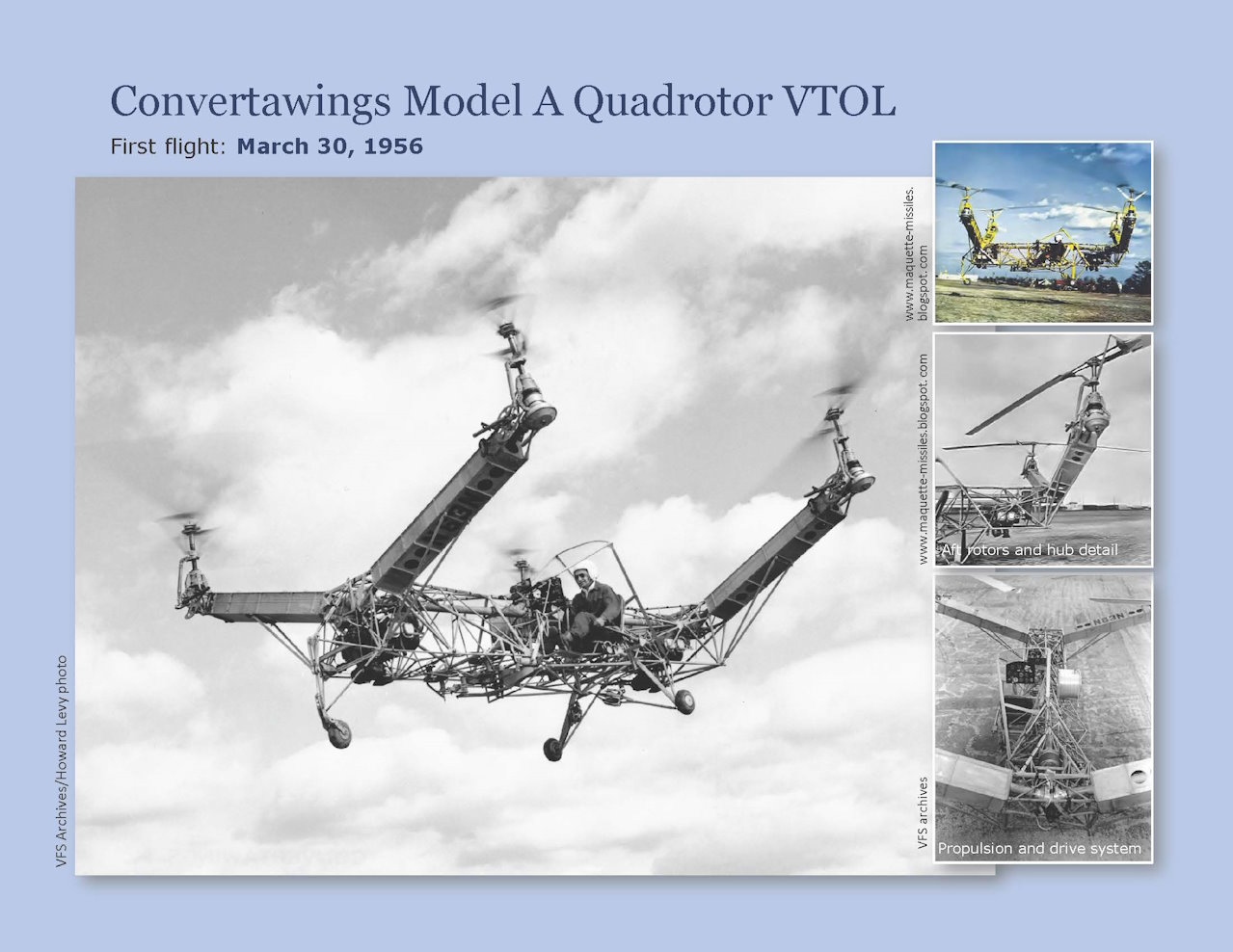
Designer Marc Adman Kaplan first flew his quadrotor helicopter design — the Convertawings Model A — on March 30, 1956. The four rotors were mounted laterally on outriggers in tandem pairs positioned in a sideways “H” configuration. This design allowed for a simplified control system that used only differential change of thrust between the rotors. The need for cyclic control was thus eliminated, but collective control was still required. Both hovering and maneuvering flight were achieved by this vertical takeoff and landing (VTOL) configuration with remarkable success.
This was the first true crewed quadrotor design. Earlier designs existed, but they all required additional vertically mounted rotors to provide forward propulsion. This was the first design that could successfully fly with forward propulsion without the need for additional rotors.
The single-seat fuselage was constructed of tubular steel supported by a non-retractable, tricycle landing gear; the maximum gross weight was 2,200 lb (1-tonne). Power was provided by two Continental C-90 reciprocating engines, each providing 90 hp (67 kW), connected to the inter-connected transmissions and shafting by multiple V-belts. This allowed for single-engine operation should the loss of one engine occur.
Each two-bladed rotor system had a diameter of 19.42 ft (5.92 m), which gave a disc area of 296.1 ft² (27.5 m²) and a low disk loading of 1.857 lb/ft² (9 kg/m²). The blades were strap-mounted to simplified hubs, resulting in a unique form of a hingeless rotor system. Despite successful testing with flights of top speeds of 80 mph (35.7 m/s) being achieved, military support for the project ended due to budget cutbacks.
It is interesting to note that the quadrotor platform/design is now widely being used in today’s drone industry.
— Text by Paul Fardink
Go back to the previous photo or view the photo for next month
2025 History Calendar Index