

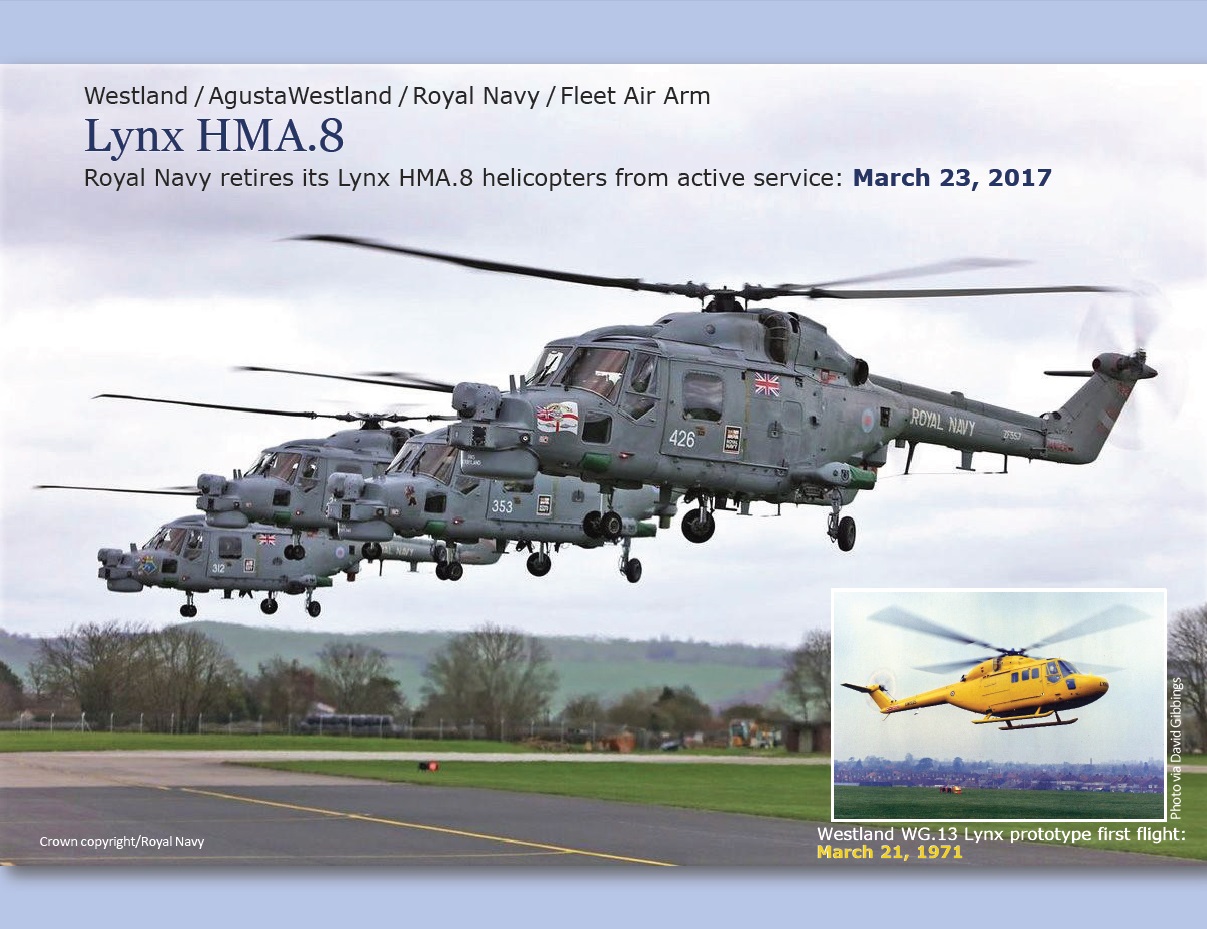
 Westland Lynx HMA.8
Westland initiated development of the Lynx in the mid-1960’s as a replacement for the Saro P.531 and its derivatives — the Westland Scout and Wasp. Designed to be a higher-performance alternative to the UH-1 Iroquois, the first Lynx prototype flew on March 21, 1971. The UK Ministry of Defense began placing orders for both the British Army and Royal Navy in the early 1970s, with deliveries of the Lynx starting in 1977.
Improvements to the Lynx performance have been continuously incorporated over its service life. Due to these upgrades, the Lynx set the world speed record for a conventional helicopter, one that it still holds to this day. In addition to performance enhancements, numerous other improvements have been incorporated including strengthened airframes, new avionics and engines, improved rotor blades, and additional surveillance and communication systems.
In the 1990s, Westland developed a new variant called the Super Lynx that featured BERP rotor blades, composite tail rotor blades, Rolls-Royce Gem 42 engines, under-nose radar, and nose-mounted optical sensor. For the Royal Navy, the Super Lynx aircraft were designated the Lnyx HMA.8. Further improvements to the Super Lynx include the introduction of LHTEC CTS800 engines.
Prepared by Robert Roedts.
Crown copyright/Royal Navy and David Gibbings
Go back to the previous photo or view the photo for next month
2022 History Calendar Index