

Westland Westminster
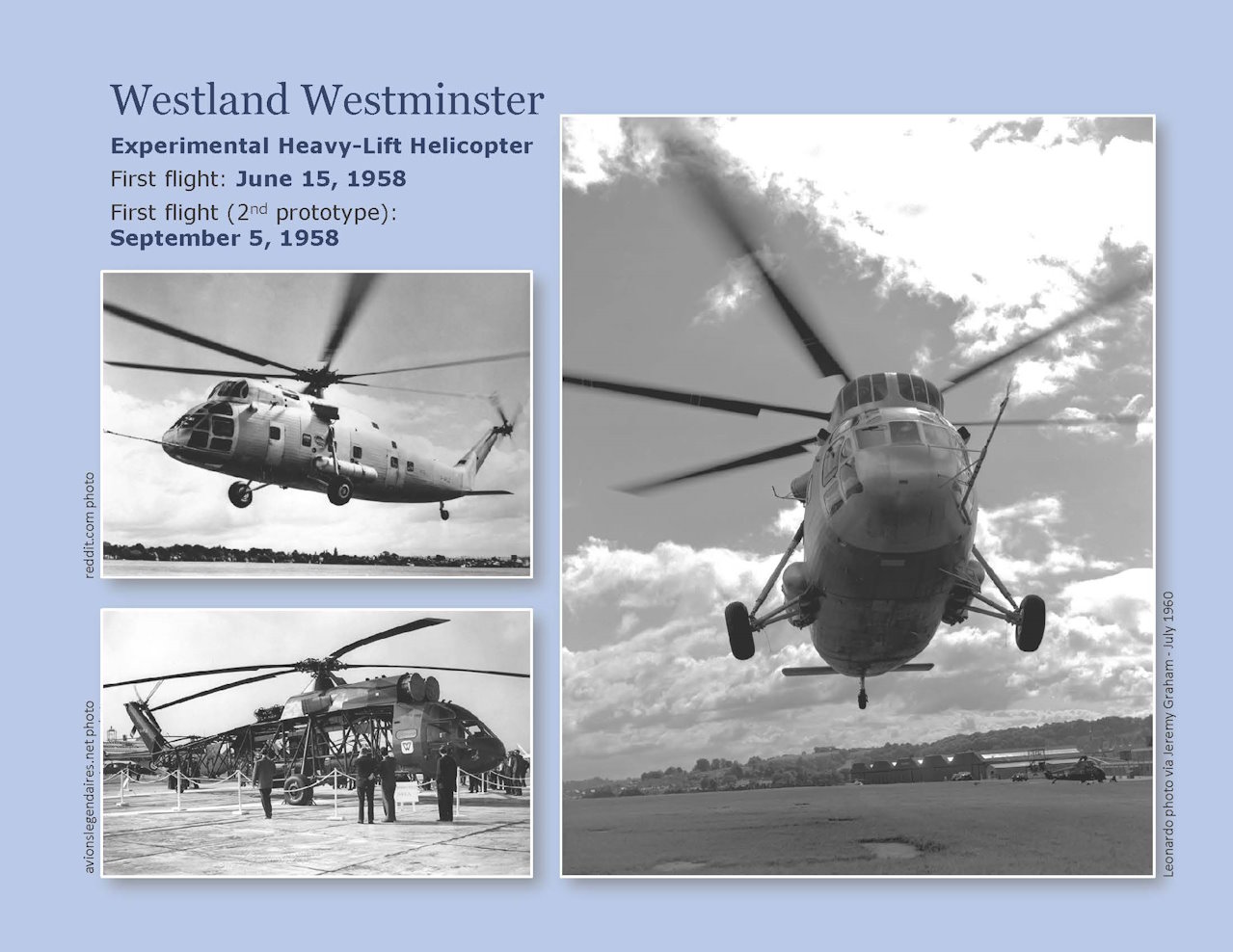
The story of the Westland Westminster experimental heavy-lift helicopter can be traced to the 1952 UK government requirement describing a large civil rotorcraft that would be operated by British European Airways BEA) as an inter-city transport, commonly known as the “BEAline Bus.” Several companies submitted proposals, including Westland (which today is part of Leonardo Helicopters), which offered a traditional main rotor/tail rotor design that can be seen to advance (but not revolutionize) the state of the art at the time. Fairey Aviation would be selected to build the winning proposal as the Rotodyne, but Westland did not abandon its effort to bring the large helicopter forward.
Initially, follow-up work focused on introducing a turbine-powered version of the Sikorsky S-56 (military designation CH-37 Mojave and license-produced in the UK as the Westland Wessex) under cover of the on-going and successful liaison that had been established by the two companies. Offering a seating capacity only slightly less than the BEAline Bus requirement, it was far more capable than other options that might be used for a viable civil service in advance of the Rotodyne becoming available. This effort gave rise to a desire to demonstrate the S-56 dynamics when mated to a turbine powerplant and the concept of a simple “iron-bird” ground rig was born. As the test rig was being designed it became obvious that there would be no great impediment to converting the rig into a flying test bed.
The first of two aircraft flew in June 1958 from the Yeovil, Somerset, site to be followed by the second a little over a year later. Terylene polyester fabric covering was used from 1960 to give the visual impression of an aircraft being constructed as planned in production. The Westminster was flown with a pair of Napier Eland E220 turboshaft engine of 2,920 hp (2,177 kW) each, compared to the S-56 use of the Pratt & Whitney Double Wasp, rated at 2,100 hp (1,566 kW) each. Rotor diameter was as the S-56 (and the later S-64) at 72 ft (21.9 m); the tail drive and the tail rotor were common between the two aircraft. Initially cleared to operate at 3,000 lb (1.36 tonnes) above the S-56 maximum take-off weight, a third of this apparent benefit was lost to the use of a simple, low cost but somewhat inefficient primary frame structure. The second aircraft would have a lighter structure and be cleared to operate up to 36,000 lb (16.3 tonnes). Production aircraft were intended to use a traditional fuselage construction, though layout variations between roles were identified; a crane variant having the appearance of the Mil MI-10 was perhaps the most extreme variation published.
Early flight test had shown that vibration levels at cruise speed were high, and this was pinned down to the use of the baseline S-56 blades that were highly twisted for improved hover performance, and which had caused similar issues for the US Marine Corps aircraft. The rotor would be modified to mount the definitive S-56 “wide chord” blades in 1959 to cure this problem; many military heavy-lift demonstrations were then undertaken, both in the UK and in Germany. During 1960, the first aircraft was fitted with a Sikorsky six-bladed rotor and flown in this standard from July 1960 to represent the proposed in-service configuration of the dynamics. Engine choice for production settled on the Rolls-Royce Tyne, which — in combination with the six-bladed rotor — allowed Westland to offer the Westminster able to operate at up to 40,000 lb (18.1 tonnes) take-off weight.
The Westminster program was a private venture endeavor: UK government funding for this class of rotorcraft was directed at the Fairey Rotodyne and despite military interest shown by both the UK and US armies in a heavy lift helicopter, no formal requirement was available on which to justify expenditure. On the merging of the UK rotorcraft industry (including Fairey) under the Westland banner, a decision had to be made as to which program would be continued. The Westminster had no official backing and the Rotodyne seemed to point to the future. Westland elected to abandon the Westminster in 1960 to fully focus on the Rotodyne. Twelve months later, however, the Royal Air Force would publish a requirement for a heavy lift rotorcraft and the UK government would withdraw its financial support for Rotodyne.
Heavy lift in the UK would be eventually met by the Boeing HC1 Chinook which entered service in 1981, over 20 years after the Royal Air Force had formally recognized the need for such a capability and the two Westminster prototypes had been sold for their scrap value.
— Text by Jeremy Graham
Go back to the photo for last month or view the photo for next month
2025 History Calendar Index