

US Air Force/Piasecki Helicopter Corp. YH-16 Transporter/YH-16A (XH-27) Turbo Transporter
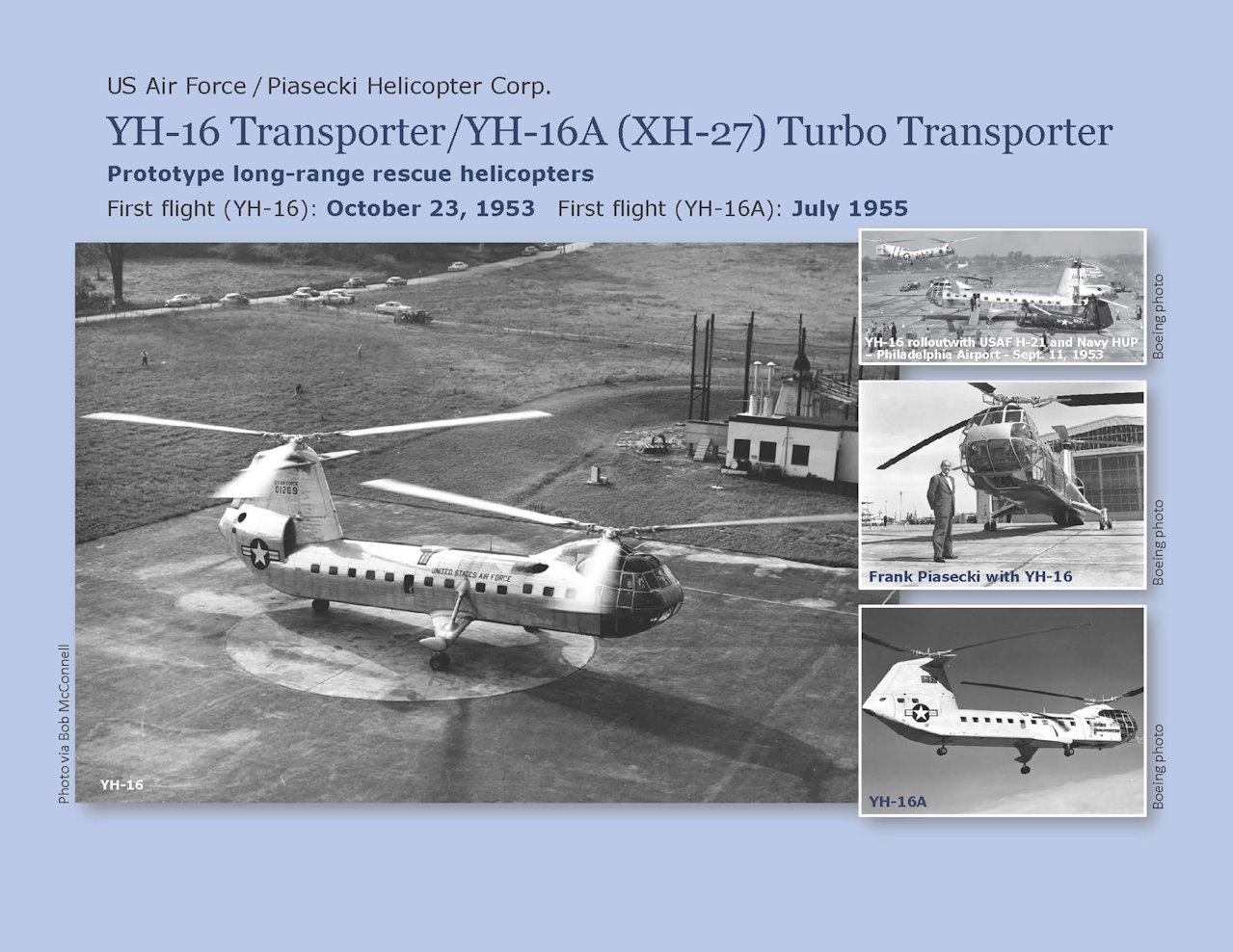
In 1946, the US Army Air Forces — becoming the US Air Force (USAF) the following year — contacted helicopter manufacturers about a preliminary proposal specification for a polar rescue helicopter due to the threat of attack by Soviet Union via the North Pole. The design guidelines were a capacity for 6,000 lb [13.2 tonnes] payload; space for 30 litters; ability to carry sling-loaded trailers or building modules containing medical, communication or housing facilities; a 188-mile [300-km] range; and a proven advanced cruise speed. At the time, no helicopter design was remotely capable of meeting these requirements.
In 1948, the Piasecki Helicopter Company was declared the winner of the competition. Within two years, Piasecki had completed preliminary design, wind tunnel testing and full-scale mockup construction of its proposed aircraft called the Piasecki Model PV-15 — Air Force designation XH-16. In 1950, Piasecki received a follow-up contract from the USAF for two prototypes, along with data and publications, all flight-testing, spare parts and any needed special tools.
The massive XH-16 went from blueprint to a completed aircraft by early 1953. The fuselage measured 78 ft (23.8 m) from the nose to the tail, 9.6 ft (2.9 m) across, with a 2,500-ft³ (70.8-m³) capacity. It had two three-bladed metal main rotor blades, each with a diameter of 82 ft (25 m) and an extremely low rotor speed of 147 rpm. Power for the helicopter came from two Pratt & Whitney R-2180-11 radial engines, each producing 1,650 hp (1,230 kW). The empty weight of the XH-16 was 32,000 lb (14.5 tonnes), with a useful load of 14,000 lb (6.35 tonnes). Its maximum speed was 123 mph (198 km/h), with a cruise speed of 110 mph (177 km/h). It had a range of 230 miles (370 km) and a ceiling with a normal load of 18,000 ft (5,490 m). The first flight of the helicopter took place on Oct. 23, 1953, at the Philadelphia airport. The helicopter could carry 40 passengers or 32 litters, plus an aircrew of three. If not carrying passengers, it could transport up to three Jeeps or small vehicles.
Piasecki engineers were soon designing an upgraded H-16 transport helicopter (known as the YH-16A). This was based on the earlier flying prototype, but included YT38-A-10 turbine engines designed and manufactured by General Motors Allison Division. They were considerably smaller and lighter than piston engines of comparable power. The extra space they freed up in the YH-16A’s interior could be used for more passengers and cargo. The upgraded YH-16A was faster and could carry greater loads than its predecessor.
The empty weight of the improved YH-16A was 22,500 lb (10.2 tonnes), with a useful load of 11,070 lb (5 tonnes). Its maximum speed was 146 mph (235 km/h), with a cruise speed of 140 mph (225 km/h). Its range was 230 miles (370 km) and had a ceiling with a normal load of 19,100 ft (5,820 m). In December 1955, the Piasecki turbine YH-16A reached an unprecedented speed of 166 mph (265 km/h) during calibration flight test runs. This was 10 mph (16 km/h) faster than the official helicopter speed record set by the Sikorsky XH-39 turbine helicopter.
The Transporter surprised everyone with its absence of shaking, to the extent that there was no need for vibration reduction devices. Test flights demonstrated the exceptional capabilities of the H-16 design in performance, handling qualities, speed, external payload, structural integrity and operational suitability. Both Piasecki and the Air Force envisioned further improvements to the platform and great performance.
Unfortunately, the upgraded versions of the YH-16A never saw the light of day. On Jan. 5, 1956, during its final test phase, the YH-16A crashed near the Delaware River while returning from a flight over New Jersey killing both pilots. The resulting accident investigation indicated that the rear rotor shaft had failed. The aft rotor blades desynchronized, allowing them to contact the forward rotors. The root cause was determined to be a frozen bearing in the test instrumentation, which allowed an undetectable groove to form within the shaft.
With the loss of the YH-16A, the USAF decided to cancel and abandon the Transporter helicopter program.
— Text by Rob Roedts
Go back to the photo for last month or view the photo for next month
2025 History Calendar Index