

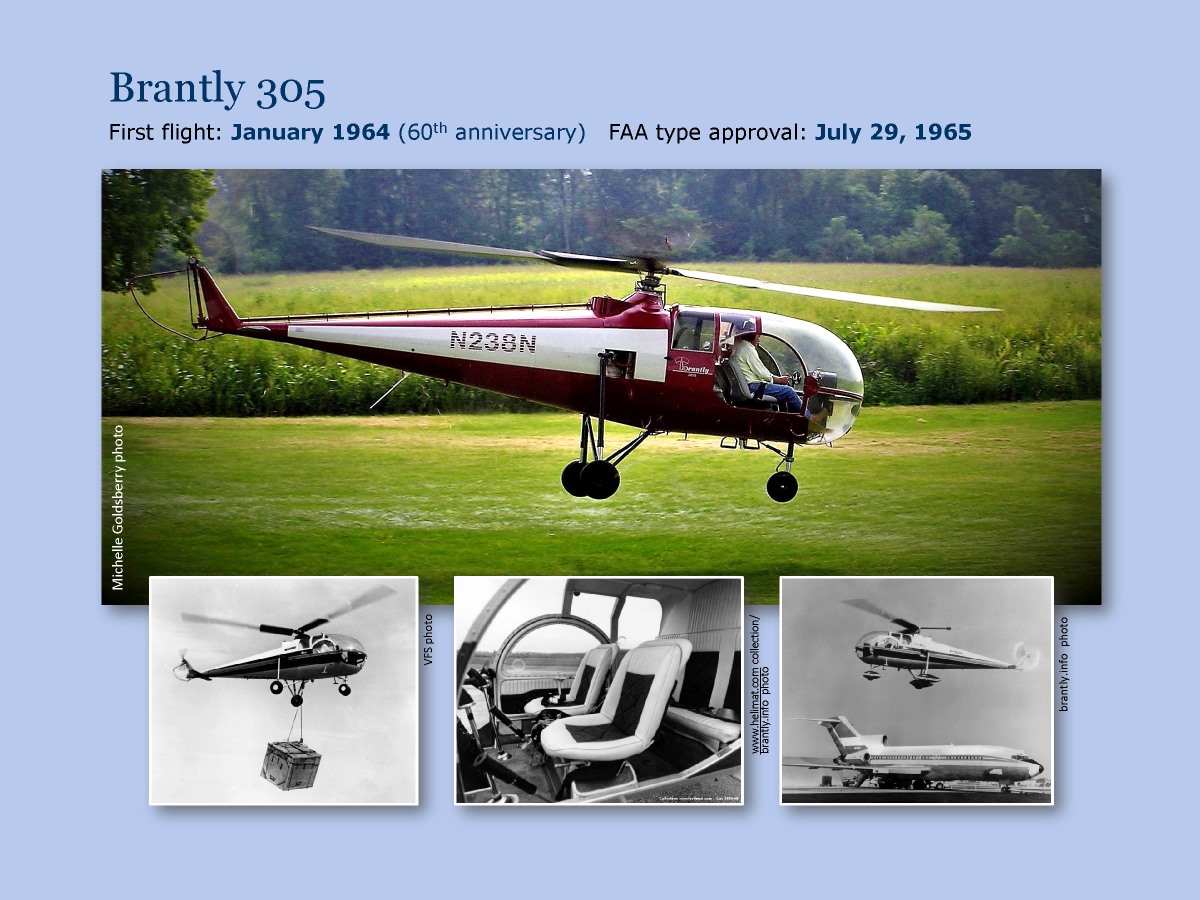
 Brantly 305
Newby O. Brantly developed the Brantly 305, or B-305, as a successor to the B-2, a single-rotor helicopter that emerged in the years following the conclusion of the Second World War. Brantly completed the first flight of the two-seat B-2 in February 1953, before securing the certification of the aircraft in 1959 and moving the development and production of the aircraft from Philadelphia to Frederick, Oklahoma. Brantly subsequently developed several improved variants of the B-2, including the B-2A and, in 1963, the more powerful B-2B, which became the main production version.
That same year, Brantly began working on the Model 305. Despite being larger in virtually every respect, the B-305 retained 305-shp (227-kW) Lycoming IVO-540-B1A engine of the B-2B and many of the design features that characterized the earlier aircraft such as a hemispherical nose and conical tail section. The five-seat B-305 featured a bench seat behind the two front seats and a maximum takeoff weight of 2,900 lb (1,315 kg), a little less than double that of its predecessor, the B-2B. The Brantly 305 made its maiden flight in January 1964 and was certified on July 29, 1965.
However, the 305 was not a commercial success. Brantly production stopped in the early 1970s, after more than 400 Brantly helicopters had been built. It was acquired in 1976 and became known as Brantly-Hynes, through the mid-1980s. In 1989, James Kimura obtained the rights and renamed it Brantly Helicopter Industries, but again was only able to resume low-rate production of both models.
By 1998, the Chinese-supported Brantly International, Inc. restarted production of the B-2B in Vernon, Texas. Brantly was fully acquired by Chinese aircraft manufacturer Qingdao Haili Helicopters in 2007. With the Aviation Industry Corporation of China (AVIC), the B-2B was developed into the V750 uncrewed rotorcraft.
Main photo by Michelle Goldsberry
Description by Dan Gettinger
- Brantly Model B-2, Vertipedia, Vertical Flight Society
- Brantly B-2B, Vertipedia, Vertical Flight Society
- Brantly-Hynes Model 305 (1964), Aviastar
- Brantly 305, Wikipedia
- Brantly Historical Photos, Brantly.info
- Brantly B2 & 305, Barrie Aircraft Museum website
- Brantly International Inc., Archives.com website, final snapshot, Aug. 7, 2016
- Fog Begins to Clear in China, Vertiflite, Nov/Dec 2013
Go back to the photo for last month or view the photo for next month
2024 History Calendar Index