

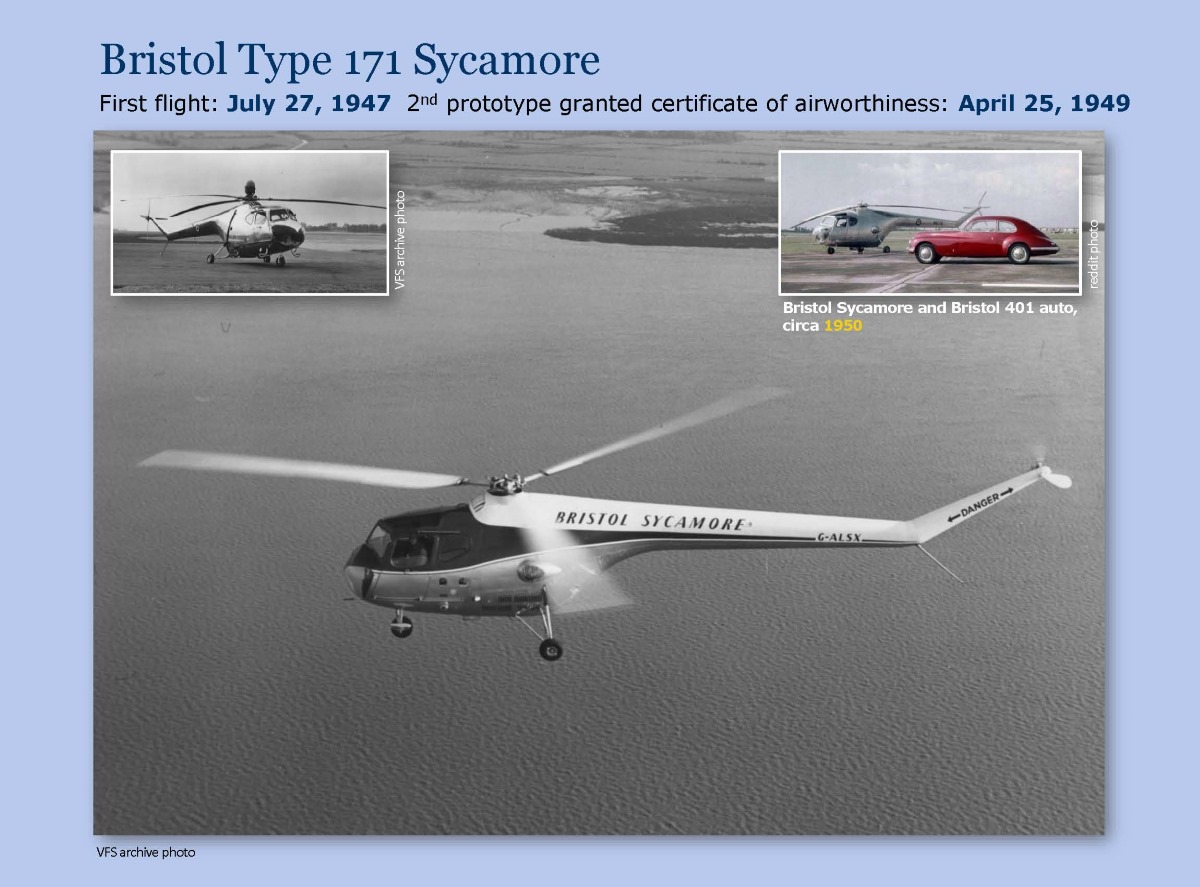
 July 2023: Bristol Type 171 Sycamore
First flight: July 27, 1947
Certificate of airworthiness: April 25, 1949
At the end of the Second World War, the Bristol Aeroplane Company in England began to develop an innovative type of helicopter. Under the leadership of Raoul Hafner, who emigrated from Austria to England prior to the Second World War, the company created the first-ever helicopter to be built in Britain.
The Bristol Type 171 Sycamore was an early helicopter developed and built by the helicopter division of the Bristol Aeroplane Company. The name refers to the seeds of the sycamore tree, Acer pseudoplatanus, which fall with a rotating motion.
It was the first British helicopter to receive a certificate of airworthiness, as well as being the first British-designed helicopter to be introduced by and to serve with the Royal Air Force (RAF).
The Type 171 Sycamore Mk 1 prototype took off on its maiden flight in 1947, with the Mk 2 version following in 1949.
The Mk 2 had five seats and was equipped with a 550 hp English Alvis-Leonides, nine-cylinder radial engine. The engine was installed in the horizontal position behind the back seat with its output shaft pointed upward, because it was not possible at that time to provide in-line engines with adequate cooling.
The Sycamore was fitted with a three-blade, 48.6-ft (14.8-m) diameter main rotor and a three-blade, 9.6-ft (2.9-m) tail rotor.
The main rotor blades are made entirely of wood and were designed so that the blades could be folded to one side towards the rear boom, saving valuable space on naval vessels as well as in the hangar.
The pitch change of the blades took place at the center of the rotor head, controlled by a “spider” mechanism and applied to a torsion bar attachment for each blade. These features still continue in use today on Westland’s Lynx helicopter.
With its high-strength tail pylon constructed of hydronalium (a seawater-resistant aluminum alloy), having a top speed of 125 mph (202 km/h) and a range of 270 miles (435 km), the Bristol 171 was advanced technology for its time. Also, the Bristol Type 171 Sycamore Mk 4 re-positioned the pilot to the right, which became the standard pilot-in-command position in helicopters.
The Sycamore was often used as a transport for both passengers and cargo alike. In RAF service, the Sycamore was normally used in the search and rescue, and casualty evacuation roles. This type of aircraft proved the value of rotorcraft to be able to easily traverse inhospitable or otherwise inaccessible terrain; the Sycamore made valuable contributions to British military activities during the Malayan Emergency, the Cyprus Emergency, and the Aden Emergency, as well as other operations.
In addition to its British military service, various models of the Sycamore were produced and operated by a number of users, including overseas military operations and civil customers.
Civilian operations typically involved transportation, mountain rescue, and aerial survey work. In 1959, production of the Sycamore ended after 180 rotorcraft had been completed.
The Bristol Type 171 Sycamore was “officially” retired in December 1971, when critical parts became fatigue life-expired, although 32 Squadron continued to use their pair of aircraft until August 1972.
An excellent article on this aircraft is located at this website: https://www.heli-archive.ch/en/helicopters/in-depth-articles/bristol-171-sycamore
Description: Peter Noell
Go back to the photo for last month or view the photo for next month
2023 History Calendar Index