

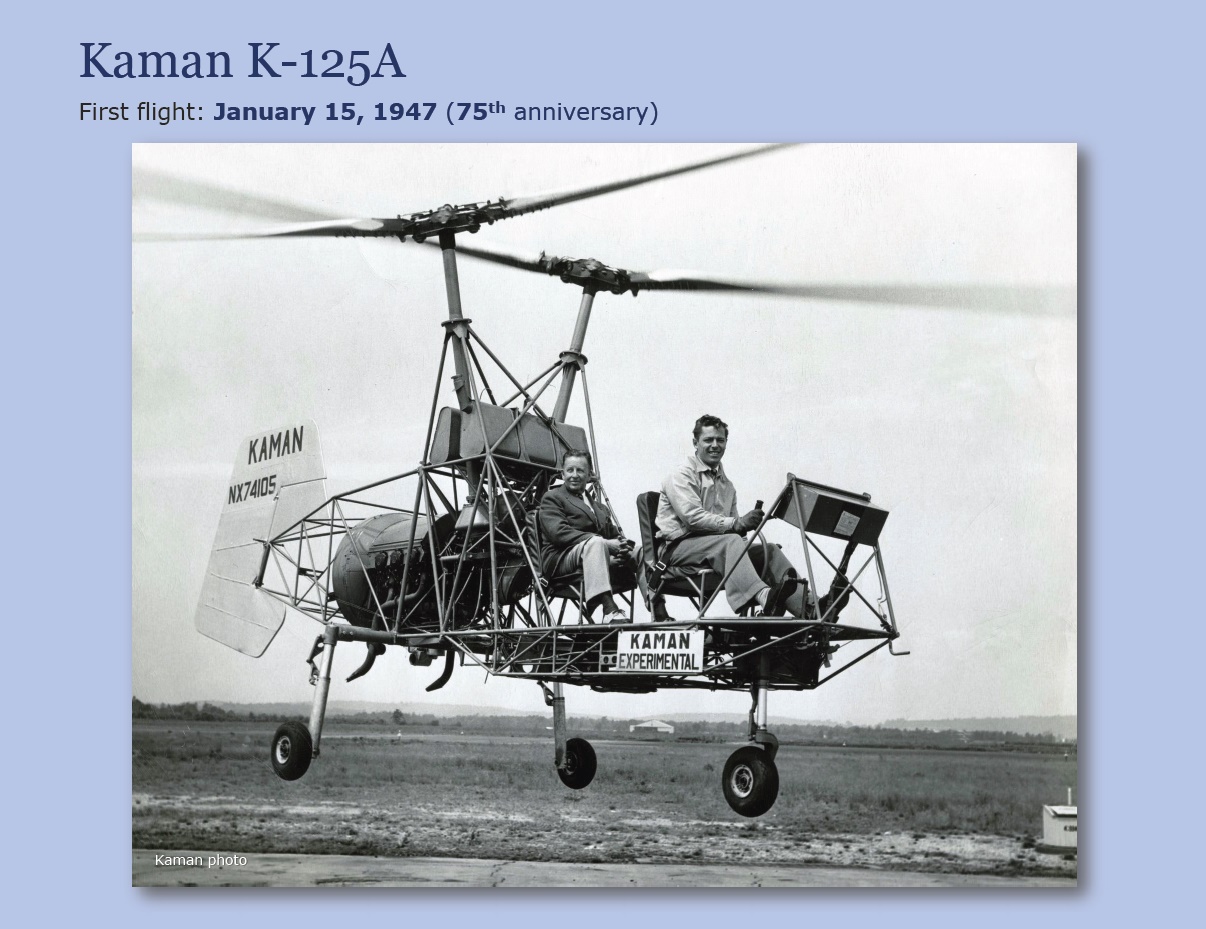
 Kaman K-125A
Charles Huron Kaman was a 26-year-old engineer in 1945 when he left United Aircraft’s Sikorsky Aircraft to create Kaman Aircraft Corporation. It was started in his mother’s garage in West Hartford, Connecticut home with $2,000 invested by two friends, after successfully conducting servo flap proof of experimental concept tests, which would make helicopters more stable and easier to fly.
In October 1946, Charles Kaman convinced a Bostonian venture capital group named New Enterprises to invest $36,000 in launching the development of the intermeshing rotor K-125 synchropter helicopter. As Charles Kaman described in his own words, the K-125 "was a wild-looking thing, with a bunch of angles and bared welded tubes, an engine, and a transmission concocted out of some worm gears." The experimental K-125 helicopter was powered by a 125-hp (92-kW) piston engine. The aircraft had a tri-cycle fixed landing gear and a short tailplane mounted with an endplate fin. The twin counter-rotating intermeshing rotor pylons were mounted behind the pilot seat with two-blade rotors fitted with controllable servo flaps.
In the hands of Jack Rohr, the tethered K-125 lifted six inches (15 cm) off the ground on Jan. 15, 1947. The K-125 first flew its public demonstration flight on April 4, 1947 (Good Friday) at Bradley Field outside Hartford, Connecticut.
Prepared by Jacques Virasak
Kaman photo
Go back to the calendar cover photo or view the photo for next month
2022 History Calendar Index