

Piasecki Aircraft Corp. Pathfinder Compound Helicopters
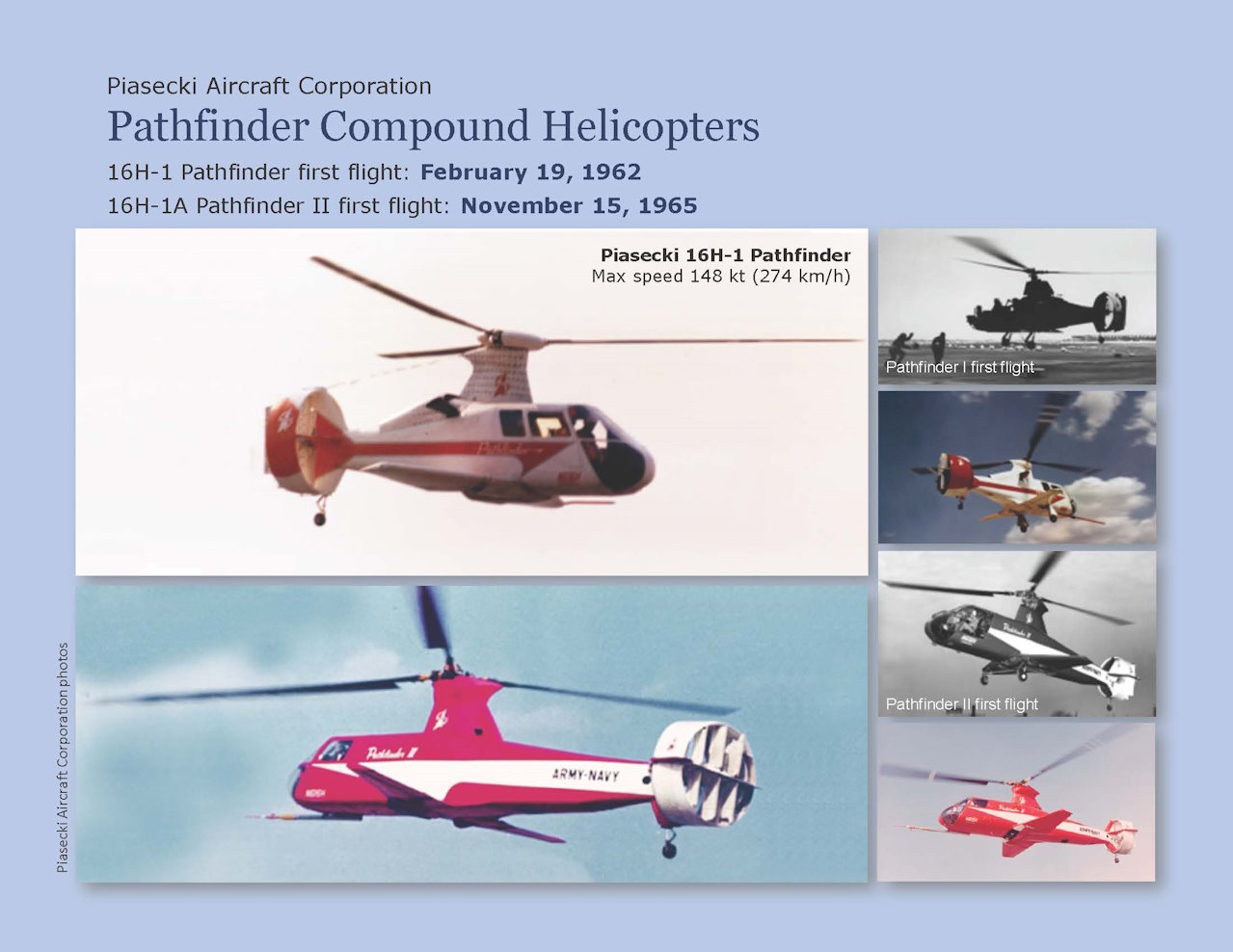
The Piasecki Aircraft Corp. (PiAC) 16H-1 Pathfinders were innovative compound helicopters with a design that combined vertical lift with increased speed and efficiency. They featured a single main rotor, a pusher propeller and a wing with a wingspan of 32 ft 10 inches (10 m) to blend helicopter and fixed-wing aircraft capabilities. Although not commercially successful, they paved the way for future advancements.
The 4,200 lb (1.9 t) 16H-1 Pathfinder I used a 41-ft (12.5-m) diameter rotor, a wing to unload the rotor in forward flight, and a 5.5-ft (1.68-m) diameter tail-mounted ducted propeller for thrust and anti-torque. Powered by a 405-shp (300-kW) Pratt & Whitney Canada PT6 turboshaft engine, it first flew on Feb. 19, 1962, and was flown up to 170 mph (273.59 km/h) over 185 flight hours. The US military showed interest, but adding armament and armor tripled its weight; this then led to the Advanced Aerial Fire Support System (AAFSS) competition, which included the 16H-1A (ultimately resulting in the Lockheed AH-56 Cheyenne compound helicopter).
In 1964, under a US Army contract, Piasecki modified the aircraft to the 16H-1A Pathfinder II, achieving speeds over 200 mph (321,87 km/h). Upgrades included a 1,050-shp (772-kW) General Electric T58 turboshaft engine, a new drive system, a new ducted pusher propeller and a 44-ft (13.4-m) diameter rotor. The fuselage was lengthened to accommodate eight people. The 6,300-lb (2.86-t) 16H-1A first flew on Nov. 15, 1965, logging over 150 flight hours, reaching up to 225 mph (362 km/h) and demonstrating high maneuverability.
— Text by Jacques Virasak
Go back to the previous photo or view the photo for next month
2025 History Calendar Index