

North American Rockwell XFV-12A V/STOL Fighter
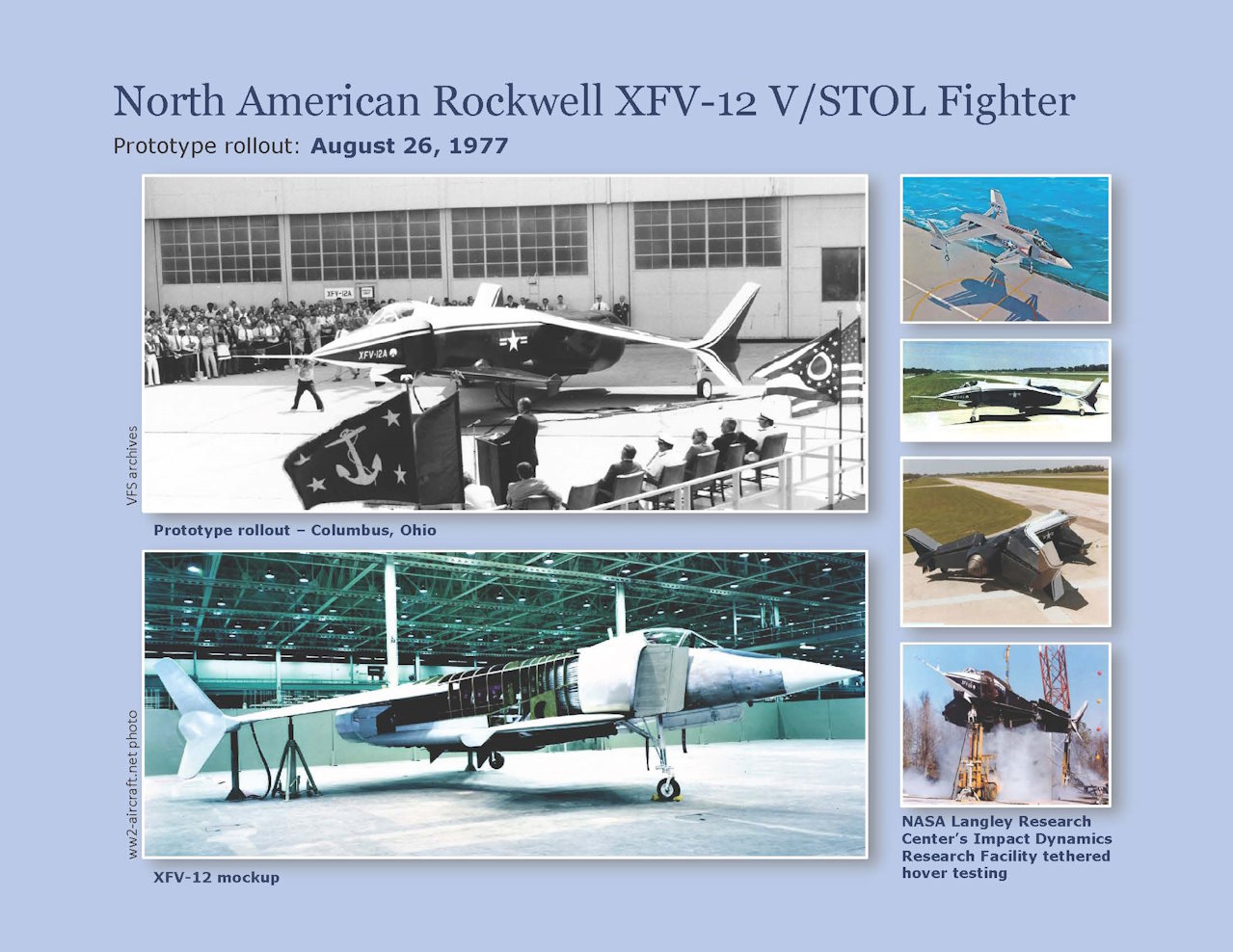
In 1971, the US Navy’s Chief of Naval Operations (CNO) initiated the Sea Control Ship (SCS) program. Envisioned to be equipped with different types of vertical and/or short takeoff and landing (V/STOL) aircraft, these small aircraft carriers would reduce the number of large ones required. In November 1971, to expedite the availability of the requisite supersonic V/STOL fighter, which would take longer to develop than the ship, the Navy issued a letter of interest instead of a detailed request for proposal (RFP). It outlined the SCS concept and solicited proposals for a preproduction demonstrator, to be flown quickly and at minimum cost. Proposals of no more than 20 pages were requested within 45 days.
Approximately 35% of the XFV-12A airframe by weight consisted of components from existing aircraft: the Douglas A-4 Skyhawk’s forward fuselage, cockpit and landing gear, and the McDonnell F-4 Phantom’s inlets, wing box and fuel cell.
The TAW concept piped the diverted thrust of a jet engine through ducts leading to vertically mounted ejectors in the wing (and in this case, large canards ahead of the wing). The high-velocity exhaust flow emitted from the ejectors entrained a large secondary flow of external air passing through openings in the wing and canards created by pivoting panels. Based on sub-scale tests, the combined flows were expected to produce lift 55% greater than the engine thrust alone.
Because of development delays with the TAW system, the formal rollout was not accomplished until Aug. 26, 1977, almost two years behind schedule. The empty weight had increased by 13% to 15,596 lb (7 tonnes). When initial attempts to hover failed, the aircraft was shipped to NASA Langley for static and dynamic vertical tests in the Impact Dynamics Research Facility (IDRF), a huge framework used initially to train the pilots of the Apollo lunar lander. In static tests, the aircraft was tethered at its top and bottom with load cells to measure all forces and moments generated as the thrust and controls were exercised. In dynamic tests, the lower tethers would be removed so the aircraft was capable of limited maneuvering.
The results from initial testing in early 1978 were disappointing. The overall augmentation ratio of the F401’s thrust of 14,070 lb (6.4 tonnes) was considerably below the anticipated 1.55, resulting in a total thrust roughly only equal to the airplane’s weight empty. Rockwell engineers were subsequently able to demonstrate acceptable augmentation ratios in a completely redesigned system but by then the CNO who had been the chief proponent of the SCS concept had retired and his successor did not share his enthusiasm for it. The test aircraft was scrapped, with second prototype never finished.
— Text by Tommy H. Thomason
Go back to the photo for last month or view the photo for next month
2025 History Calendar Index