

Boeing/Columbia 234 Commercial Chinook
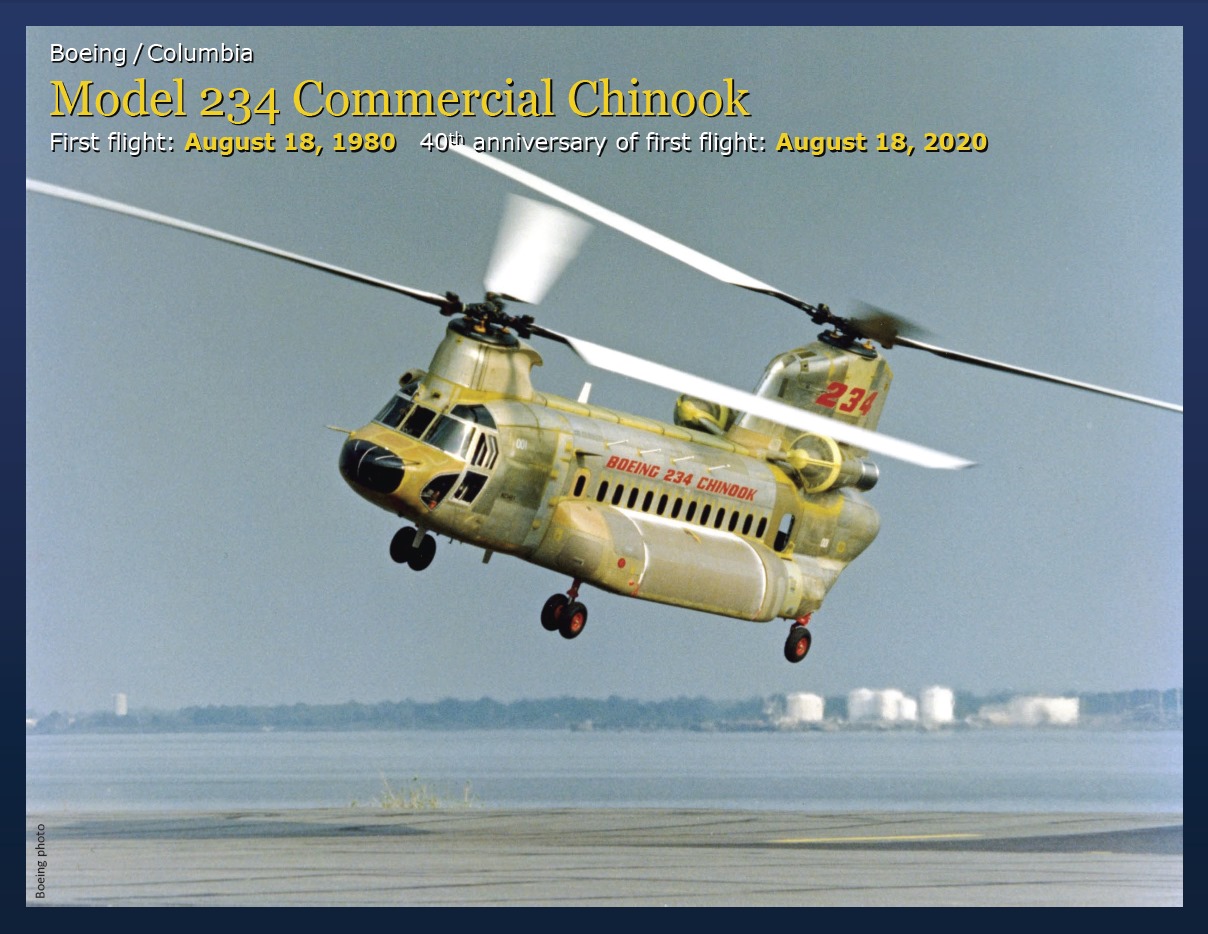
The Boeing Vertol Model 234 Chinook, or BV-234, was originally designed to transport passengers and cargo, for logging and construction heavy lift services, and remote resources exploration and extraction. The program was launched in November 1978 with British Airway as the original customer for three (later six) aircraft. The original Type Certificate application was made to the Federal Aviation Administration (FAA) on Oct. 29, 1975 and were approved June 19, 1981. First revenue passenger service occurred from airports in Scotland to off-shore oil rigs located in the North Sea that were operated by Esso (now Exxon) and Shell petroleum companies.
Based on a modified CH-47C airframe, advanced features included with the BV-234 included a longer nose that housed a weather radar, improved automatic flight control system, wider, higher-capacity composite fuel pods, triple cargo hook system, rotor brake and fiberglass rotor blades of 32-in. chord that would also appear on the CH-47D Chinook. The interior could be configured with 44 airliner seats in a 4-abreast layout, a galley and lavatory, air conditioning, overhead bins and ramp-mounted baggage bins. It could also be arranged as a passenger/freight ‘234 Combi’ with a mix of seats and cargo space. As a cargo carrier, 20,000 lb (9,072 kg) could be carried internally or for external lift missions, 28,000 lb (12,700 kg) could be lifted.
The 234 is powered by two Avco-Lycoming (now Honeywell) AL 5512 turboshaft engines, which is based on the military T55 turboshaft. Ratings: 4,075 shp (3,039 kW) takeoff; 2,957 shp (2,205 kW) max continuous.
Three aircraft took part in the development program and FAA and Civil Aviation Authority (CAA) certifications were obtained on June 18, 1981. It was the first helicopter to receive initial approval from the FAA for full day/night IFR operations. The first aircraft entered service with British Airways Helicopters on July 1, 1981.
The 234 was originally offered as a 234LR long range airliner, a 234ER extended range variant, a 234UT utility variant which utilized internal, cabin-mounted fuel tanks with the long-range external fuel pods removed. This not only decreased the weight of the aircraft but also decreased the rotor download on the fuselage which improved the hover/lift capability. The 234UT was certificated in October 1981 to a maximum gross weight of 51,000 lb.
Six 234LRs were delivered to British Airways Helicopters in 1981, three 234LRs were sold to Helikopter Service SA of Norway, 1981 to 1985, and two 234ERs were leased to Arco Alaska in 1983 and one to ERA Helicopters in 1985.
Three 234s built for the Republic of China Army and later operated by Air Asia of Taiwan received the unique designation of 234MLR, Multi-purpose Long Range. These were delivered in 1985 and operated as VIP transports, troop/cargo lift, disaster relief, and firefighting roles through 2016.
In 1987, a Boeing 234 on a two-month demonstration tour in the People’s Republic of China established a new record for hanging power transmission lines when it strung two power lines from 570-foot-high transmission towers 1.5 miles apart on either side of a river in China.
Two second-hand 234s were delivered to Trump Air in 1989 for short-lived New York City to Atlantic City casino shuttle service.
The 234s were eventually all acquired by Columbia Helicopters, Inc. (CHI) of Aurora, Oregon. Beginning with the first 234 acquisition by CHI in 1984, the aircraft became a reliable workhorse with the aircraft performing a wide range of heavy lift missions: aerial firefighting, logging, oil and gas industry support and charter transport services. In 2016, CHI acquired the remaining 234s from Taiwan and is now the sole operator of the type.
Boeing transferred the FAA Type Certificates for the Vertol 107-II and Boeing 234 Chinook helicopters to Columbia Helicopters on December 15, 2006. The TCs gave CHI access to all materials and manufacturing details for the 107-II and 234 helicopters that they currently operate. Columbia redesignated the aircraft as Columbia 107 and Columbia 234.
Columbia’s fleet consists of 21 Chinooks, with 234s and recently converted US Army CH-47D civilian variants. These operate together with 11 Boeing-Vertol 107-IIs which were originally operated as early twin-turbine Pan Am/New York Airways airliners in the early 1960s and as the CH-46 Sea Knight in US Marine Corps and US Navy service. Some of the 107-IIs also were previously used by international customers in Canada (CH-113) and Sweden (HKP4).
A total of thirteen Boeing Vertol 234s were built and completed more than 110 million revenue passenger miles in operation with British Airways and Helikopter Service in the North Sea. With CHI, the versatility of the 234 has been demonstrated over and over again. Examples of this versatility includes harvesting over 3 million tons of timber in 2002, supporting wildfire suppression activities worldwide, flying more than 2,000 flight hours per aircraft per year in Afghanistan supporting the peacekeeping efforts, and even constructing oceanfront houses on the Pacific coast. This versatility is complemented with unparalleled reliability as some of these Chinooks have accumulated more than 40,000 flight hours total time at an availability rate of well over 90%. The 10 remaining 234s in operation will celebrate nearly 40 years of service in 2020.
Characteristics:
- Rotor diameter: 2 x 60.0 ft (18.29 m)
- Fuselage length: 52 ft 1 in (15.8 m)
- Cabin length: 30 ft 2 in (9.19 m)
- Cabin width: 8 ft 3 in (2.51 m)
- Cabin height: 6 ft 6 in (1.98 m)
- Max. take-off weight, LR with 44 passengers: 48,500 lb (21,999 kg)
- Max. cruising speed, LR at 2,000 ft (610 m): 145 knots (269 km/h)
- Fuel capacity, LR: 2,000 gal (7,570 liters)
- Range with 45 min. reserves, LR, 44 passengers: 574 nm (1,063 km)
- Operational ceiling: 15,000 ft (4,572 m)
Sources:
- 234 Revenue Passenger Miles, Flight International, November 17, 1984
- 234 China Tour, Flight International, February 13, 1988
- Jane’s All the World’s Aircraft, 1982-83
Text by Ken Bartie and Rob Roedts
Go back to the photo for last month or view the photo for next month
2020 History Calendar Index