

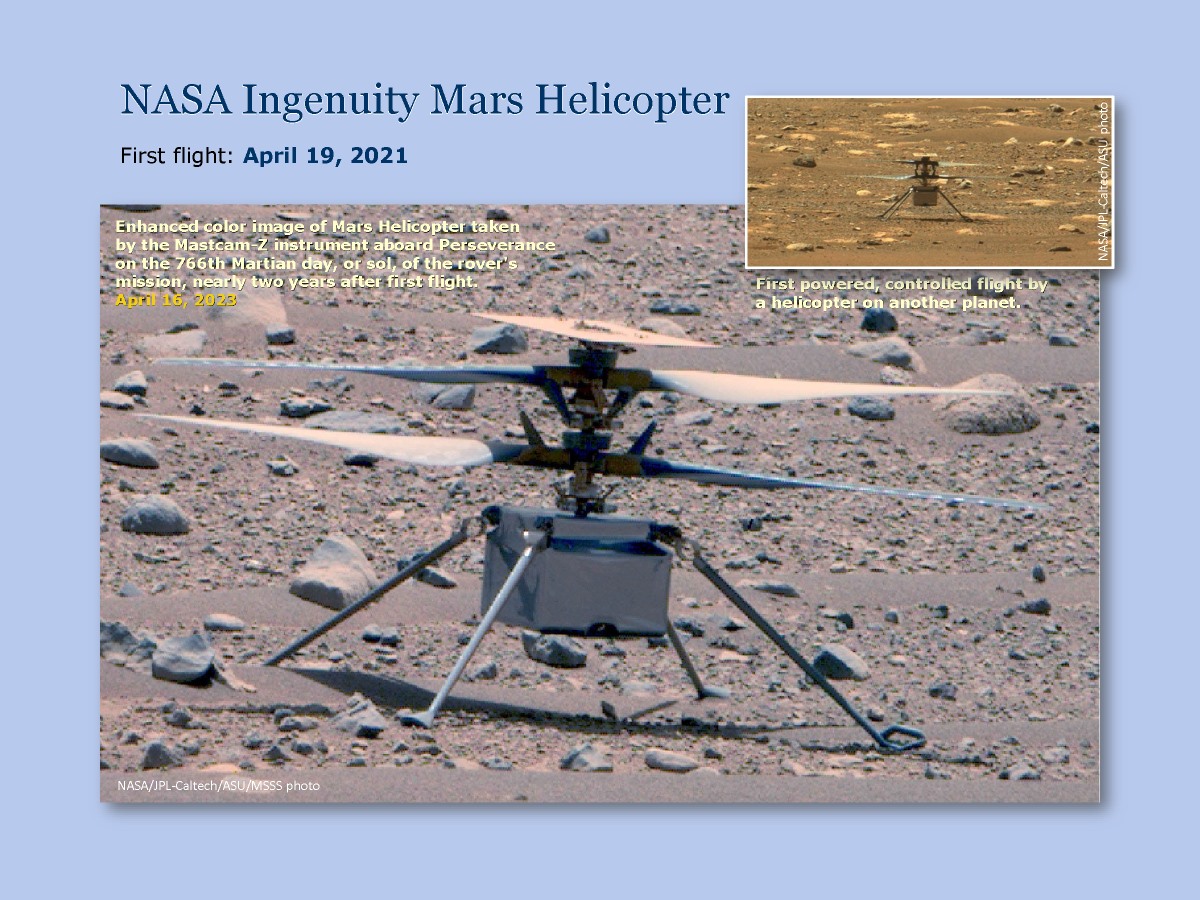
 NASA Ingenuity Mars Helicopter
First flight: April 19, 2021
The Ingenuity helicopter was the first rotary-wing aircraft to fly outside the earth’s atmosphere. Launched with the Perseverance Mars Rover on July 30, 2020, the duo landed on the Red Planet Feb. 18, 2021. Designed to prove that a vertical takeoff and landing aircraft could fly in the thin Martian atmosphere, it was hoped that Ingenuity could survive five missions. As of the end of 2023, Ingenuity had completed 70 flights, totaling more than two hours of flight time and covering more than 10 miles (16.7 km).
Beyond just proving that a helicopter could hover and fly laterally, Ingenuity soon became an invaluable partner to Perseverance, scouting ahead of the rover and providing additional insights for route planning, as well as providing a three-dimensional view of the Martian terrain.
Developed by NASA’s Joint Propulsion Laboratory in Pasadena, California, the prime contractor was AeroVironment, with major suppliers Qualcomm, SolAero and Lockheed Martin Space, and technical assistance from NASA’s Ames and Langley Research Centers and the University of Maryland. VFS awarded the Ingenuity team the Society’s 2022 Howard Hughes Award.
With cyclic and collective pitch control of its coaxial contra-rotating two-bladed rotor, Ingenuity is a true helicopter. The Mars Sample Return Helicopters, based on Ingenuity’s design but wheeled and with a robotic arm, are now being studied by JPL and AeroVironment to collect and cache rock samples on Mars, with launches planned for 2027 and 2028; the samples are expected to arrive back on earth in 2033.
NASA announced its plans to launch the Mars helicopter on May 11, 2018, and described the project: “Started in August 2013 as a technology development project at NASA’s Jet Propulsion Laboratory (JPL), the Mars Helicopter had to prove that big things could come in small packages. The result of the team’s four years of design, testing and redesign weighs in at little under four pounds (1.8 kilograms). Its fuselage is about the size of a softball, and its twin, counter-rotating blades will bite into the thin Martian atmosphere at almost 3,000 rpm — about 10 times the rate of a helicopter on Earth.”
The idea for a Mars rotorcraft is not new, with the first paper published in 1993. Interest at NASA Ames picked up in the late 1990s, and the agency suggested the 1999-2000 AHS Student Design Competition topic, “Development of Rotary-Wing Technologies for Use in Mars Exploration.” The first-place winning design by the University of Maryland was very similar in appearance to Ingenuity. Learn more at www.vtol.org/ingenuity.
Photos by NASA JPL-Caltech/ASU
Description by Mike Hirschberg
Resources:
- NASA Ingenuity Mars Helicopter, Vertical Flight Society website
- Mars Helicopter, NASA website
Go back to the previous photo or view the photo for next month
2024 History Calendar Index