Unable to log in or get member pricing? Having trouble changing your password?

Please review our Frequently Asked Questions for complete information on these and other common situations.
 

Vertical Flight Library & Store

Long-Range Mars Rotorcraft Design Optimization using Machine Learning

Jason Cornelius, Nicholas Peters, Jeremy Aires, NASA Ames Research Center Tove Ågren, Analytical Mechanics Associates Darrell Nieves Lugo, Anthony Comer, Zachary Miles, Science and Technology Corp.

https://doi.org/10.4050/F-0081-2025-0364

Abstract:
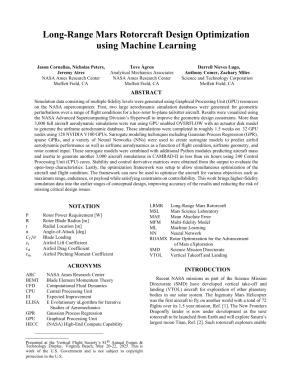
Simulation data consisting of multiple fidelity levels were generated using Graphical Processing Unit (GPU) resources on the NASA supercomputers. First, two large aerodynamic simulation databases were generated for geometric perturbations over a range of flight conditions for a hex-rotor bi-plane tailsitter aircraft. Results were visualized using the NASA Advanced Supercomputing Division's Hyperwall to improve the geometric design constraints. More than 3,000 full aircraft aerodynamic simulations were run using GPU enabled OVERFLOW with an actuator disk model to generate the airframe aerodynamic database. These simulations were completed in roughly 1.5 weeks on 32 GPU nodes using 128 NVIDIA V100 GPUs. Surrogate modeling techniques including Gaussian Process Regression (GPR), sparse GPRs, and a variety of Neural Networks (NNs) were used to create surrogate models to predict airfoil aerodynamic performance as well as airframe aerodynamics as a function of flight condition, airframe geometry, and rotor control input. These surrogate models were combined with additional Python modules predicting aircraft mass and inertia to generate another 3,000 aircraft simulations in CAMRAD-II in less than six hours using 240 Central Processing Unit (CPU) cores. Stability and control derivative matrices were obtained from the output to evaluate the open-loop characteristics. Lastly, the optimization framework was setup to allow simultaneous optimization of the aircraft and flight condition. The framework can now be used to optimize the aircraft for various objectives such as maximum range, endurance, or payload while satisfying constraints on controllability. This work brings higher-fidelity simulation data into the earlier stages of conceptual design, improving accuracy of the results and reducing the risk of missing critical design issues.


Long-Range Mars Rotorcraft Design Optimization using Machine Learning

  • Presented at Forum 81
  • 16 pages
  • SKU # : F-0081-2025-0364
  • Aircraft Design

  • Your Price : $30.00
  • Join or log in to receive the member price of $15.00!


VFS member?
Don't add this to your cart just yet!
Be sure to log in first to receive the member price of $15.00!

 
Add To Cart

Reward Value:
(60) Member Points

Long-Range Mars Rotorcraft Design Optimization using Machine Learning

Authors / Details: Jason Cornelius, Nicholas Peters, Jeremy Aires, NASA Ames Research Center Tove Ågren, Analytical Mechanics Associates Darrell Nieves Lugo, Anthony Comer, Zachary Miles, Science and Technology Corp.