Unable to log in or get member pricing? Having trouble changing your password?

Please review our Frequently Asked Questions for complete information on these and other common situations.
 

Vertical Flight Library & Store

Methods for Laboratory Replication of Rotary-wing Air Ambulance Vibration Conditions for Neonatal Patient Transport Applications

Keely Gibb, Adrian D. C. Chan, James R. Green, Robert G. Langlois, Carleton University Navin Francis, Andrew Law, Eric Chen, National Research Council Canada Eleanor Gerson, Kim Greenwood, Andrew A. M. Ibey, Jean Ngoie, Stephanie Redpath, Children's Hospital of Eastern Ontario

https://doi.org/10.4050/F-0081-2025-0071

Abstract:
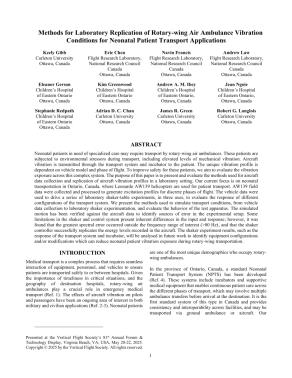
Neonatal patients in need of specialized care may require transport by rotary-wing air ambulances. These patients are subjected to environmental stressors during transport, including elevated levels of mechanical vibration. Aircraft vibration is transmitted through the transport system and incubator to the patient. The unique vibration profile is dependent on vehicle model and phase of flight. To improve safety for these patients, we aim to evaluate the vibration exposure across this complex system. The purpose of this paper is to present and evaluate the methods used for aircraft data collection and replication of aircraft vibration profiles in a laboratory setting. Our current focus is on neonatal transportation in Ontario, Canada, where Leonardo AW139 helicopters are used for patient transport. AW139 field data were collected and processed to generate excitation profiles for discrete phases of flight. The vehicle data were used to drive a series of laboratory shaker-table experiments, in three axes, to evaluate the response of different configurations of the transport system. We present the methods used to simulate transport conditions, from vehicle data collection to laboratory shaker experimentation, and evaluate the behavior of the test apparatus. The simulated motion has been verified against the aircraft data to identify sources of error in the experimental setup. Some limitations in the shaker and control system present inherent differences in the input and response; however, it was found that the greatest spectral error occurred outside the frequency range of interest (>80 Hz), and that the shaker controller successfully replicates the energy levels recorded in the aircraft. The shaker experiment results, such as the response of the transport system and incubator, will be analysed in future work to identify equipment configurations and/or modifications which can reduce neonatal patient vibration exposure during rotary-wing transportation.


Methods for Laboratory Replication of Rotary-wing Air Ambulance Vibration Conditions for Neonatal Patient Transport Applications

  • Presented at Forum 81
  • 13 pages
  • SKU # : F-0081-2025-0071
  • Test and Evaluation

  • Your Price : $30.00
  • Join or log in to receive the member price of $15.00!


VFS member?
Don't add this to your cart just yet!
Be sure to log in first to receive the member price of $15.00!

 
Add To Cart

Reward Value:
(60) Member Points

Methods for Laboratory Replication of Rotary-wing Air Ambulance Vibration Conditions for Neonatal Patient Transport Applications

Authors / Details: Keely Gibb, Adrian D. C. Chan, James R. Green, Robert G. Langlois, Carleton University Navin Francis, Andrew Law, Eric Chen, National Research Council Canada Eleanor Gerson, Kim Greenwood, Andrew A. M. Ibey, Jean Ngoie, Stephanie Redpath, Children's Hospital of Eastern Ontario