Unable to log in or get member pricing? Having trouble changing your password?

Please review our Frequently Asked Questions for complete information on these and other common situations.
 

Vertical Flight Library & Store

Lichten Award Paper: Variational Tolerance Analysis (VTA) - Design and Manufacturing Optimization Using Statistical Simulation

Andrew Lavoie, Sikorsky a Lockheed Martin Co.

May 10, 2021

https://doi.org/10.4050/F-0077-2021-16817

Abstract:
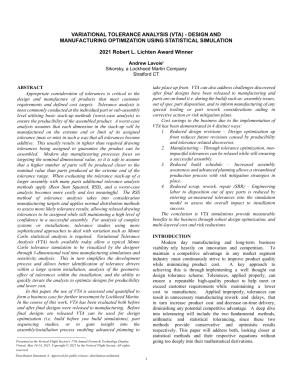
Appropriate consideration of tolerances is critical to the design and manufacture of products that meet customer requirements and defined cost targets. Tolerance analysis is most commonly conducted at the individual part or sub-assembly level utilizing basic stack-up methods (worst-case analysis) to ensure the producibility of the assembled product. A worst-case analysis assumes that each dimension in the stack-up will be manufactured on the extreme end or limit of its assigned tolerance (max or min) in such a way that all tolerances become additive. This usually results in tighter than required drawing tolerances being assigned to guarantee the product can be assembled. Modern day manufacturing processes focus on targeting the nominal dimensional value, so it is safe to assume that a higher number of parts will be produced closer to the nominal value than parts produced at the extreme end of the tolerance range. When evaluating the tolerance stack-up of a larger assembly with many parts additional tolerance analysis methods apply (Root Sum Squared, RSS), and a worst-case analysis becomes more costly and less meaningful. The RSS method of tolerance analysis takes into consideration manufacturing targets and applies normal distribution methods to assess more likely tolerance results, allowing relaxed drawing tolerances to be assigned while still maintaining a high level of confidence in a successful assembly. For analysis of complex systems or installations, tolerance studies using more sophisticated approaches to deal with variation such as Monte Carlo statistical analysis is required. Variational Tolerance Analysis (VTA) tools available today allow a typical Monte Carlo tolerance simulation to be visualized by the designer through 3-dimensional real time manufacturing simulations and sensitivity analysis. This in turn simplifies the development process and allows better identification of tolerance drivers within a large system installation; analysis of the geometric effect of tolerances within the installation; and the ability to quickly iterate the analysis to optimize designs for producibility and lower cost. In this paper, the use of VTA is assessed and quantified to form a business case for further investment by Lockheed Martin. In the course of this work, VTA has been evaluated both before and after final designs were released to manufacturing.


Lichten Award Paper: Variational Tolerance Analysis (VTA) - Design and Manufacturing Optimization Using Statistical Simulation

  • Presented at Forum 77 - Best Paper for this session
  • 11 pages
  • SKU # : F-0077-2021-16817
  • Manufacturing Technology and Processing

  • Your Price : $30.00
  • Join or log in to receive the member price of $15.00!


VFS member?
Don't add this to your cart just yet!
Be sure to log in first to receive the member price of $15.00!

 
Add To Cart

Reward Value:
(60) Member Points

Lichten Award Paper: Variational Tolerance Analysis (VTA) - Design and Manufacturing Optimization Using Statistical Simulation

Authors / Details:
Andrew Lavoie, Sikorsky a Lockheed Martin Co.